Researchers build transparent, super-stretchy skin-like sensor (w/ video)
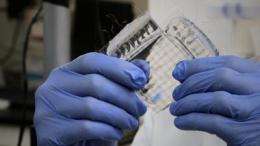
A close-up view of the super-stretchy, transparent, highly sensitive skin-like sensor that Zhenan Bao, associate professor of chemical engineering, and Darren Lipomi, postdoctoral researcher in chemical engineering, developed at Stanford University with their colleagues. Credit: Steve Fyffe, Stanford News Service
Imagine having skin so supple you could stretch it out to more than twice its normal length in any direction - repeatedly - yet it would always snap back completely wrinkle-free when you let go of it. You would certainly never need Botox.
That enviable elasticity is one of several new features built into a new transparent skin-like pressure sensor that is the latest sensor developed by Stanford's Zhenan Bao, associate professor of chemical engineering, in her quest to create an artificial "super skin." The sensor uses a transparent film of single-walled carbon nanotubes that act as tiny springs, enabling the sensor to accurately measure the force on it, whether it's being pulled like taffy or squeezed like a sponge.
"This sensor can register pressure ranging from a firm pinch between your thumb and forefinger to twice the pressure exerted by an elephant standing on one foot," said Darren Lipomi, a postdoctoral researcher in Bao's lab, who is part of the research team.
"None of it causes any permanent deformation," he said.
This video is not supported by your browser at this time.
Using carbon nanotubes bent to act as springs, Stanford researchers have developed a stretchable, transparent skin-like sensor. The sensor can be stretched to more than twice its original length and bounce back perfectly to its original shape. It can sense pressure from a firm pinch to thousands of pounds. The sensor could have applications in prosthetic limbs, robotics and touch-sensitive computer displays. Darren Lipomi, a postdoctoral researcher in Chemical Engineering and Zhenan Bao, associate professor in Chemical Engineering, explain their work. Credit: Steve Fyffe, Stanford News Service
Lipomi and Michael Vosgueritchian, graduate student in chemical engineering, and Benjamin Tee, graduate student in electrical engineering, are the lead authors of a paper describing the sensor published online Oct. 23 by Nature Nanotechnology. Bao is a coauthor of the paper.The sensors could be used in making touch-sensitive prosthetic limbs or robots, for various medical applications such as pressure-sensitive bandages or in touch screens on computers.
The key element of the new sensor is the transparent film of carbon "nano-springs," which is created by spraying nanotubes in a liquid suspension onto a thin layer of silicone, which is then stretched.
When the nanotubes are airbrushed onto the silicone, they tend to land in randomly oriented little clumps. When the silicone is stretched, some of the "nano-bundles" get pulled into alignment in the direction of the stretching.
When the silicone is released, it rebounds back to its original dimensions, but the nanotubes buckle and form little nanostructures that look like springs.
"After we have done this kind of pre-stretching to the nanotubes, they behave like springs and can be stretched again and again, without any permanent change in shape," Bao said.
Stretching the nanotube-coated silicone a second time, in the direction perpendicular to the first direction, causes some of the other nanotube bundles to align in the second direction. That makes the sensor completely stretchable in all directions, with total rebounding afterward.
Additionally, after the initial stretching to produce the "nano-springs," repeated stretching below the length of the initial stretch does not change the electrical conductivity significantly, Bao said. Maintaining the same conductivity in both the stretched and unstretched forms is important because the sensors detect and measure the force being applied to them through these spring-like nanostructures, which serve as electrodes.
The sensors consist of two layers of the nanotube-coated silicone, oriented so that the coatings are face-to-face, with a layer of a more easily deformed type of silicone between them.
The middle layer of silicone stores electrical charge, much like a battery. When pressure is exerted on the sensor, the middle layer of silicone compresses, which alters the amount of electrical charge it can store. That change is detected by the two films of carbon nanotubes, which act like the positive and negative terminals on a typical automobile or flashlight battery.
The change sensed by the nanotube films is what enables the sensor to transmit what it is "feeling."
Whether the sensor is being compressed or extended, the two nanofilms are brought closer together, which seems like it might make it difficult to detect which type of deformation is happening. But Lipomi said it should be possible to detect the difference by the pattern of pressure.
With compression, you would expect to see sort of a bull's-eye pattern, with the greatest deformation at the center and decreasing deformation as you go farther from the center.
"If the device was gripped by two opposing pincers and stretched, the greatest deformation would be along the straight line between the two pincers," Lipomi said. Deformation would decrease as you moved farther away from the line.
Bao's research group previously created a sensor so sensitive to pressure that it could detect pressures "well below the pressure exerted by a 20 milligram bluebottle fly carcass" that the researchers tested it with. This latest sensor is not quite that sensitive, she said, but that is because the researchers were focused on making it stretchable and transparent.
"We did not spend very much time trying to optimize the sensitivity aspect on this sensor," Bao said.
"But the previous concept can be applied here. We just need to make some modifications to the surface of the electrode so that we can have that same sensitivity."
Provided by
Stanford University
-
From lemons to lemonade: Reaction uses carbon dioxide to make carbon-based semiconductor,
32 comments
-
Thioridazine kills cancer stem cells in human while avoiding toxic side-effects of conventional cancer treatments,
3 comments
-
SpaceX private rocket blasts off for space station (Update),
42 comments
-
Climate scientists say they have solved riddle of rising sea,
31 comments
-
SpaceX capsule has 'new car' smell, astronauts say (Update),
3 comments
-
Water flow question
4 hours ago
-
[Drift velocity] Factors affecting velocity
6 hours ago
-
does cold gasoline have less energy
7 hours ago
-
distribution of molecules throughout the atmosphere
9 hours ago
-
The Global Positioning System !
10 hours ago
-
A Question relating Power
11 hours ago
- More from Physics Forums - General Physics
More news stories
'Unzipped' carbon nanotubes could help energize fuel cells, batteries
Multi-walled carbon nanotubes riddled with defects and impurities on the outside could replace some of the expensive platinum catalysts used in fuel cells and metal-air batteries, according to scientists at ...
Nanotechnology / Nanomaterials
1 hour ago |
not rated yet |
0
|
In nanorod crystal growth, nanoparticles seen as artificial atoms
In the growth of crystals, do nanoparticles act as "artificial atoms" forming molecular-type building blocks that can assemble into complex structures? This is the contention of a major but controversial theory ...
May 24, 2012 |
4.8 / 5 (6) |
0
|
Dopant gives graphene solar cells highest efficiency yet
(Phys.org) -- By taking advantage of graphenes favorable electrical and optical properties, and then adding an organic dopant, researchers have achieved the highest power conversion efficiency yet for ...
First direct observation of oriented attachment in nanocrystal growth
Berkeley Lab researchers have reported the first direct observation of nanoparticles undergoing oriented attachment, the critical step in biomineralization and the growth of nanocrystals. A better understanding ...
May 24, 2012 |
4.7 / 5 (3) |
0
|
Synthetic nano-waste does not disappear
(Phys.org) -- Tiny particles of cerium oxide do not burn or change in the heat of a waste incineration plant. They remain intact on combustion residues or in the incineration system, as a new study by Swiss ...
Nanotechnology / Bio & Medicine
May 25, 2012 |
5 / 5 (2) |
1
|
Land and sea species differ in climate change response: study
(Phys.org) -- Marine and terrestrial species will likely differ in their responses to climate warming, new research by Simon Fraser University and Australia’s University of Tasmania has found.
Almost half of new vets seek disability
(AP) -- America's newest veterans are filing for disability benefits at a historic rate, claiming to be the most medically and mentally troubled generation of former troops the nation has ever seen.
T cells 'hunt' parasites like animal predators seek prey, study shows
By pairing an intimate knowledge of immune-system function with a deep understanding of statistical physics, a cross-disciplinary team at the University of Pennsylvania has arrived at a surprising finding: T cells use a movement ...
Computer model used to pinpoint prime materials for efficient carbon capture
When power plants begin capturing their carbon emissions to reduce greenhouse gases and to most in the electric power industry, it's a question of when, not if it will be an expensive undertaking.
Change in developmental timing was crucial in the evolutionary shift from dinosaurs to birds: study
At first glance, it's hard to see how a common house sparrow and a Tyrannosaurus Rex might have anything in common. After all, one is a bird that weighs less than an ounce, and the other is a dinosaur that ...
Yale study concludes public apathy over climate change unrelated to science literacy
Are members of the public divided about climate change because they don't understand the science behind it? If Americans knew more basic science and were more proficient in technical reasoning, would public consensus match ...
Oct 24, 2011
Rank: 3 / 5 (4)
Oct 24, 2011
Rank: 5 / 5 (2)
Oct 24, 2011
Rank: not rated yet
Oct 24, 2011
Rank: not rated yet
Oct 24, 2011
Rank: 5 / 5 (2)
It will enable limbs to rely less of geometric accuracy of placement and rely more on near-enough bump/feel into place type of handling (like humans). Not to mention knowing how much force to apply.