A tool to touch the sun
October 25, 2011 By Alvin Powell
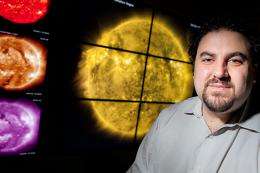
“Within 100 kilometers of the visible surface of the sun, temperatures jump by an order of magnitude. When you get up into the solar corona, temperatures are 1 million to 10 million degrees,” said Justin Kasper, a solar scientist at the CfA and a lecturer on astronomy, who is heading a team designing two instruments that will fly aboard NASA’s Solar Probe Plus as part of a project to investigate the nature of the sun’s atmosphere, or corona. Credit:Justin Ide/Harvard Staff Photographer
A scientist at the Harvard-Smithsonian Center for Astrophysics (CfA) is leading an effort to design an instrument that would be the first to come directly into contact with the suns fiery atmosphere after the device is launched on a NASA probe in 2018.
Justin Kasper, a solar scientist at the CfA and a lecturer on astronomy, heads a team designing two instruments that will fly aboard NASA's Solar Probe Plus as part of a project to investigate the nature of the sun's atmosphere, or corona. The car-sized spacecraft will carry instruments for four projects three times closer to the sun than any previous spacecraft.
After launch, Solar Probe Plus will use a series of close encounters with Venus to put on the brakes and slow before it passes into the sun's atmosphere. The craft will pass within 4 million miles of the suns surface to an area of the corona thought to have temperatures of up to several million degrees Celsius. At that distance, the sun will be 520 times brighter than on Earth, and 20 times larger in the sky.
Because of such high temperatures, the craft will be heavily shielded from heat, using a high-tech, carbon-composite heat shield. The front of the shield will bear the brunt of the sun's heat, rising to 2,000 degrees Celsius but leaving the shadows behind the shield significantly cooler, Kasper said.
The project, Solar Wind Electrons Alphas and Protons (SWEAP), is backed by a consortium of institutions, including the CfA, NASA, the University of California, Berkeley, Massachusetts Institute of Technology, the University of Alabama Huntsville, and Los Alamos National Laboratory. Though SWEAP has been selected for the mission, several rounds of planning, approvals and refinement remain before construction can begin in earnest, Kasper said. In addition to NASA approvals, the organizers will have to coordinate with the team from Johns Hopkins Universitys Applied Physics Laboratory that is in charge of the overall craft to make sure everything fits properly.
Kasper, who was recently named to Popular Science magazines Brilliant 10 list and in September received a Presidential Early Career Award for Scientists and Engineers, said he also works with French researchers who have a solar furnace that focuses the suns rays to very high temperatures and that can be used to heat-test instrument components.
Flying a mission to the sun has long been considered, Kasper said, but it has only been recently that technology has advanced enough for it to be possible. Kaspers first thought when he heard of the mission was that if it was going that close, despite the intense heat, it ought to get some direct measurements of the solar atmosphere.
I just cant see us going into the atmosphere of a star for the first time and not have an instrument seeing the [solar] wind directly, Kasper said. I said, Why dont we go with an instrument that can look right at the sun?
The result is the solar probe cup, a rugged instrument crisscrossed with metallic grids that can measure charged particles. Made of heat-resistant tungsten, the device is an often-used design called a Faraday cup, which has flown on many missions to measure charged particles in space, Kasper said. The second instrument is made up of twin solar probe analyzers, which will look ahead and behind the spacecraft, recording particles that strike it.
Together, the instruments aim to measure the properties of particles in the solar wind and the suns atmosphere, hopefully answering the question of why the suns atmosphere unlike the Earths, which cools the further you get from the planet is hundreds of times hotter than the suns surface. The solar wind is the stream of charged particles that flow from the sun out into the solar system.
Within 100 kilometers of the visible surface of the sun, temperatures jump by an order of magnitude. When you get up into the solar corona, temperatures are 1 million to 10 million degrees, Kasper said.
Existing theories focus on the suns enormous magnetic field, Kasper said. Some scientists think that the magnetic field lines, which loop from the sun into space and back again, are shaken by the extreme turbulence of the suns surface and that this shaking generates enormous amounts of energy that heats the atmosphere. Others think the loops actually detach explosively and send streams of energy into space, while still others focus on what happens when those loops reconnect with the suns surface.
Were pretty confident that the magnetic field plays a strong role, Kasper said.
The craft will take a roundabout, six-year route to get to the sun, looping past Venus seven times to slow down and dip ever deeper into the suns atmosphere with each pass. Throughout these encounters, the instruments will measure particles, recording their type, their temperature, their direction, and their speed.
Kasper said scientists are expecting the unusual, primed by years of studying the solar wind. For example, scientists have detected that helium in the solar wind is eight times hotter than hydrogen, though they dont know why.
We know from the solar wind itself that very unusual things happen, Kasper said.
This story is published courtesy of the Harvard Gazette, Harvard Universitys official newspaper. For additional university news, visit Harvard.edu.
Provided by
Harvard University
-
From lemons to lemonade: Reaction uses carbon dioxide to make carbon-based semiconductor,
32 comments
-
Thioridazine kills cancer stem cells in human while avoiding toxic side-effects of conventional cancer treatments,
3 comments
-
SpaceX private rocket blasts off for space station (Update),
42 comments
-
Climate scientists say they have solved riddle of rising sea,
31 comments
-
SpaceX capsule has 'new car' smell, astronauts say (Update),
3 comments
-
Distance of planets from stars and revolution
1 hour ago
-
revamping general concept and cosmological principle
May 25, 2012
-
Transiting Exoplanet Light Curve
May 25, 2012
-
Math behind Theoretical Physics
May 24, 2012
-
Do we know whats at the center of galaxies yet?
May 23, 2012
-
Structure of the Milky Way?
May 20, 2012
- More from Physics Forums - General Astronomy
More news stories
Yale study concludes public apathy over climate change unrelated to science literacy
Are members of the public divided about climate change because they don't understand the science behind it? If Americans knew more basic science and were more proficient in technical reasoning, would public consensus match ...
1 hour ago |
not rated yet |
8
|
10 million years needed to recover from mass extinction
It took some 10 million years for Earth to recover from the greatest mass extinction of all time, latest research has revealed.
Space & Earth / Earth Sciences
1 hour ago |
not rated yet |
1
|
Sophisticated simulations predict future warming
The chances of our planet being hit by a global warming of 3 degrees Celsius by 2050 is as likely as it being hit by an increase of 1.4 degrees, new research shows. Presented in the journal Nature Geoscience, the British study ...
Space & Earth / Earth Sciences
May 22, 2012 |
4.4 / 5 (9) |
51
Aliens don't want to eat us, says former SETI director
Alien life probably isnt interested in having us for dinner, enslaving us or laying eggs in our bellies, according to a recent statement by former SETI director Jill Tarter.
Space & Earth / Space Exploration
May 25, 2012 |
4.4 / 5 (14) |
39
Kyoto Protocol architect 'frustrated' by climate dialogue
UN climate talks are going nowhere, as politicians dither or bicker while the pace of warming dangerously speeds up, one of the architects of the Kyoto Protocol told AFP.
May 23, 2012 |
3.7 / 5 (7) |
39
'Unzipped' carbon nanotubes could help energize fuel cells, batteries
Multi-walled carbon nanotubes riddled with defects and impurities on the outside could replace some of the expensive platinum catalysts used in fuel cells and metal-air batteries, according to scientists at ...
T cells 'hunt' parasites like animal predators seek prey, study shows
By pairing an intimate knowledge of immune-system function with a deep understanding of statistical physics, a cross-disciplinary team at the University of Pennsylvania has arrived at a surprising finding: T cells use a movement ...
Computer model used to pinpoint prime materials for efficient carbon capture
When power plants begin capturing their carbon emissions to reduce greenhouse gases and to most in the electric power industry, it's a question of when, not if it will be an expensive undertaking.
Change in developmental timing was crucial in the evolutionary shift from dinosaurs to birds: study
At first glance, it's hard to see how a common house sparrow and a Tyrannosaurus Rex might have anything in common. After all, one is a bird that weighs less than an ounce, and the other is a dinosaur that ...
Same gene that stunts infants' growth also makes them grow too big: research
UCLA geneticists have identified the mutation responsible for IMAGe* syndrome, a rare disorder that stunts infants' growth. The twist? The mutation occurs on the same gene that causes Beckwith-Wiedemann syndrome, which makes ...
Scientists develop ultra-sensitive test that detects diseases in their earliest stages
Scientists have developed an ultra-sensitive test that should enable them to detect signs of a disease in its earliest stages, in research published today in the journal Nature Materials.
Oct 25, 2011
Rank: 1.8 / 5 (8)
this project is like trying to get a closeup glimpse of god. the light will blind you and kil you so why not weight until a few hundred years until we might have the right tech. if you want to study a hot surface i think venus is still a worthy and still formideable challenge.
Oct 25, 2011
Rank: 4.9 / 5 (7)
because data on the sun's corona will probably notch us up invaluable knowledge of how an average star works, and its effects on the local planetary environment, including interactions with the earth's magnetic field.
i think there's stacks of good reasons to have a first go at the sun :D
Oct 26, 2011
Rank: 1 / 5 (4)
Thanks, Justin! Data and observations will counter Big Brother's BS:
The "Great Reality" that surrounds and sustains us (Cosmos, Universe, God, What Is, etc) definitely has a sense of humor!
1. Flipped off the solar switch for Al Gore's big AGW campaign;
2. Arranged snow on Denver for the latest Global Climate Conference;
http://conference...dex.html
3. Allowed us to finish a research project started in 1960 to conclude the universe and life itself are sustained by dynamic competition between
a.) Attractive forces of gravity, and
b.) Repulsive forces between neutrons:
http://journalofc...102.html
Big Brother is no match for the Great Reality!
www.tparents.org/...0-06.htm
With kind regards,
Oliver K. Manuel
Oct 26, 2011
Rank: 3 / 5 (2)
Oct 26, 2011
Rank: 1 / 5 (3)
www.princeton.edu...featured
Including some features shared with the pulsar core of the Crab nebula!
Sadly UC-Berkeley may now be stuck - like the Norwegian Nobel Prize Committee, the US National Academy of Sciences and the UKs Royal Society - to the "tar baby": The UN 's IPCC and the obsolete model of Earth's heat source as a homogeneous ball of hydrogen steadily generating heat by H-fusion in equilibrium:
http://judithcurr...t-127960
With kind regards,
Oliver K. Manuel
Oct 27, 2011
Rank: 1 / 5 (2)
http://mominer.ms...hildren/
http://www.homefa...uel.html