Titanic Jigsaw Challenge: Piecing together a global colour map of Saturn’s largest moon
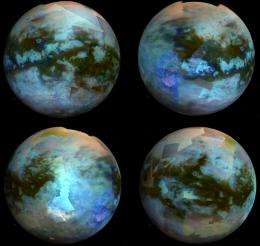
Global mosaic of VIMS infrared images acquired during the nominal and equinox Cassini mission. Differences in composition translate into subtle differences of colours in this mosaic, revealing the diversity of terrains on Titan, such as the brownish equatorial dune fields or the bright elevated terrains. (Colour coding : Red=5 μm, Green=2.0 μm, Blue=1.27 μm). Credits JPL/NASA/Univ. of Arizona/CNRS/LPGNantes
An international team led by the University of Nantes has pieced together images gathered over six years by the Cassini mission to create a global mosaic of the surface of Titan. The global maps and animations of Saturns largest moon are being presented by Stéphane Le Mouélic at the EPSC-DPS Joint Meeting 2011 in Nantes, France on Tuesday 4th October.
The team has compiled all the infrared images acquired by the Visual and Infrared Mapping Spectrometer (VIMS) during Cassinis first seventy flybys of Titan. Fitting the pieces of the puzzle together is a painstaking task. The images must be corrected for differences in the illuminating conditions and each image is filtered on a pixel-by-pixel basis to screen out atmospheric distortions. Titan is veiled by a thick, opaque atmosphere composed mainly of nitrogen. It has clouds of methane and ethane and there is increasing evidence for methane rain. Only a few specific infrared wavelengths can penetrate the cloud and haze to provide a window down to Titans surface. An exotic frozen world with many Earth-like geological features has progressively emerged from darkness.
This video is not supported by your browser at this time.
An animation of the mosaic
Stéphane Le Mouélic explains: As Cassini is orbiting Saturn and not Titan, we can observe Titan only once a month on average. The surface of Titan is therefore revealed year after year, as pieces of the puzzle are progressively put together. Deriving a final map with no seams is challenging due to the effects of the atmosphere clouds, mist etc. and due to the changing geometries of observation between each flyby.Cassini has made 78 flybys of Titan since it arrived in orbit around Saturn in July 2004. A further 48 flybys are planned up to 2017. On flybys to date, VIMS has only had a few opportunities to observe Titan with a high spatial resolution. This means that the global map currently shows some regions of Titan in more detail than others.
We have created the maps using low resolution images as a background with the high resolution data on top. In the few opportunities where we have VIMS imagery from the closest approach, we can show details as low as 500 metres per pixel. An example of this is from the 47th flyby, which allowed the observation of the site where the Huygens descent module landed. This observation is a key one as it might help us to bridge the gap between the ground truth provided by Huygens, and ongoing global mapping from orbit, which will continue up to 2017.
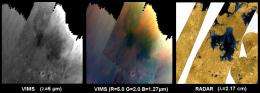
Observations of the northern seas of Titan by VIMS (left and center) and by Radar (right). Credits JPL/NASA/Univ. of Arizona/CNRS/LPGNantes
In addition to improving the spatial coverage, future mapping will allow the observation of seasonal changes in both the atmosphere and the surface. As spring comes to the northern hemispheres of Saturn and its moons, some areas are only now coming into view.Lakes in Titans northern hemisphere were first discovered by the RADAR instrument in 2006, appearing as completely smooth areas. However, we had to wait up to June 2010 to obtain the first infrared images of the northern lakes, emerging progressively from the northern winter darkness, says Le Mouélic. The infrared observations provide the additional opportunity to investigate the composition of the liquids within the lakes area. Liquid ethane has already been identified by this means.
Provided by Europlanet
-
From lemons to lemonade: Reaction uses carbon dioxide to make carbon-based semiconductor,
32 comments
-
Thioridazine kills cancer stem cells in human while avoiding toxic side-effects of conventional cancer treatments,
3 comments
-
SpaceX private rocket blasts off for space station (Update),
42 comments
-
Climate scientists say they have solved riddle of rising sea,
31 comments
-
SpaceX capsule has 'new car' smell, astronauts say (Update),
3 comments
-
Distance of planets from stars and revolution
1 hour ago
-
revamping general concept and cosmological principle
May 25, 2012
-
Transiting Exoplanet Light Curve
May 25, 2012
-
Math behind Theoretical Physics
May 24, 2012
-
Do we know whats at the center of galaxies yet?
May 23, 2012
-
Structure of the Milky Way?
May 20, 2012
- More from Physics Forums - General Astronomy
More news stories
Yale study concludes public apathy over climate change unrelated to science literacy
Are members of the public divided about climate change because they don't understand the science behind it? If Americans knew more basic science and were more proficient in technical reasoning, would public consensus match ...
1 hour ago |
not rated yet |
8
|
10 million years needed to recover from mass extinction
It took some 10 million years for Earth to recover from the greatest mass extinction of all time, latest research has revealed.
Space & Earth / Earth Sciences
1 hour ago |
not rated yet |
1
|
Sophisticated simulations predict future warming
The chances of our planet being hit by a global warming of 3 degrees Celsius by 2050 is as likely as it being hit by an increase of 1.4 degrees, new research shows. Presented in the journal Nature Geoscience, the British study ...
Space & Earth / Earth Sciences
May 22, 2012 |
4.4 / 5 (9) |
51
Aliens don't want to eat us, says former SETI director
Alien life probably isnt interested in having us for dinner, enslaving us or laying eggs in our bellies, according to a recent statement by former SETI director Jill Tarter.
Space & Earth / Space Exploration
May 25, 2012 |
4.4 / 5 (14) |
39
Kyoto Protocol architect 'frustrated' by climate dialogue
UN climate talks are going nowhere, as politicians dither or bicker while the pace of warming dangerously speeds up, one of the architects of the Kyoto Protocol told AFP.
May 23, 2012 |
3.7 / 5 (7) |
39
'Unzipped' carbon nanotubes could help energize fuel cells, batteries
Multi-walled carbon nanotubes riddled with defects and impurities on the outside could replace some of the expensive platinum catalysts used in fuel cells and metal-air batteries, according to scientists at ...
T cells 'hunt' parasites like animal predators seek prey, study shows
By pairing an intimate knowledge of immune-system function with a deep understanding of statistical physics, a cross-disciplinary team at the University of Pennsylvania has arrived at a surprising finding: T cells use a movement ...
Computer model used to pinpoint prime materials for efficient carbon capture
When power plants begin capturing their carbon emissions to reduce greenhouse gases and to most in the electric power industry, it's a question of when, not if it will be an expensive undertaking.
Change in developmental timing was crucial in the evolutionary shift from dinosaurs to birds: study
At first glance, it's hard to see how a common house sparrow and a Tyrannosaurus Rex might have anything in common. After all, one is a bird that weighs less than an ounce, and the other is a dinosaur that ...
Same gene that stunts infants' growth also makes them grow too big: research
UCLA geneticists have identified the mutation responsible for IMAGe* syndrome, a rare disorder that stunts infants' growth. The twist? The mutation occurs on the same gene that causes Beckwith-Wiedemann syndrome, which makes ...
Scientists develop ultra-sensitive test that detects diseases in their earliest stages
Scientists have developed an ultra-sensitive test that should enable them to detect signs of a disease in its earliest stages, in research published today in the journal Nature Materials.

Oct 04, 2011
Rank: 5 / 5 (1)