Planned Tanzanian soda ash plant threatens flamingoes
October 17, 2011 by Helen Vesperini

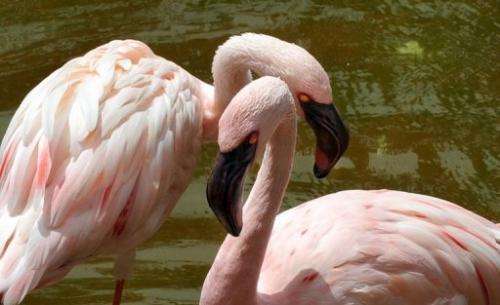
The lesser flamingo is the smallest and most numerous flamingo, with up to two million birds in Africa and southern Asia

Enlarge

Two lesser flamingos at a Hong Kong park in September 2011.

Salmon-coloured clouds of flamingoes sweeping overhead is a common sight at east Africa's Rift Valley lakes, but the mounds of mud where they lay their eggs are found only here.

The caustic waters of Lake Natron form the only for east Africa's endangered lesser flamingoes, but the Tanzanian government is determined to revive plans to build a soda ash plant at the lake.

The Royal Society for the Protection of Birds (RSPB) estimates that three quarters of the of lesser live and nest in east Africa.

"All depend on Tanzania's Lake Natron as a breeding site. Food is plentiful, nesting sites abound and above all, the lake is isolated and undisturbed," The RSPB says.

Lake Natron, whose maximum depth is 50 centimetres (20 inches) lies at the foot of Ol Doinyo Lengai, which means the Mountain of God in the local Maa language.

It is the lake's proximity to the volcano that accounts for the caustic nature of its water. Ol Doinyo Lengai is the world's only active volcano whose lava is a type of rock called natrocarbonatite.

That rock creates caustic water keeping predators at bay for the flamingoes, who typically lay one egg on a small volcano-shaped mound of mud on the salt pans in the lake.
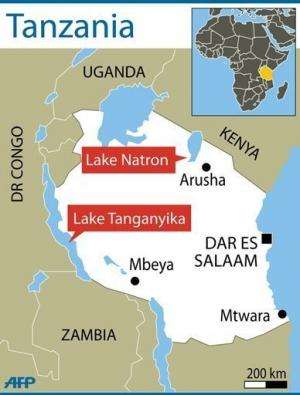
The RSPB estimates that three quarters of the world population of lesser flamingos live and nest in east Africa
Enlarge

The caustic waters of Lake Natron form the only breeding ground for east Africa's endangered lesser flamingoes, but the Tanzanian government is determined to revive plans to build a soda ash plant at the lake.

Tanzanian President Jakaya Kikwete in April spoke of the need to fast-track the soda ash plant plan, already shelved once over environmental concerns.

"There is no need for further delay of the project, which will give the country's economy a big boost," Kikwete told officials at the trade and industry ministry.

He said Lake Natron's reserves of soda ash deposits were big enough to make Tanzania the world's leading producer of the product.

Sodium carbonate is used in water softening agents for laundry and in the manufacture of certain types of glass.

Ibrahim Matovu, acting executive director for Longido District welcomed the planned soda ash plant with enthusiasm.
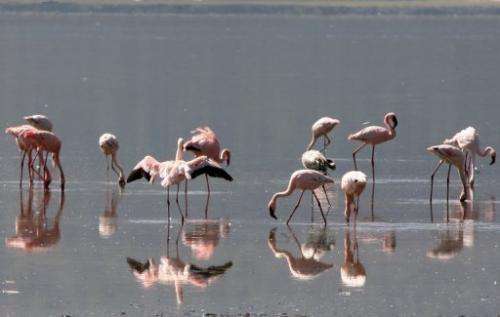
Lake Natron has a maximum depth of 50 centimetres (20 inches) and lies at the foot of a volcano
Enlarge

A flamboyance of lesser flamingos feed in the waters of east Africa's Rift Valley. Salmon-coloured clouds of flamingoes sweeping overhead is a common sight at east Africa's Rift Valley lakes, where the birds lay their eggs on the mounds of mud.

"We expect it'll raise the standard of living of the people here and create jobs and support social services -- education and health," he told AFP in Longido - a town desperately short of formal employment or visible prospects.

Under pressure from environmentalists the Tanzanian government mooted moving the actual plant several dozen kilometres (miles) away from the lakeshore.

However, the pipes that will pump the soda to the plant would still disturb flamingo breeding, environmentalists say.

There is the infrastructure and the workers required to build them and the fact the pipe will have to be moved in order to keep channelling soda from different parts of the lake.

"It takes very little disturbance to cause an entire breeding colony to abandon its nests," said the RSPB.

Breeding is further complicated by the fact flamingoes, who live to be as old as 40, only breed once every five or six years.
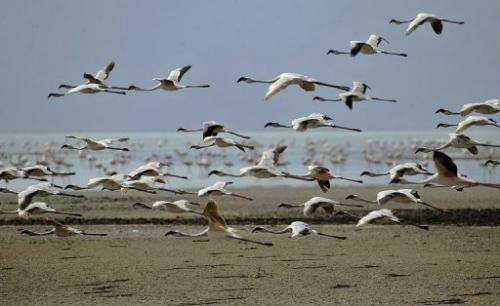
Lesser flamingoes fly over Tanzania's Lake Natron
Enlarge

Lesser flamingoes fly over Tanzania's Lake Natron. Salmon-coloured clouds of flamingoes sweeping overhead is a common sight at east Africa's Rift Valley lakes, where the birds lay their eggs on the mounds of mud.

Here at Lake Natron many residents say they do not want the plant to be built.

"For my part I don’t like the idea," said Lemra Kingi, who looks after the basic "tourist office" in Engaresero village.

"The birds will move from this area," he predicted, perched on a tree branch.

He wears traditional Maasai blankets in orange and purple, topped off with a necklace of shells and silver, with tennis socks and hiking boots as a concession to modernity.

But Lucas Lemole, 23, and secretary of the association of guides, said: "We don’t know how the industry will work but we want the jobs. We'll get jobs, development, a hospital, education."

Engaresero and the entire lakeside area have no mobile phone network. The main road along the western shore of the lake is a boulder-strewn track.

A host of small mammals -- mongooses, jumping hares and baboons come scampering across it.

Sarupe Koileken, a livestock officer turned local official told AFP he also feared that local traditions would be diluted if there was an influx of workers from elsewhere.

"The population here is 95 percent Maasai. Traditions will be affected because there will be a mix of cultures," he said.

Joseph Seuri, a community NGO coordinator whose home village Pinyinyi lies just 29 kilometres (18 miles) from Magadi, a soda lake on the Kenyan side of the border that has a functioning soda ash plant, warned his fellow villages to be wary of any promises made.

"At Magadi .. they told the people they'd get jobs. Then they chased the people away and stopped the cattle grazing near the factory," he said bitterly.

(c) 2011 AFP

Filter


Move the slider to adjust rank threshold, so that you can hide some of the comments.


Display comments: newest first

Jonseer
Oct 18, 2011

Rank: not rated yet
Lake Natron is huge.

Only the small-minded environmentalist can see this as an either or proposition.

Certainly Tanzania can utilize part of the lake and set a certain percentage off as a wildlife refuge - JUST like the Western nations do.

How galling it must be to be part of the leadership of a 3rd. world nation to have environmentalists suggest you forestall all development not because of certainty, but of simple concern.

If they are so concerned about wildlife why don't they head to Australia where there are numerous species on the edge of extinction thanks to stupid pie in the sky environmentalism there.
Rank not rated yet
Relevant PhysicsForums posts

More news stories

Yale study concludes public apathy over climate change unrelated to science literacy

Are members of the public divided about climate change because they don't understand the science behind it? If Americans knew more basic science and were more proficient in technical reasoning, would public consensus match ...

Space & Earth / Environment

created 1 hour ago | popularity not rated yet | comments 8 | with audio podcast

10 million years needed to recover from mass extinction

It took some 10 million years for Earth to recover from the greatest mass extinction of all time, latest research has revealed.

Space & Earth / Earth Sciences

created 1 hour ago | popularity not rated yet | comments 1 | with audio podcast

Sophisticated simulations predict future warming

The chances of our planet being hit by a global warming of 3 degrees Celsius by 2050 is as likely as it being hit by an increase of 1.4 degrees, new research shows. Presented in the journal Nature Geoscience, the British study ...

Space & Earth / Earth Sciences

created May 22, 2012 | popularity 4.4 / 5 (9) | comments 51

Aliens don't want to eat us, says former SETI director

Alien life probably isn’t interested in having us for dinner, enslaving us or laying eggs in our bellies, according to a recent statement by former SETI director Jill Tarter.

Space & Earth / Space Exploration

created May 25, 2012 | popularity 4.4 / 5 (14) | comments 39

Kyoto Protocol architect 'frustrated' by climate dialogue

UN climate talks are going nowhere, as politicians dither or bicker while the pace of warming dangerously speeds up, one of the architects of the Kyoto Protocol told AFP.

Space & Earth / Environment

created May 23, 2012 | popularity 3.7 / 5 (7) | comments 39


'Unzipped' carbon nanotubes could help energize fuel cells, batteries

Multi-walled carbon nanotubes riddled with defects and impurities on the outside could replace some of the expensive platinum catalysts used in fuel cells and metal-air batteries, according to scientists at ...

T cells 'hunt' parasites like animal predators seek prey, study shows

By pairing an intimate knowledge of immune-system function with a deep understanding of statistical physics, a cross-disciplinary team at the University of Pennsylvania has arrived at a surprising finding: T cells use a movement ...

Computer model used to pinpoint prime materials for efficient carbon capture

When power plants begin capturing their carbon emissions to reduce greenhouse gases – and to most in the electric power industry, it's a question of when, not if – it will be an expensive undertaking.

Change in developmental timing was crucial in the evolutionary shift from dinosaurs to birds: study

At first glance, it's hard to see how a common house sparrow and a Tyrannosaurus Rex might have anything in common. After all, one is a bird that weighs less than an ounce, and the other is a dinosaur that ...

Same gene that stunts infants' growth also makes them grow too big: research

UCLA geneticists have identified the mutation responsible for IMAGe* syndrome, a rare disorder that stunts infants' growth. The twist? The mutation occurs on the same gene that causes Beckwith-Wiedemann syndrome, which makes ...

Scientists develop ultra-sensitive test that detects diseases in their earliest stages

Scientists have developed an ultra-sensitive test that should enable them to detect signs of a disease in its earliest stages, in research published today in the journal Nature Materials.