Synthetic cells: Ion exchange leads to complex cell systems with inorganic membranes
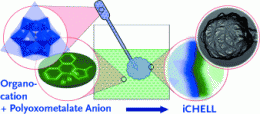
(PhysOrg.com) -- Our body consists of individual organs that are made of cells, which in turn contain a number of separate organelles. Biological function cannot be maintained if there are no separate compartments, and compartments are also of use in chemistry. In the journal Angewandte Chemie, a team led by Leroy Cronin at the University of Glasgow (UK) has now introduced a method for the easy production of inorganic chemical cells, known as iCHELLS. Their method even makes it possible to make cells embedded within cells.
Membranes for synthetic compartments are normally made from high-molecular-weight polymers by aggregation on a surface. In contrast, the iCHELL membranes are made from low-molecular-weight building blocks at the interface of two aqueous solutions. One aqueous solution is simply injected into a second. Solution 1 contains polyoxometallate clusters, tiny clumps made of several transition metal atoms, oxygen atoms, and sometimes others. For example, the researchers used a phosphotungstate, a negatively charged cluster in which a phosphorus atom is surrounded by twelve tungsten and 40 oxygen atoms. The counterions are small positively charged ions, such as protons or sodium ions.
Solution 2 contains a compound made of large positively charged organic ions, for example aromatic ring systems, and small negatively charged counterions. When the two solutions come into contact, the ion pairs immediately undergo an exchange of partners: While the two small partners stay in solution, the two large ions come together and aggregate to form a thin membrane because they become insoluble when paired. This forms a cell enclosed by a membrane.
Choosing different ions allows for the thickness and permeability of the membrane to be varied. The membrane can also be given functionality. For example, it is possible to select building blocks that catalyze chemical reactions or recognize specific target molecules. The use of microfluidic systems (chips with tiny fluid-filled channels) makes it possible to easily produce the cells in large numbers, which is a prerequisite for technical applications. Potential uses include encapsulated catalysts in which the membrane would selectively allow the substrate to enter the cell to react.
More complex cell systems can also be made: Simply injecting another solution containing a suitable ion into a cell produces a cell within a cell. Such systems could be used as vessels for multistep reactions. However, the biggest goal is the formation of synthetic chemical cells with properties that resemble those of living systems. The scientists hope to gain some indication of how life was able to develop in an inorganic world billions of years ago, and whether it is possible to use the iCHELLS as a platform to develop non-organic inorganic biology in the laboratory.
More information: Leroy Cronin, Modular Redox-Active Inorganic Chemical Cells: iCHELLs, Angewandte Chemie International Edition, http://dx.doi.org/ … ie.201105068
Provided by
Wiley
-
From lemons to lemonade: Reaction uses carbon dioxide to make carbon-based semiconductor,
32 comments
-
Thioridazine kills cancer stem cells in human while avoiding toxic side-effects of conventional cancer treatments,
3 comments
-
SpaceX private rocket blasts off for space station (Update),
42 comments
-
Climate scientists say they have solved riddle of rising sea,
31 comments
-
SpaceX capsule has 'new car' smell, astronauts say (Update),
3 comments
-
Gibbs Free Energy Change/Entropy
9 hours ago
-
What's the rule to covalent character
10 hours ago
-
Schwartz reagent-- NMR/MS/IR
May 26, 2012
-
High school chemistry EEI
May 25, 2012
-
oxidation of I- by KMnO4
May 25, 2012
-
Inversion temp
May 25, 2012
- More from Physics Forums - Chemistry
More news stories
Computer model used to pinpoint prime materials for efficient carbon capture
When power plants begin capturing their carbon emissions to reduce greenhouse gases and to most in the electric power industry, it's a question of when, not if it will be an expensive undertaking.
1 hour ago |
not rated yet |
0
|
Scientists develop ultra-sensitive test that detects diseases in their earliest stages
Scientists have developed an ultra-sensitive test that should enable them to detect signs of a disease in its earliest stages, in research published today in the journal Nature Materials.
Chemistry / Analytical Chemistry
1 hour ago |
not rated yet |
0
|
New CO2-removing catalyst can take the heat
(Phys.org) -- The current method of removing the greenhouse gas carbon dioxide (CO2) from the flues of coal-fired power plants uses so much energy that no one bothers to use it. So says Roger Aines, principal ...
May 24, 2012 |
5 / 5 (9) |
10
|
High-speed method to aid search for solar energy storage catalysts
Eons ago, nature solved the problem of converting solar energy to fuels by inventing the process of photosynthesis.
May 25, 2012 |
5 / 5 (3) |
4
|
Researchers demonstrate possible primitive mechanism of chemical info self-replication
(Phys.org) -- When scientists think about the replication of information in chemistry, they usually have in mind something akin to what happens in living organisms when DNA gets copied: a double-stranded molecule ...
May 25, 2012 |
5 / 5 (4) |
2
|
Land and sea species differ in climate change response: study
(Phys.org) -- Marine and terrestrial species will likely differ in their responses to climate warming, new research by Simon Fraser University and Australia’s University of Tasmania has found.
Almost half of new vets seek disability
(AP) -- America's newest veterans are filing for disability benefits at a historic rate, claiming to be the most medically and mentally troubled generation of former troops the nation has ever seen.
'Unzipped' carbon nanotubes could help energize fuel cells, batteries
Multi-walled carbon nanotubes riddled with defects and impurities on the outside could replace some of the expensive platinum catalysts used in fuel cells and metal-air batteries, according to scientists at ...
T cells 'hunt' parasites like animal predators seek prey, study shows
By pairing an intimate knowledge of immune-system function with a deep understanding of statistical physics, a cross-disciplinary team at the University of Pennsylvania has arrived at a surprising finding: T cells use a movement ...
Change in developmental timing was crucial in the evolutionary shift from dinosaurs to birds: study
At first glance, it's hard to see how a common house sparrow and a Tyrannosaurus Rex might have anything in common. After all, one is a bird that weighs less than an ounce, and the other is a dinosaur that ...
Yale study concludes public apathy over climate change unrelated to science literacy
Are members of the public divided about climate change because they don't understand the science behind it? If Americans knew more basic science and were more proficient in technical reasoning, would public consensus match ...
Oct 06, 2011
Rank: 5 / 5 (1)
I picture a factory of inorganic cells producing exactly what we program them to make; sort of gives me the shivers imagining it!
It's amazing how no matter what the size, galaxy clusters resembling neural connections, bacterial smears (under the microscope) looking like city movement of vehicles from high up or how a cell resembles a city right down to the waste treatment and transportation out of (and inside) the city, that everything is sort of fractal.
Imagination really is the key to a good understanding of reality. If I couldn't picture these molecular interations in my mind, I'd be lost!
Sort of went off an a tangent but the point remains, this is just awesome!
Oct 07, 2011
Rank: not rated yet
imagination is important, but analogies are only good if they serve some insight (e.g. the neural connections/galaxies analogy is a bad one because it does not deliver an insight and may even lead one off on a wrong track)
One should remember that with an anaogy you are not only trying to further understand what you ae looking. At the same time you are putting on blinders as to what the object you're looking at really is.
Just look at what the 'wave' analogy (or the photon 'particle') has done to the laymans' understanding of teh nature of light. It basically has led to everyone but physicists having a completely wrong picture of what light is in their heads.
Beware of analogies - unless you really know what you're talking about.