Students building satellite that's seen as future of space research
Using needle-thin solder, tweezers and a very steady hand, Anna Espinal peers through a microscope and attaches capacitors the size of large grains of sand to boards no bigger than a credit card.
Each board — she’s building eight — requires hundreds of capacitors, connected by circuits Espinal is laying down with more precision soldering.
The circuit boards, along with a processor, will function as the brain of a tiny satellite called a CubeSat that an international team of engineering students is constructing in Berkeley’s Space Sciences Lab.
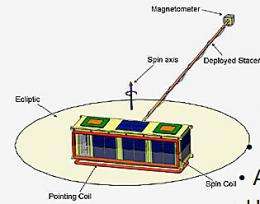
If all goes as planned, Berkeley’s CubeSat will ride up into space on an Atlas rocket fired from Vandenberg Air Force Base in Southern California next June. It is being designed to spend a year in orbit, using a new miniature instrument to measure ions, electrons and neutral particles, and a magnetometer to measure currents generated during electrical storms, and radio the information back to Earth.
Espinal arrived from Puerto Rico in July to work on the satellite. Just down the workbench from her, David Clarino, a recent Berkeley graduate in physics and electrical engineering, is figuring out the connections linking the processor, the boards and the satellite’s radio and scientific equipment.
Downstairs in another lab, Berkeley senior Stephanie Taylor sits at a computer working out the flight software. A student in computer science and electrical engineering, she spent the summer before her senior year working at NASA and joined the CubeSat team in February.
South Korean students working with her are helping Berkeley’s effort as well as learning what they need to know to build two just like it back home.
In the basement, a group of mechanical engineers from Berkeley and Korea works to fit the pieces together, an intricate 3-D puzzle. Every day they start over, learning from the previous day’s experience how to adjust the boards, wires and equipment — including an aerial boom that extends to three feet — into the shiny little chassis.
“This is probably the most complicated CubeSat anyone has ever fabricated,” says Thomas Immel, a research physicist at the lab and part of the faculty team supervising the project.
CubeSats are a big breakthrough in affordable space science. Miniaturization and standardization — CubeSats measure 10 by 10 by 10 centimeters and weigh just over one kilogram — have substantially reduced the cost of sending experiments to space. The cubes can be joined together — Berkeley’s will be a constellation of three, making for a satellite that looks like a long shoe box. And they can be loaded in large groups onto rockets. Their relatively low cost and open-source design ethic has allowed universities to seize on the CubeSat concept to teach students and to conduct research in space.
Berkeley’s CubeSat — officially called CINEMA, or CubeSat for Ions, Neutrals, Electrons, & MAgnetic fields — “will provide cutting-edge magnetospheric science and critical space-weather measurements,” according to a description provided by project leader Robert Lin, a professor of physics at Berkeley and former director of the Space Sciences Lab. The project has attracted $890,000 in funding from the National Science Foundation.
CINEMA is guided by Lin, with daily help from Immel, mechanical engineers David Auslander and David Glaser and systems engineer Jerry Kim. Both Kim and Glaser worked on the project as students and were hired on to see it through.
Having students to do much of the work has been key to keeping costs down. The three-year effort has involved dozens from Berkeley’s engineering and physics programs, plus dozens more from the Puerto Rico Space Consortium (Espinal is one) and South Korea’s Kyung Hee University. Imperial College London is building the magnetometer and will share the space weather data it captures.
Espinal is a good example of what the students contribute and what they receive.
“She’s the best student solderer I’ve ever seen,” says Immel. In addition to the circuit boards, Espinal is soldering 24 mini solar panels — 10 for Berkeley’s CubeSat, the rest for the Puerto Rican and Korean projects.
A recent graduate of InterAmerican University of Puerto Rico with hopes to be a researcher on similar projects, Espinal says her time at the Berkeley space lab has been “a pretty amazing experience, because in Puerto Rico we don’t have access to this kind of equipment.” It has also allowed her to learn from space-qualified technicians.
CINEMA will be one of eight CubeSats riding up on a National Reconnaissance Office rocket next June. Two others are also NSF projects.
According to a recent Scientific American article, at least two-dozen student CubeSat missions have been successfully completed and many more are in the works.
“At Berkeley, we see an exciting future for CubeSats,” says Lin “With the continued miniaturization of instruments, more cutting-edge science will become possible. In addition, CubeSats may provide a modest-cost approach to do science that requires constellations of spacecraft.”
Provided by University of California - Berkeley


