October 4, 2011 report
New startup believes it has a way to cheaply convert methane to ethylene
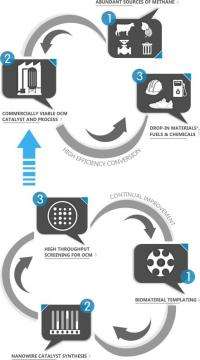
(PhysOrg.com) -- When people think of uses for petroleum, they generally think of oil and gasoline, but doing so means ignoring the production of ethylene, a compound used to make many of the products most people use every day, such as plastics. Unfortunately though, as the price of petroleum goes up, so too does the cost of producing ethylene and all the products that come from it. This is why chemical researchers have been searching for years for a way to produce ethylene via anther process. Now, startup company San Francisco based Siluria, believes it has found a pathway there using methane instead of petroleum, and has received some $20 million in investment capital from various groups that are confident that Siluria is on the right track.
Everyone knows that over the next few decades, petroleum prices are going to rise dramatically as reserves begin to dwindle. At the same time, new natural gas deposits seem to be popping up every day, so much so that its price continues to fall. What everyone may not know is that methane can be extracted from natural gas, and rather cheaply at that. This is why MIT professor Angela Belcher, a board member of Siluria, has been focusing her research on ways to use methane to make ethylene. She’s developed a virus-based template technology that can be used to guide growing nanowire catalysts comprised of inorganic crystals. Afterwards the template can be burned away, leaving just the inorganic surface. That, the folks at Siluria believe, will provide the perfect platform for discovering the perfect catalyst for replacing oil with methane when making ethylene.
Success for Siluria in this endeavor would mean success for everyone else as well, as it would mean lower prices for ethylene and the products that are made from it. It also appears that the new process would require less energy and water than current methods, meaning the resultant products would be greener.
One dark spot on the horizon however is the growing unease that has cropped up regarding some products made from ethylene, particularly those that wind up as polyvinyl chloride (PVC), a clear plastic used to make, among other things, baby bottles. Some research has suggested that becomes of its impact on hormones, it might be causing health problems for people, such as cancers of the endocrine or reproductive systems.
© 2011 PhysOrg.com


