A new species of fossil silky lacewing insects that lived more than 120 million years ago
Oct 05, 2011
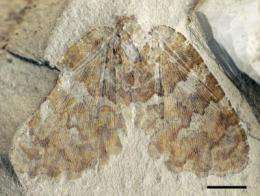
This is the new fossil species, Undulopsychopsis alexi. Credit: Prof. Dong Ren

A team of researchers from the Capital Normal University in Beijing (China) and the Institute of Biology and Soil Sciences in Vladivostok (Russia) has discovered a remarkable silky lacewing insect from the Mesozoic of China. The study has been published recently in the open access journal ZooKeys and is available for free download.

The extant silky lacewings (the family Psychopsidae) may be recognized by their broad wing shape, dense venation, spectacularly patterned and hairy wings. Today, this family is very small, restricted only to , southeastern Asia and Australia, but in the Mesozoic, it was much more widely distributed.

The new fossil silky lacewing - Undulopsychopsis alexi - was found from in the Yixian Formation of western Liaoning Province, one of the most productive Mesozoic fossil-bearing horizons in . The species is characterized by the undulate wing margin, a unique condition amongst known Psychopsidae, and a number of unusual characters of the wing venation.

"The most important trait of this fossil is that it shares the features of two different families of neuropteran , the extant Psychopsidae (known also from the Mesozoic) and the extinct Mesozoic Osmylopsychopidae", said the author Vladimir Makarkin.

This discovery is expected to shed light on the of lacewings related to the family Psychopsidae.

Explore further: Fossil brain teaser: New study reveals patterns of dinosaur brain development

More information: Peng Y, Makarkin V, Wang X, Ren D (2011) A new fossil silky lacewing genus (Neuroptera, Psychopsidae) from the Early Cretaceous Yixian Formation of China. ZooKeys 130: 217-228. doi: 10.3897/zookeys.130.1576

add to favorites email to friend print save as pdf

Related Stories

Paleontologists discover a new Mesozoic mammal

Oct 08, 2009

Pittsburgh, Pennsylvania, USA…An international team of paleontologists has discovered a new species of mammal that lived 123 million years ago in what is now the Liaoning Province in northeastern China. ...

Mysterious fossils provide new clues to insect evolution

Jul 19, 2011

German scientists at the Stuttgart Natural History Museum were leading in the discovery of a new insect order from the Lower Cretaceous of South America. The spectacular fossils were named Coxoplectoptera by the ...

Early cretaceous birds with crops found in China

Sep 06, 2011

The crop is characteristic of seed-eating birds today, yet little is known about its early history despite remarkable discoveries of many Mesozoic seed-eating birds in the past decade. Scientists from Institute ...

Recommended for you

Tiny ancient bandicoot shines light on future

21 hours ago

(Phys.org) —A 20 million-year-old fossil skull identified as a 'pocket-sized' ancestor of the bandicoot will give insights into the future of Australia's modern endangered animals.

The eloquence of the otoliths

May 16, 2013

Fish fossils that are about 23 million years old give unprecedented insight into the evolutionary history of the gobioid order, one of the most species-rich groups among the modern bony fishes.

Light cast on lifestyle and diet of first New Zealanders

May 16, 2013

(Phys.org) —A University of Otago-led multidisciplinary team of scientists have shed new light on the diet, lifestyles and movements of the first New Zealanders by analysing isotopes from their bones and teeth.

User comments : 0

More news stories

Tiny ancient bandicoot shines light on future

(Phys.org) —A 20 million-year-old fossil skull identified as a 'pocket-sized' ancestor of the bandicoot will give insights into the future of Australia's modern endangered animals.

No new H7N9 cases in China for a week

No new human cases of the H7N9 virus have been recorded in China for a week, national health authorities said, for the first time since the outbreak began in March.

Slow pokes: Acupuncture helps hypothermic turtles

Two endangered sea turtles that are shells of their former selves after getting stranded on Cape Cod during a cold spell are getting some help easing back into the wild—from an acupuncturist.