Soyuz ready with Galileo satellites for milestone launch
Oct 14, 2011
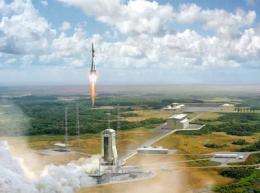
Credits: ESA - D. Ducros

International space cooperation will be highlighted in a historic event on 20 October: the launch of Europe’s first Galileo navigation satellites on Russia’s first Soyuz rocket to depart from Europe’s Spaceport in French Guiana.

Liftoff is scheduled for Thursday, 20 October at 12:34 CEST (10:34 GMT, 07:34 local time).
The launch will be the first time that Russia’s venerable Soyuz vehicle has ascended from European territory, adding a trusted workhorse to Europe’s launchers family.

This Soyuz-2 version is the latest in the renowned family of Russian rockets that began the space race more than 50 years ago by carrying both the first satellite, Sputnik, and the first man, Yuri Gagarin, into space.

Riding Soyuz will be the first two operational satellites in the Galileo constellation that will provide Europe with an independent global satellite navigation system.

Media can follow this important event live at one of the many events being organised around , via for broadcasters or on the web.

Explore further: Field tests in Mojave Desert pave way for human exploration of small bodies

add to favorites email to friend print save as pdf

Related Stories

Galileo's Soyuz launchers arrive at French Guiana

Jun 22, 2011

(PhysOrg.com) -- The two Soyuz launchers that will fly the first four satellites of Europe’s Galileo navigation system into orbit have arrived at Kourou harbour in French Guiana, completing a journey ...

Russia's Soyuz: historic symbol of space reliability

Aug 25, 2011

Russia's Soyuz rocket, which failed to put a Russian supply ship into orbit, is descended from launch vehicles of the early days of the space race but until now has been a byword for reliability.

Russia delays commercial space launches after crash

Sep 13, 2011

Russia will have to delay the upcoming launch of six US satellites and two commercial European craft due to last month's Soyuz carrier rocket mishap, Russian industry sources said Tuesday.

Soyuz launch from Europe space base set for October

May 10, 2011

The maiden launch of the veteran Soviet-Russian rocket Soyuz from Europe's space base in South America has been scheduled for October, a spokesman for launch operators Arianespace said on Tuesday.

First Soyuz launch from Kourou to go ahead: Arianespace

Aug 25, 2011

The maiden flight of a Soyuz from Europe's space base will go ahead as scheduled on October 20, as it is a different version from the rocket involved in Wednesday's launch failure by Russia, Arianespace said on Thursday.

Recommended for you

Mars rover Opportunity examines clay clues in rock

5 hours ago

(Phys.org) —NASA's senior Mars rover, Opportunity, is driving to a new study area after a dramatic finish to 20 months on "Cape York" with examination of a rock intensely altered by water.

NASA's STEREO detects a CME from the sun

18 hours ago

On 5:24 a.m. EDT on May 17, 2013, the sun erupted with an Earth-directed coronal mass ejection or CME, a solar phenomenon that can send billions of tons of solar particles into space that can reach Earth ...

Nine-year-old Mars rover passes 40-year-old record

May 17, 2013

While Apollo 17 astronauts Eugene Cernan and Harrison Schmitt visited Earth's moon for three days in December 1972, they drove their mission's Lunar Roving Vehicle 19.3 nautical miles (22.210 statute miles ...

Bright explosion on the Moon

May 17, 2013

For the past 8 years, NASA astronomers have been monitoring the Moon for signs of explosions caused by meteoroids hitting the lunar surface. "Lunar meteor showers" have turned out to be more common than anyone ...

User comments : 7

Adjust slider to filter visible comments by rank

Display comments: newest first

omatumr
1 / 5 (4) Oct 15, 2011
International space cooperation will be highlighted, . . .


International cooperation may renew interest in space science, if not hampered by lock-step, model-driven consensus opinions - like the Bilderberg model of a Hydrogen-filled Sun.

The Bilderberg solar model, Solar Physics 3, 5-25 (1968)

http://adsabs.har....3....5G

With kind regards,
Oliver K. Manuel
Former NASA Principal
Investigator for Apollo
http://myprofile....anuelo09

Ethelred
5 / 5 (1) Oct 15, 2011
Oliver you have made it quite clear that you think there is something you call neutron repulsion and it stops the formation of Black Holes. If Black Holes are stopped by NR then Neutron stars couldn't exist either. Of course there are all those claims that NR is causing galaxies to fragment and you spammed the site with that dozens of times.

If it has the range to fragment galaxies and the strength and range to block the formation of ANY black holes then it not only is strong enough to stop the formation of neutron stars but also ANYTHING that is held together by gravity.

For NR to stop the formation of Black Holes and cause the fragmentation of galaxies then it is stronger than gravity at both the range of a dozen kilometers and at kiloparsecs. This means that not only does it shatter galaxies but they could not form in first place. Planets could not form and ALL gravity bound objects would be sundered by this hypothetical galaxy busting Black Hole blocking force.

Ethelred
omatumr
1 / 5 (3) Oct 16, 2011
Science addresses REALITY. False science continues advocating models that have been falsified by data and observations.

The Bilderberg model of Earth's heat source as a giant, homogeneous ball of hydrogen, steadily heated by H-fusion "in equilibrium."

http://adsabs.har....3....5G

Was repeatedly falsified by experimental data on:

a.) Solar flares
b.) The solar wind
c.) The photosphere
d.) The Galileo Mission to Jupiter
h.) Analysis of meteorites and planets
e.) The Apollo Mission to the Moon
f.) Neutron-capture cross sections
g.) Nuclear rest mass data, but . . .

Ignored because the AGW fable is based on the Bilderberg model of constant heat arriving from the Sun.

Data that falsify SSM and AGW are summarized in three papers:

1. Journal of Fusion Energy 21, 193-198 (2002)

http://arxiv.org/.../0501441

2. ESA SP-517, 345-348 (2003)

http://arxiv.org/...410717v1

3. APERION J, in press

http://arxiv.org/...2.1499v1
jsdarkdestruction
5 / 5 (1) Oct 16, 2011
oliver, you have absolutely no right to talk about reality, you left that behind you a long time ago, along with your honor and dignity and integrity. your lies are sickening and no one here believes in your nonsense except you and kio. youve got no training in any of the fields you claim are wrong and experts have shown you are wrong repeatdley. Get real, its sad how low youve fallen. no, pathetic.
Ethelred
5 / 5 (1) Oct 16, 2011
Science addresses REALITY. False science continues advocating models that have been falsified by data and observations.
Absolutely. So stop with your false science and your false accusations about others.

Was repeatedly falsified by experimental data on:
a.) Solar flares
No. Nor do they support you.

b.) The solar wind
Fits the standard models.

c.) The photosphere
Which couldn't exist with a Neutron Star in it. But DOES fit the standard models.

d.) The Galileo Mission to Jupiter
Which does not support your claims.

q]h.) Analysis of meteorites and planets Support the standard models.

e.) The Apollo Mission to the Moon
Supports the standard models.

f.) Neutron-capture cross sections
Fits the Pauli Exclusion Principle.

g.) Nuclear rest mass data
Fits the PEP. Which you refuse to address in any way.>>
Ethelred
5 / 5 (2) Oct 16, 2011
Ignored because the AGW fable is based on the Bilderberg model of constant heat arriving from the Sun.
Something YOU made up recently in your continuing attack on rational science. An exceeding bizarre excursion into rampant paranoid nonsense. Not a one those people give a damn about your ridiculous self contradictory theory.

And few scientists think or claim the Sun doesn't have variation.

And that another attempt to evade answering my question. SO here it is again.

You have made it quite clear that you think there is something you call neutron repulsion and it stops the formation of Black Holes. If Black Holes are stopped by NR then Neutron stars couldn't exist either. Of course there are all those claims that NR is causing galaxies to fragment and you spammed the site with that dozens of times.>>
Ethelred
5 / 5 (2) Oct 16, 2011
If it has the range to fragment galaxies and the strength and range to block the formation of ANY black holes then it not only is strong enough to stop the formation of neutron stars but also ANYTHING that is held together by gravity.

For NR to stop the formation of Black Holes and cause the fragmentation of galaxies then it is stronger than gravity at both the range of a dozen kilometers and at kiloparsecs. This means that not only does it shatter galaxies but they could not form in first place. Planets could not form and ALL gravity bound objects would be sundered by this hypothetical galaxy busting Black Hole blocking force.

Anytime you want to stop evading out of cowardice feel free to answer the questions instead of attacking people.

Ethelred

More news stories

Alaska volcano shoots ash 15,000 feet into the air

(AP)—One of Alaska's most restless volcanoes has shot an ash cloud 15,000 feet into the air in an ongoing eruption that has drawn attention from a nearby community but isn't expected to threaten air traffic.

Chinese, Indian airlines face EU pollution fines

Eight Chinese and two Indian airlines face fines of up to several million euros for not paying for their greenhouse gas emissions during flights within the bloc, the European Commission said on Friday.

Yahoo Japan suspects 22 million IDs stolen

Yahoo Japan Corp. has said it suspects up to 22 million user IDs may have been stolen during an unauthorised attempt to access the administrative system of its Yahoo! Japan portal.

US seizes Bitcoin operator accounts

US authorities seized the accounts of a Bitcoin digital currency exchange operator, claiming it was functioning as an "unlicensed money service business," court documents showed Friday.

Temporal processing in the olfactory system

The neural machinery underlying our olfactory sense continues to be an enigma for neuroscience. A recent review in Neuron seeks to expand traditional ideas about how neurons in the olfactory bulb might encode information about ...