A simple compound with surprising antifreeze properties

The material shown here was generated without the addition of zirconium acetate. Its structure lacks a uniform pattern. Credit: Sylvain Deville
A chemical compound used to stabilize particles in suspension has proved capable of controlling the growth of ice crystals. This finding was made by CNRS/Saint-Gobain researchers in France. Surprisingly, the compound in question is a simple molecule, not at all like the macromolecules previously known for their antifreeze properties. It offers many advantages, including low production costs, stability and ease of use, which should open the way to industrial applications. Published in the online journal PLoS ONE, this work also provides new leads for the development of synthetic equivalents of antifreeze proteins, different from those currently produced.
The formation of ice crystals can have multiple, and often destructive, consequences. Cell degradation in living organisms, damage to land and roads in cold climates, ice crystals in ice creams These are all examples of situations where it is useful to control ice growth. Many organisms and species that live in cold environments have adapted to control ice growth. Their resistance to low temperatures is based on the presence of antifreeze proteins, all of which are made up of very long organic chains with amphiphilic structures (partly hydrophilic, partly hydrophobic). How do these proteins interact with ice crystals? Researchers are trying to identify the mechanism enabling antifreeze proteins to identify these crystals, but the phenomenon is still not fully understood. In addition, since these proteins are extremely costly to extract, the preferred solution is to create synthetic equivalents inspired by natural structures. All proteins currently known for their antifreeze properties are macromolecules (like glycoproteins, polysaccharides, etc.).
A team led by Sylvain Deville, CNRS researcher at the LSFC (Laboratoire de Synthèse et Fonctionnalisation des Céramiques, Synthesis and Functionalization of Ceramics Laboratory, CNRS/Saint-Gobain), in collaboration with the Matériaux, Ingénierie et Sciences (Materials, Engineering and Sciences) laboratory, has discovered that zirconium acetate, a chemical compound normally used to stabilize particles in suspension, can control ice crystal growth. The compound governs the morphology of the ice crystals obtained by freezing a solution in which it is combined with water. The crystals obtained when adding zirconium acetate are very homogenous, whereas those obtained without it show no particular uniformity.
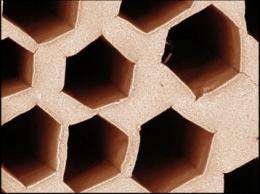
This material was generated with the addition of the salt. Its structure consists of uniform hexagonal patterns. Credit: Sylvain Deville
These results are quite surprising, given that zirconium acetate is a salt, a simple compound that is radically different from the macromolecules known for their antifreeze properties. It was not known as a substance capable of controlling ice crystal growth. Such control can be exerted in a number of ways: by reducing the speed of crystal growth (to slow their formation), by lowering the freezing point (to delay their formation), or by controlling their morphology, as in this case. Since this implies a direct interaction with the ice crystals, the researchers were surprised to find out that such radically different molecules as zirconium acetate and proteins could affect crystalline growth.This compound offers significant advantages over existing equivalents, whether natural or synthetic. It is cheap to produce, stable, simple and easy to use, which bodes well for a wealth of future industrial applications. In addition, since it is totally different from all previously identified and/or developed substances with the same function, further research could lead to the development of other molecules with antifreeze properties.
This project relied on X-ray diffraction and imaging. These works were made possible by using the X-ray synchrotron (beam line ID19) at the ESRF in Grenoble, France. They are covered by two patents published on October 1, 2011.
More information: Ice shaping properties, similar to that of antifreeze proteins, of a zirconium acetate complex. Sylvain Deville, et al. PLoS ONE. 18 October 2011. doi:10.1371/journal.pone.0026474
Provided by
CNRS
-
From lemons to lemonade: Reaction uses carbon dioxide to make carbon-based semiconductor,
32 comments
-
Thioridazine kills cancer stem cells in human while avoiding toxic side-effects of conventional cancer treatments,
3 comments
-
SpaceX private rocket blasts off for space station (Update),
42 comments
-
Climate scientists say they have solved riddle of rising sea,
31 comments
-
SpaceX capsule has 'new car' smell, astronauts say (Update),
3 comments
-
Gibbs Free Energy Change/Entropy
9 hours ago
-
What's the rule to covalent character
10 hours ago
-
Schwartz reagent-- NMR/MS/IR
May 26, 2012
-
High school chemistry EEI
May 25, 2012
-
oxidation of I- by KMnO4
May 25, 2012
-
Inversion temp
May 25, 2012
- More from Physics Forums - Chemistry
More news stories
Computer model used to pinpoint prime materials for efficient carbon capture
When power plants begin capturing their carbon emissions to reduce greenhouse gases and to most in the electric power industry, it's a question of when, not if it will be an expensive undertaking.
1 hour ago |
not rated yet |
0
|
Scientists develop ultra-sensitive test that detects diseases in their earliest stages
Scientists have developed an ultra-sensitive test that should enable them to detect signs of a disease in its earliest stages, in research published today in the journal Nature Materials.
Chemistry / Analytical Chemistry
1 hour ago |
not rated yet |
0
|
New CO2-removing catalyst can take the heat
(Phys.org) -- The current method of removing the greenhouse gas carbon dioxide (CO2) from the flues of coal-fired power plants uses so much energy that no one bothers to use it. So says Roger Aines, principal ...
May 24, 2012 |
5 / 5 (9) |
10
|
High-speed method to aid search for solar energy storage catalysts
Eons ago, nature solved the problem of converting solar energy to fuels by inventing the process of photosynthesis.
May 25, 2012 |
5 / 5 (3) |
4
|
Researchers demonstrate possible primitive mechanism of chemical info self-replication
(Phys.org) -- When scientists think about the replication of information in chemistry, they usually have in mind something akin to what happens in living organisms when DNA gets copied: a double-stranded molecule ...
May 25, 2012 |
5 / 5 (4) |
2
|
Land and sea species differ in climate change response: study
(Phys.org) -- Marine and terrestrial species will likely differ in their responses to climate warming, new research by Simon Fraser University and Australia’s University of Tasmania has found.
Almost half of new vets seek disability
(AP) -- America's newest veterans are filing for disability benefits at a historic rate, claiming to be the most medically and mentally troubled generation of former troops the nation has ever seen.
'Unzipped' carbon nanotubes could help energize fuel cells, batteries
Multi-walled carbon nanotubes riddled with defects and impurities on the outside could replace some of the expensive platinum catalysts used in fuel cells and metal-air batteries, according to scientists at ...
T cells 'hunt' parasites like animal predators seek prey, study shows
By pairing an intimate knowledge of immune-system function with a deep understanding of statistical physics, a cross-disciplinary team at the University of Pennsylvania has arrived at a surprising finding: T cells use a movement ...
Change in developmental timing was crucial in the evolutionary shift from dinosaurs to birds: study
At first glance, it's hard to see how a common house sparrow and a Tyrannosaurus Rex might have anything in common. After all, one is a bird that weighs less than an ounce, and the other is a dinosaur that ...
Yale study concludes public apathy over climate change unrelated to science literacy
Are members of the public divided about climate change because they don't understand the science behind it? If Americans knew more basic science and were more proficient in technical reasoning, would public consensus match ...
