Secrets of flocking revealed
October 26, 2011 By Katharine Gammon

Secrets of flocking revealed

Enlarge

Credit: Elise esq. via flickr

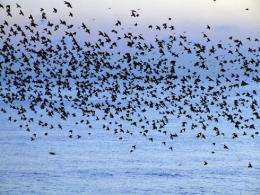
Watching thousands of birds fly in a highly coordinated, yet leaderless, flock can be utterly baffling to humans. Now, new research is peeling back the layers of mystery to show how exactly they do it -- and why it might be advantageous to fly right.

Mathematical models show that the birds' complicated can be the consequence of a few simple rules of the road -- or sky.

"Initially in [the] 1930s, people thought it might be telepathy that guided flocks of birds. Now we know self-organization is at the heart," said Charlotte Hemelrijk of the University of Groningen in the Netherlands.

Hemelrijk has studied schools of fish and flocks of starlings -- birds that can gather in flocks as large as 30,000 individuals.

"Each day they flap around for 30 minutes in the evening before sleep, and it's just spectacular the way they do this," Hemelrijk said.

And while fish generally only made long skinny shapes as they swam, the shapes that the bird flocks could take -- elongated, bulbous, hourglass, and constantly shifting -- were incredibly diverse. This motivated Hemelrijk to work, collaborating with a computer programmer to create a new model that figured out the underlying logic of the starlings' flight.

She found that even in giant flocks, each bird maintained just about the same speed and only interacted with about seven neighbors as it swooped and dove. As the birds rolled through a turn, the shape of the changed from wide and flat to long and narrow. Additionally, birds that are flying abreast each other end up in a single file line when they turn. The research was published recently in the journal .

The benefits of flocking are still being determined. In one study that measured the of , birds consumed more energy when they were forced to fly closer to each other.

"Clearly for some birds, flying together is costing them energy, so the question remains: why do they do it?" said Geoffrey Spedding, a professor of mechanical and aerospace engineering at University of Southern California. "It could be that flocking is a social phenomenon as well as mechanical one -- something like getting on the treadmill at lunch for exercise."

Spedding said that the study of flocking can be applied to lots of other fields.

"Suppose I want to make a flock of flying machines that can sense an environment and manage coordination among individuals. A good place to start would some rules of interaction in birds that can equally apply to our artificial devices," Spedding said.

Gathering in flocks could also raise the overall intelligence of the group. According to a new study in the Proceedings of the National Academy of Sciences, larger groups of great and blue tits are better at solving problems than smaller ones.

"For one thing, when there are more birds around, each bird doesn't have to be as vigilant for predators, so they can devote more attention to the task," said Julie Morand-Ferron, a researcher at Oxford University's zoology department.

Social birds can learn quickly from each other, so having one whiz kid present among the group can improve the situation for everyone. In the experiments, the researchers created a lever-pulling device that the birds had to operate to get a food reward. They found that as the size of the groups increased individual birds got more food in return for the time they spent mastering the device.

Morand-Ferron said it's not clear if larger groups work better for all types of , but that several species have had the same outcomes.

"Technical innovation is a new benefit to flocking that had not been described in the wild before," Morand-Ferron said.

Source: Inside Science News Service search and more info website

Filter


Move the slider to adjust rank threshold, so that you can hide some of the comments.


Display comments: newest first

Nikola
Oct 26, 2011

Rank: not rated yet
Did I miss something? What was the 'secret' that was revealed? How do they know which way to fly and at what moment? It sounds like they just follow the closest birds.
ryggesogn2
Oct 26, 2011

Rank: 3 / 5 (5)
A few simple rules the each individual follows creates a society.
Why do socialists and statists insist that there must be top down, coercive laws to create a society?
Isaacsname
Oct 26, 2011

Rank: not rated yet
Flocking reminds me of how crowds at sporting events move, the wave, etc. Watching a video of a crowd, sped up, also reveals subtle waves.

With birds, ...hmmmm...well,......birds often take a few naps during the day,....in the wild they subsist, more often than not, on protein-heavy diets, ...having had a few birds myself, I can say that getting one to sit still or sleep for 8 or so hours is impossible unless they are tired.

Maybe flocking is a little end of the day play/stress relief that also burns up excess energy the birds may have.

That's my big O.
antolethron
Oct 26, 2011

Rank: 5 / 5 (2)
It is no longer a secret that "larger groups of great tits ... are better ... than smaller ones"
Isaacsname
Oct 26, 2011

Rank: 5 / 5 (2)
It is no longer a secret that "larger groups of great tits ... are better ... than smaller ones"


Go ahead...profess your love for flocking boobies.
antolethron
Oct 26, 2011

Rank: not rated yet
A few simple rules the each individual follows creates a society.
Why do socialists and statists insist that there must be top down, coercive laws to create a society?


Why can't a whole be greater than the sum of its parts? Social organization aside, there are many other phenomena that emerge as a result of interactions of multiple constituents following very simple rules. Being a reductionist myself, I understand how hard it may be to step away from a this point of view, but as Douglas Hofstadter demonstrates in the book titled 'I am a strange loop', some things are best understood using the top-down framework.
Star_Gazer
Oct 26, 2011

Rank: 5 / 5 (1)
Physorg actions for this article: tl;dr. Stick sensationalized headline. Copy & Paste. Post.
Deesky
Oct 26, 2011

Rank: 5 / 5 (1)
Did I miss something? What was the 'secret' that was revealed? How do they know which way to fly and at what moment? It sounds like they just follow the closest birds.

Yup, that's it. What's more, this is hardly a new insight. I remember reading about it at least ten years ago when computer programmers used the same rules to model flocking/schooling behaviors in birds and fish and no doubt stampeding animal herds. It's a wonderful example of emergent behavior.
Rank 3 /5 (3 votes)
Relevant PhysicsForums posts

More news stories

Manufacturing genes to attack flu virus

An international research team has manufactured a new protein that can combat deadly flu epidemics.

Biology / Biotechnology

created 2 hours ago | popularity not rated yet | comments 0 | with audio podcast

Scientist: Evolution debate will soon be history

(AP) -- Richard Leakey predicts skepticism over evolution will soon be history. Not that the avowed atheist has any doubts himself.

Biology / Evolution

created 21 hours ago | popularity 3.5 / 5 (20) | comments 81

More plant species responding to global warming than previously thought

(Phys.org) -- Far more wild plant species may be responding to global warming than previous large-scale estimates have suggested.

Biology / Ecology

created May 22, 2012 | popularity 4.6 / 5 (14) | comments 18 | with audio podcast

Thousands of shellfish found dead in Peru

Thousands of crustaceans were found dead off the coast of Lima following the mystery mass death of dolphins and pelicans, the Peruvian Navy said Friday.

Biology / Ecology

created May 26, 2012 | popularity 4.8 / 5 (5) | comments 7

For monogamous sparrows, it doesn't pay to stray (but they do it anyway)

It's quite common for a female song sparrow to stray from her breeding partner and mate with the male next door, but a new study shows that sleeping around can be costly.

Biology / Plants & Animals

created May 22, 2012 | popularity 5 / 5 (2) | comments 8 | with audio podcast


Land and sea species differ in climate change response: study

(Phys.org) -- Marine and terrestrial species will likely differ in their responses to climate warming, new research by Simon Fraser University and Australia’s University of Tasmania has found.

Almost half of new vets seek disability

(AP) -- America's newest veterans are filing for disability benefits at a historic rate, claiming to be the most medically and mentally troubled generation of former troops the nation has ever seen.

'Unzipped' carbon nanotubes could help energize fuel cells, batteries

Multi-walled carbon nanotubes riddled with defects and impurities on the outside could replace some of the expensive platinum catalysts used in fuel cells and metal-air batteries, according to scientists at ...

T cells 'hunt' parasites like animal predators seek prey, study shows

By pairing an intimate knowledge of immune-system function with a deep understanding of statistical physics, a cross-disciplinary team at the University of Pennsylvania has arrived at a surprising finding: T cells use a movement ...

Computer model used to pinpoint prime materials for efficient carbon capture

When power plants begin capturing their carbon emissions to reduce greenhouse gases – and to most in the electric power industry, it's a question of when, not if – it will be an expensive undertaking.

Change in developmental timing was crucial in the evolutionary shift from dinosaurs to birds: study

At first glance, it's hard to see how a common house sparrow and a Tyrannosaurus Rex might have anything in common. After all, one is a bird that weighs less than an ounce, and the other is a dinosaur that ...