Taking the pulse of marine life in stressed seas
The Earth currently has more than 400 so-called "dead zones"--huge expanses of deep ocean that, because of human activities, become too oxygen-starved during the summer to support most life.
The total global count of dead zones--some of which cover tens of thousands of square miles--is doubling every decade. But even as encroaching dead zones, pollution and other human-caused stressors damage the oceans, more than one billion people worldwide rely on seafood as their primary source of animal protein, and more than 540 million people, or 8 percent of the world's population, earn their living directly or indirectly from the fishing industry, according to the United Nations.
The big question
With humans damaging the very waters that help sustain humanity, the question becomes: How are human-made marine stresses affecting the marine life that we need?
Louis Burnett and Karen Burnett--both biology professors at the College of Charleston and partially supported by the National Science Foundation (NSF)--are currently helping to answer that question. Specifically, the Burnetts are studying how crustaceans respond to bacterial exposures and how these responses may change in waters that are characterized by low oxygen, high acidity or pollution by heavy metals from pesticides and other sources.
The Burnetts want to understand how crustaceans, and other marine organisms, respond to bacterial exposures because these animals live in a veritable soup of bacteria: every teaspoon of seawater contains more than one million bacteria. So if, for example, the resistance of crustaceans to bacterial infections were to be compromised by human-made stressors, the vulnerability of these organisms to illness and death would likely increase.
Part of the Burnetts' research is focused on identifying how exposures to bacteria and various stressful environmental conditions impact the fitness levels of crustaceans. But because a crustacean obviously cannot describe how fit it feels under various types of stressful conditions, the Burnetts have designed an ingenious set of experiments that help them deduce this information.
Generating answers
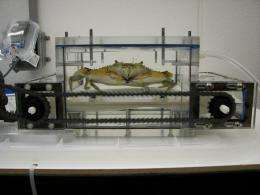
Here's how the Burnetts' experiments work: First, a crustacean is infected, by injection, with the same types of disease-causing bacteria that are commonly encountered in the wild. Next, the animal is placed on a specially built, mini underwater treadmill. Then, the organism's vital signs, such as its heart rate and blood pressure, are measured (as a proxy for fitness) while it walks on the treadmill--similar to the way that a person's vital signs are measured while he or she& walks on a treadmill during a stress test. Finally, the treadmill performances of infected crustaceans are compared to those of their uninfected counterparts.
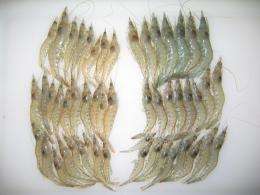
The Burnetts have repeated these experiments with various types of crustaceans under various conditions that mimic those in compromised seas, including low oxygen conditions. Results show that infected crabs and shrimp do not perform on the treadmill as well as their uninfected counterparts, and that the immune responses that are triggered by bacterial infections are enough, by themselves, to reduce these animals' ability to take up oxygen, even when high levels of oxygen are available. (See accompanying video for an explanation of this phenomenon.) The Burnetts' results also show that the infection-fighting abilities of crabs, shrimps, oysters and fish decline in low oxygen conditions.
More answers needed
The Burnetts are currently testing whether the ability of crustaceans to engage in critical, life-sustaining activities that require high levels of oxygen, such as swimming, feeding or reproducing, are impaired by their immune responses to infections and whether such impairments are magnified by environmental stresses. The researchers are also studying how gene expression in crustaceans changes by exposures to environmental stresses, i.e. whether crustaceans respond to stresses by turning on or off certain genes as part of their defense mechanisms.
Through such studies, the Burnetts may ultimately identify telltale changes in gene expression that are triggered by various environmental stresses. They would thereby lay the foundation for the development of an early warning system that could be used to help flag conditions that may harm economically and ecologically important crustaceans. Such a system could, for example, be used to determine when pollution levels from a sewage pipe would rise high enough to jeopardize the health or marketability of nearby organisms, such as oysters.
Training young scientists
In addition to offering potentially important practical applications, the Burnetts' research is also generating many types of training opportunities for students. For example, during the past 11 years, the Burnetts directly trained 16 undergraduates, including 10 underrepresented minorities, and 7 graduate students. Also, with federal and state partners, the Burnetts conducted summer programs that provided research experiences to more than 100 undergraduates from 45 states. In so doing, the Burnetts supported NSF's goals for increasing and broadening participation in the sciences.
The importance of basic research
Another benefit of the Burnetts' research is that it is advancing basic research. The researchers' advances are important because "basic research is always about understanding underlying mechanisms," says Louis Burnett. "Our research goes from the regulation of DNA molecules all the way up to organismal behavior. And all of the work in between gives us ideas about the mechanisms that animals use to live in their natural environments."
Karen Burnett adds, "If scientists only did applied research, which takes things we already know and makes them work better, we wouldn't advance anything for our society or our way of life. It is the basic research that provides new material--the types of unexpected results--that help move things forward and drive our society in a better direction."
Provided by National Science Foundation


.jpg)


