Physicists say nanoparticle assembly is like building with LEGOs
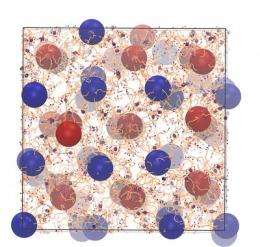
This image shows a crystal of nanoparticles (the red and blue spheres) held together by DNA strands (the orange lines) via the hybridization of complementary sequences (the blue and red rings). Credit: Image courtesy of Chris Knorowski/Iowa State University/Ames Laboratory
New processes that allow nanoparticles to assemble themselves into designer materials could solve some of today's technology challenges, Alex Travesset of Iowa State University and the Ames Laboratory reports in the Oct. 14 issue of the journal Science.
Travesset, an associate professor of physics and astronomy and an associate of the U.S. Department of Energy's Ames Laboratory, writes in the journal's Perspectives section that the controlled self-assembly of nanoparticles could help researchers create new materials with unique electrical, optical, mechanical or transport properties.
"Nanoparticle self-assembly has entered the LEGO era," Travesset said. "You can really work with nanoparticles in the same way you can work with LEGOs. This represents a breakthrough in the way we can manipulate matter. Really revolutionary applications will come."
In his commentary, Travesset reports on the ramifications of a scientific paper also published in the Oct. 14 issue of Science. Lead authors of the scientific paper are Chad Mirkin, director of the International Institute for Nanotechnology at Northwestern University in Evanston, Ill., and George Schatz, a professor of chemistry at Northwestern. Their research team describes new technologies that use complementary DNA strands to link nanoparticles and control how the particles precisely assemble into target structures.
Nanoparticles are so small - just billionths of a meter - that it is practically impossible to assemble real materials particle by particle. Past attempts to induce their self-assembly have been successful in only a handful of systems and in very restrictive conditions.
The developments by the Mirkin and Schatz research team are "likely to elevate DNA-programmed self-assembly into a technique for the design of nanoparticle structures a la carte," Travesset wrote.
Travesset's research program includes theoretical studies of the assembly of nanoparticles and how they can be uniformly mixed with polymers. A research paper describing some of his findings was published in the May 27 issue of the journal Physical Review Letters (Dynamics and Statics of DNA-Programmable Nanoparticle Self-Assembly and Crystallization).
With the development of efficient self-assembly technologies, Travesset said there's tremendous potential for nanoparticle science.
"Being able to assemble nanoparticles with such control represents a major accomplishment in our quest to manipulate matter," he wrote in Science. "There are immediate important applications related to catalysis, medical sensing, new optical materials or metamaterials, and others that will follow from these studies.
"Most likely, however, many other applications will arise as we dig deeper, understand better, expand further, and tinker with the opportunities provided by these materials."
Provided by
Iowa State University
-
From lemons to lemonade: Reaction uses carbon dioxide to make carbon-based semiconductor,
32 comments
-
Thioridazine kills cancer stem cells in human while avoiding toxic side-effects of conventional cancer treatments,
3 comments
-
SpaceX private rocket blasts off for space station (Update),
42 comments
-
Climate scientists say they have solved riddle of rising sea,
31 comments
-
SpaceX capsule has 'new car' smell, astronauts say (Update),
4 comments
-
How to calculate the repulsion force between a permanent and an electromagnet?
54 minutes ago
-
Why does light allow us to see things?
57 minutes ago
-
Room temperature superconductivity
1 hour ago
-
Water flow question
4 hours ago
-
[Drift velocity] Factors affecting velocity
7 hours ago
-
does cold gasoline have less energy
8 hours ago
- More from Physics Forums - General Physics
More news stories
'Unzipped' carbon nanotubes could help energize fuel cells, batteries
Multi-walled carbon nanotubes riddled with defects and impurities on the outside could replace some of the expensive platinum catalysts used in fuel cells and metal-air batteries, according to scientists at ...
Nanotechnology / Nanomaterials
2 hours ago |
not rated yet |
0
|
In nanorod crystal growth, nanoparticles seen as artificial atoms
In the growth of crystals, do nanoparticles act as "artificial atoms" forming molecular-type building blocks that can assemble into complex structures? This is the contention of a major but controversial theory ...
May 24, 2012 |
4.8 / 5 (6) |
0
|
Dopant gives graphene solar cells highest efficiency yet
(Phys.org) -- By taking advantage of graphenes favorable electrical and optical properties, and then adding an organic dopant, researchers have achieved the highest power conversion efficiency yet for ...
First direct observation of oriented attachment in nanocrystal growth
Berkeley Lab researchers have reported the first direct observation of nanoparticles undergoing oriented attachment, the critical step in biomineralization and the growth of nanocrystals. A better understanding ...
May 24, 2012 |
4.7 / 5 (3) |
0
|
Synthetic nano-waste does not disappear
(Phys.org) -- Tiny particles of cerium oxide do not burn or change in the heat of a waste incineration plant. They remain intact on combustion residues or in the incineration system, as a new study by Swiss ...
Nanotechnology / Bio & Medicine
May 25, 2012 |
5 / 5 (2) |
1
|
Land and sea species differ in climate change response: study
(Phys.org) -- Marine and terrestrial species will likely differ in their responses to climate warming, new research by Simon Fraser University and Australia’s University of Tasmania has found.
Almost half of new vets seek disability
(AP) -- America's newest veterans are filing for disability benefits at a historic rate, claiming to be the most medically and mentally troubled generation of former troops the nation has ever seen.
T cells 'hunt' parasites like animal predators seek prey, study shows
By pairing an intimate knowledge of immune-system function with a deep understanding of statistical physics, a cross-disciplinary team at the University of Pennsylvania has arrived at a surprising finding: T cells use a movement ...
Computer model used to pinpoint prime materials for efficient carbon capture
When power plants begin capturing their carbon emissions to reduce greenhouse gases and to most in the electric power industry, it's a question of when, not if it will be an expensive undertaking.
Change in developmental timing was crucial in the evolutionary shift from dinosaurs to birds: study
At first glance, it's hard to see how a common house sparrow and a Tyrannosaurus Rex might have anything in common. After all, one is a bird that weighs less than an ounce, and the other is a dinosaur that ...
Yale study concludes public apathy over climate change unrelated to science literacy
Are members of the public divided about climate change because they don't understand the science behind it? If Americans knew more basic science and were more proficient in technical reasoning, would public consensus match ...