Researchers change the color and shape of a single photon
October 6, 2011

Researchers Change the Color and Shape of a Single Photon

Enlarge

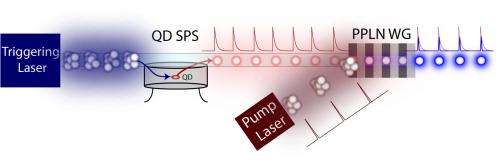
The color and shape of single photons produced by a quantum dot single photon source (QD SPS) are changed by combining them with a strong, pulsed pump laser in a nonlinear crystal (PPLN WG).

(PhysOrg.com) -- A team of researchers from the CNST and ITL has simultaneously changed the color and shape of a single photon, the smallest unit of light.

The work, reported in the August 19 issue of Physical Review Letters, represents an important step towards implementing communication over long distances with privacy secured by the laws of .

Using a specially designed optical fiber probe, a single photon at a telecommunications wavelength was extracted from a quantum dot, a semiconductor analog of an atom, that was engineered to emit photons one at a time.

Each photon was then combined with a much stronger pulsed laser beam inside a nonlinear optical crystal that enables the two to interact efficiently.

After exiting the crystal, the wavelength, or color, of the photon is shifted by almost 600 nm, an amount greater than the size of the entire visible spectrum.

Because the researchers use a pulsed laser, its temporal shape becomes imprinted on the single photon during the color-conversion process.

Researchers utilizing different , which often require single photons of a specific wavelength and shape, may be able to use this approach to link their previously incompatible systems together in a large-scale network for applications.

More information: Simultaneous wavelength translation and amplitude modulation of single photons from a quantum dot, M. T. Rakher, L. Ma, M. Davanço, O. Slattery, X. Tang, and K. Srinivasan, Physical Review Letters 107, 083602 (2011).

Provided by National Institute of Standards and Technology search and more info website

4.5 /5 (6 votes)  

Filter


Move the slider to adjust rank threshold, so that you can hide some of the comments.


Display comments: newest first

hush1
Oct 06, 2011

Rank: 5 / 5 (1)
In the "related stories" column the same authors, the same research and the same institute are reported.
http://www.physor...ots.html
axemaster
Oct 06, 2011

Rank: not rated yet
a single photon at a telecommunications wavelength was extracted from a quantum dot, a semiconductor analog of an atom, that was engineered to emit photons one at a time.


Quick question, do quantum dots actually emit single photons in a fully controllable way, or do they just emit single photons at a low enough frequency (time between emissions) to be distinguished by the electronics?
hush1
Oct 06, 2011

Rank: not rated yet
lol Quick ans. Yes.
The slower ans. The latter.
Guessing.
Callippo
Oct 06, 2011

Rank: 1 / 5 (1)
in a fully controllable way
"Fully controllable way" sounds suspiciously in a quantum world due the quantum uncertainty - or not?
Rank 4.5 /5 (6 votes)
Relevant PhysicsForums posts
  • How to calculate the repulsion force between a permanent and an electromagnet?
    created53 minutes ago
  • Why does light allow us to see things?
    created56 minutes ago
  • Room temperature superconductivity
    created1 hour ago
  • Water flow question
    created4 hours ago
  • [Drift velocity] Factors affecting velocity
    created7 hours ago
  • does cold gasoline have less energy
    created8 hours ago
  • More from Physics Forums - General Physics

More news stories

Is a classical electrodynamics law incompatible with special relativity?

(Phys.org) -- The laws of classical electromagnetism that were developed in the 19th century are the same laws that scientists use today. They include Maxwell’s four equations along with the Lorentz la ...

Physics / General Physics

created May 24, 2012 | popularity 4.7 / 5 (17) | comments 43 | with audio podcast feature

Landmark calculation clears the way to answering how matter is formed

(Phys.org) -- An international collaboration of scientists, including Thomas Blum, associate professor of physics, is reporting in landmark detail the decay process of a subatomic particle called a kaon – ...

Physics / General Physics

created May 25, 2012 | popularity 4.3 / 5 (22) | comments 51 | with audio podcast

Lying in wait for WIMPs: Researchers seek to dramatically increase sensitivity of Large Underground Xenon detector

Although it's invisible, dark matter accounts for at least 80 percent of the matter in the universe. No one knows what it is, but most scientists would bet on weakly interacting massive particles, or WIMPs.

Physics / General Physics

created May 23, 2012 | popularity 4 / 5 (7) | comments 16 | with audio podcast

Hawaii lab turns laser-powered bubbles into microrobots

(Phys.org) -- A team of scientists from the University of Hawaii are working on microrobots created from bubbles of air in a saline solution. The bubbles take on their title of “robots” as a laser ...

Physics / General Physics

created May 23, 2012 | popularity 5 / 5 (4) | comments 2 | with audio podcast weblog

Sound increases the efficiency of boiling

Scientists at the Georgia Institute of Technology achieved a 17-percent increase in boiling efficiency by using an acoustic field to enhance heat transfer. The acoustic field does this by efficiently removing vapor bubbles ...

Physics / Soft Matter

created May 24, 2012 | popularity 5 / 5 (2) | comments 2


Land and sea species differ in climate change response: study

(Phys.org) -- Marine and terrestrial species will likely differ in their responses to climate warming, new research by Simon Fraser University and Australia’s University of Tasmania has found.

Almost half of new vets seek disability

(AP) -- America's newest veterans are filing for disability benefits at a historic rate, claiming to be the most medically and mentally troubled generation of former troops the nation has ever seen.

'Unzipped' carbon nanotubes could help energize fuel cells, batteries

Multi-walled carbon nanotubes riddled with defects and impurities on the outside could replace some of the expensive platinum catalysts used in fuel cells and metal-air batteries, according to scientists at ...

T cells 'hunt' parasites like animal predators seek prey, study shows

By pairing an intimate knowledge of immune-system function with a deep understanding of statistical physics, a cross-disciplinary team at the University of Pennsylvania has arrived at a surprising finding: T cells use a movement ...

Computer model used to pinpoint prime materials for efficient carbon capture

When power plants begin capturing their carbon emissions to reduce greenhouse gases – and to most in the electric power industry, it's a question of when, not if – it will be an expensive undertaking.

Change in developmental timing was crucial in the evolutionary shift from dinosaurs to birds: study

At first glance, it's hard to see how a common house sparrow and a Tyrannosaurus Rex might have anything in common. After all, one is a bird that weighs less than an ounce, and the other is a dinosaur that ...