Research paper on cancer drug accorded 'VIP' status
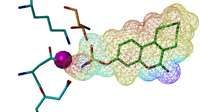
Picture showing how the drug molecule (right) interacts with the steroid sulfatase enzyme (left).
A paper on the anti-cancer drug Irosustat, designed by researchers at the University of Bath, has been awarded 'Very Important Paper' status by the medicinal chemistry journal ChemMedChem, including a special cover feature designed by the research group.
The drug, originally known as STX64 and now as Irosustat, was designed and chemically synthesised in the Medicinal Chemistry Group of the Universitys Department of Pharmacy & Pharmacology.
STX64 and its associated intellectual property formed part of the assets of the Bath-Imperial College spin-out company Sterix Ltd that was co-founded by Professor Barry Potter and was acquired by the pharmaceutical company Ipsen in 2004.
The drug has been developed by Ipsen in recent years, with human clinical trials carried out in hormone-dependent breast cancer, endometrial cancer and in male prostate cancer.
The drug can be given orally and is termed a first-in-class irreversible steroid sulfatase inhibitor. It works by blocking an enzyme pathway that gives rise to precursors of the steroid hormones oestrogen and an androgen that can trigger the growth of hormone-dependent tumours.
The new paper, entitled Structure-activity relationship of the clinical steroid sulfatase inhibitor Irosustat (STX64, BN83495), has appeared in the November issue of the journal and describes how the research team has modified the chemical structure of the drug to explore the effects on biological activity.
Referee reports on the paper were so strong that the journal ChemMedChem accorded it coveted VIP status and also invited the authors to design a cover feature for the publication.
Professor Potter, with colleagues Dr Lawrence Woo and Dr Mark Thomas of the Department of Pharmacy & Pharmacology, designed an imaginative cover feature illustrating the drug molecule flanked by renderings of the target enzyme, all superimposed upon a false colour staining of the target protein in malignant breast cancer cells.
The publisher Wiley has also issued a feature on this paper in its own Chem Views online news magazine entitled Best in Class.
Professor Potter said: It is highly rewarding for the whole team to see the progression of this drug from the bench in a University of Bath synthetic laboratory all the way into diverse major clinical trials in cancer patients and also to see such continuing academic peer-recognition.
This work emphasises the strength of medicinal chemistry at the University of Bath and demonstrates that academic scientists can play a key role in the drug discovery and development processes, traditionally a preserve of the pharmaceutical industry.
More information: The full paper can be accessed through the ChemMedChem website.
Provided by
University of Bath
-
From lemons to lemonade: Reaction uses carbon dioxide to make carbon-based semiconductor,
32 comments
-
Thioridazine kills cancer stem cells in human while avoiding toxic side-effects of conventional cancer treatments,
3 comments
-
SpaceX private rocket blasts off for space station (Update),
42 comments
-
Climate scientists say they have solved riddle of rising sea,
31 comments
-
SpaceX capsule has 'new car' smell, astronauts say (Update),
4 comments
-
Gibbs Free Energy Change/Entropy
9 hours ago
-
What's the rule to covalent character
11 hours ago
-
Schwartz reagent-- NMR/MS/IR
May 26, 2012
-
High school chemistry EEI
May 25, 2012
-
oxidation of I- by KMnO4
May 25, 2012
-
Inversion temp
May 25, 2012
- More from Physics Forums - Chemistry
More news stories
Computer model used to pinpoint prime materials for efficient carbon capture
When power plants begin capturing their carbon emissions to reduce greenhouse gases and to most in the electric power industry, it's a question of when, not if it will be an expensive undertaking.
2 hours ago |
not rated yet |
0
|
Scientists develop ultra-sensitive test that detects diseases in their earliest stages
Scientists have developed an ultra-sensitive test that should enable them to detect signs of a disease in its earliest stages, in research published today in the journal Nature Materials.
Chemistry / Analytical Chemistry
2 hours ago |
not rated yet |
0
|
New CO2-removing catalyst can take the heat
(Phys.org) -- The current method of removing the greenhouse gas carbon dioxide (CO2) from the flues of coal-fired power plants uses so much energy that no one bothers to use it. So says Roger Aines, principal ...
May 24, 2012 |
5 / 5 (9) |
10
|
High-speed method to aid search for solar energy storage catalysts
Eons ago, nature solved the problem of converting solar energy to fuels by inventing the process of photosynthesis.
May 25, 2012 |
5 / 5 (3) |
4
|
Researchers demonstrate possible primitive mechanism of chemical info self-replication
(Phys.org) -- When scientists think about the replication of information in chemistry, they usually have in mind something akin to what happens in living organisms when DNA gets copied: a double-stranded molecule ...
May 25, 2012 |
5 / 5 (4) |
2
|
Land and sea species differ in climate change response: study
(Phys.org) -- Marine and terrestrial species will likely differ in their responses to climate warming, new research by Simon Fraser University and Australia’s University of Tasmania has found.
Almost half of new vets seek disability
(AP) -- America's newest veterans are filing for disability benefits at a historic rate, claiming to be the most medically and mentally troubled generation of former troops the nation has ever seen.
'Unzipped' carbon nanotubes could help energize fuel cells, batteries
Multi-walled carbon nanotubes riddled with defects and impurities on the outside could replace some of the expensive platinum catalysts used in fuel cells and metal-air batteries, according to scientists at ...
T cells 'hunt' parasites like animal predators seek prey, study shows
By pairing an intimate knowledge of immune-system function with a deep understanding of statistical physics, a cross-disciplinary team at the University of Pennsylvania has arrived at a surprising finding: T cells use a movement ...
Change in developmental timing was crucial in the evolutionary shift from dinosaurs to birds: study
At first glance, it's hard to see how a common house sparrow and a Tyrannosaurus Rex might have anything in common. After all, one is a bird that weighs less than an ounce, and the other is a dinosaur that ...
Yale study concludes public apathy over climate change unrelated to science literacy
Are members of the public divided about climate change because they don't understand the science behind it? If Americans knew more basic science and were more proficient in technical reasoning, would public consensus match ...