More oil spills from stricken New Zealand ship
October 18, 2011 by Marty Melville

Bad weather has halted salvage work at Bay of Plenty and poor conditions are expected to continue until Wednesday

Enlarge

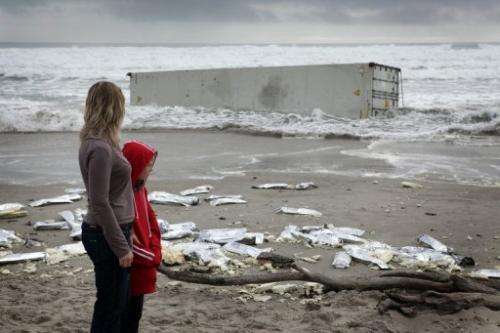
Local residents are seen here on the beach as a container from the stricken ship 'Rena' lies in the water at Mount Maunganui near Tauranga, on October 13. Fresh oil leaked from a container ship stuck on a New Zealand reef Tuesday, as bad weather halted both salvage work on the vessel and a massive pollution clean up on the coast.

Fresh oil leaked from a container ship stuck on a New Zealand reef Tuesday, as bad weather halted both salvage work on the vessel and a massive pollution clean up on the coast.

Maritime New Zealand (MNZ) said the Rena was pounded by four metre (13 foot) swells and 35 knot (65 kilometres per hour) winds overnight, forcing salvage crews pumping oil from its fuel tanks to abandon their work.

It said about 90 tonnes of oil had been offloaded, leaving more than 1,200 tonnes still on board the vessel, which sparked New Zealand's biggest sea pollution disaster when it ploughed into a reef on October 5.

Some 300 tonnes have already fouled beaches on the North Island's Bay of Plenty, killing at least 1,300 birds in the environmentally sensitive area, with the final toll expected to be significantly higher.

MNZ salvage chief Andrew Berry said more oil had spilled from the Liberian-flagged ship but the amount appeared to be small and prevailing winds were driving it offshore.
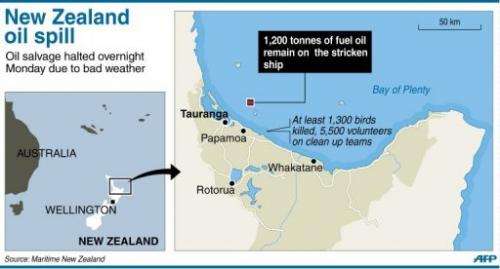
Graphic showing the latest situation in New Zealand's Bay of Plenty
Enlarge

Graphic showing the latest situation in New Zealand's Bay of Plenty where oil salvage operations from a stricken container ship was halted overnight due to bad weather

Huge cracks have opened on the vessel's hull since it grounded, threatening to shear it in two, and Berry said the stop-start salvage operation would take a long time.

"Every drop of oil that we can get off the Rena is one less drop that potentially can end up in the environment," he said.

"But given the huge range of variables that can affect operations, it's going to be a long, slow process."

Poor conditions expected to continue until Wednesday also forced MNZ to stand down an army of more than 5,000 volunteers involved in cleaning up blackened beaches.

"This is a last minute change due to ," it said. "Our thanks and apologies to those volunteers who were ready for action."

New Zealand's Bay of Plenty contains marine reserves and wetlands and teems with wildlife
Enlarge

Prime Minister of New Zealand John Key (R) watches blue penguins that were rescued from the Bay of Plenty oil spill, during a visit to a wildlife facility at the Tauranga Wastewater Treatment Plant, on October 18.

MNZ has described the salvage operation on the Rena, which is cracked and listing badly on the Astrolabe Reef 22 kilometres (14 miles) offshore, as one of the most complex it has ever faced.

The viscous oil has a treacle-like consistency and has to be pumped through an eight-centimetre (three-inch) pipe, with the crew ready to evacuate at a moment's notice if the ship begins to break up.

The Rena's owner, Greek company Costamare, has apologised for the disaster, while its charterer, the world's second-largest container shipping firm Mediterranean Shipping Company, has agreed to pay some of the clean up bill.

New Zealand has launched two investigations into how the ship hit the reef in calm conditions but its captain and second office have already been charged with operating a vessel in a manner causing unnecessary danger or risk.

Compared with some of the world's worst oil spills, the disaster remains small -- the Exxon Valdez which ran aground in 1989 in Alaska dumped 37,000 tonnes of into Prince William Sound.

But it is significant because of the once-pristine nature of New Zealand's Bay of Plenty, which contains marine reserves and wetlands and teems with wildlife including whales, dolphins, penguins, seals and rare sea birds.

(c) 2011 AFP


Rank not rated yet
Relevant PhysicsForums posts

More news stories

Yale study concludes public apathy over climate change unrelated to science literacy

Are members of the public divided about climate change because they don't understand the science behind it? If Americans knew more basic science and were more proficient in technical reasoning, would public consensus match ...

Space & Earth / Environment

created 1 hour ago | popularity not rated yet | comments 8 | with audio podcast

10 million years needed to recover from mass extinction

It took some 10 million years for Earth to recover from the greatest mass extinction of all time, latest research has revealed.

Space & Earth / Earth Sciences

created 1 hour ago | popularity not rated yet | comments 1 | with audio podcast

Sophisticated simulations predict future warming

The chances of our planet being hit by a global warming of 3 degrees Celsius by 2050 is as likely as it being hit by an increase of 1.4 degrees, new research shows. Presented in the journal Nature Geoscience, the British study ...

Space & Earth / Earth Sciences

created May 22, 2012 | popularity 4.4 / 5 (9) | comments 51

Aliens don't want to eat us, says former SETI director

Alien life probably isn’t interested in having us for dinner, enslaving us or laying eggs in our bellies, according to a recent statement by former SETI director Jill Tarter.

Space & Earth / Space Exploration

created May 25, 2012 | popularity 4.4 / 5 (14) | comments 39

Kyoto Protocol architect 'frustrated' by climate dialogue

UN climate talks are going nowhere, as politicians dither or bicker while the pace of warming dangerously speeds up, one of the architects of the Kyoto Protocol told AFP.

Space & Earth / Environment

created May 23, 2012 | popularity 3.7 / 5 (7) | comments 39


'Unzipped' carbon nanotubes could help energize fuel cells, batteries

Multi-walled carbon nanotubes riddled with defects and impurities on the outside could replace some of the expensive platinum catalysts used in fuel cells and metal-air batteries, according to scientists at ...

T cells 'hunt' parasites like animal predators seek prey, study shows

By pairing an intimate knowledge of immune-system function with a deep understanding of statistical physics, a cross-disciplinary team at the University of Pennsylvania has arrived at a surprising finding: T cells use a movement ...

Computer model used to pinpoint prime materials for efficient carbon capture

When power plants begin capturing their carbon emissions to reduce greenhouse gases – and to most in the electric power industry, it's a question of when, not if – it will be an expensive undertaking.

Change in developmental timing was crucial in the evolutionary shift from dinosaurs to birds: study

At first glance, it's hard to see how a common house sparrow and a Tyrannosaurus Rex might have anything in common. After all, one is a bird that weighs less than an ounce, and the other is a dinosaur that ...

Same gene that stunts infants' growth also makes them grow too big: research

UCLA geneticists have identified the mutation responsible for IMAGe* syndrome, a rare disorder that stunts infants' growth. The twist? The mutation occurs on the same gene that causes Beckwith-Wiedemann syndrome, which makes ...

Scientists develop ultra-sensitive test that detects diseases in their earliest stages

Scientists have developed an ultra-sensitive test that should enable them to detect signs of a disease in its earliest stages, in research published today in the journal Nature Materials.