Nuclear power essential to cut emissions: UK expert
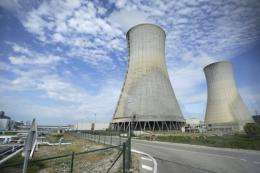
A nuclear power plant operates in Bollene, France in September 2011. Britain's chief scientific adviser voiced concern Wednesday at moves to abandon nuclear power after Japan's Fukushima crisis, saying it remains vital to combat global warming.
Britain's chief scientific adviser voiced concern Wednesday at moves to abandon nuclear power after Japan's Fukushima crisis, saying it remains vital to combat global warming.
John Beddington called for greater global efforts to cut carbon emissions, saying the world could otherwise face "unprecedented" challenges with natural disasters becoming more frequent and destructive.
Britain has pledged to reduce greenhouse gas emissions by at least 80 percent by 2050, but this could hardly be achieved without nuclear power, he said.
"There is very clear analytical work that says this is not feasible for the United Kingdom to abandon nuclear without a completely catastrophic increase in energy prices," Beddington told a Seoul forum on climate change.
"So that is why the UK has a very different energy policy from Germany," he said, stressing nuclear would play "a significant part" in Britain's energy sources.
The Fukushima crisis sparked global fears over the safety of atomic reactors. Germany decided to shut down all of its nuclear reactors by the end of 2022 as a result.
Beddington said however the world may not have the luxury of shunning nuclear power.
Volatile weather caused by climate change had led to more floods, droughts, tropical storms and forest fires of greater intensity while reducing crop yields, he said, adding most victims were in developing nations.
Beddington said "time is against us" and the world should not dismiss any kind of technology.
"We need them all if we are to address, not just climate change, but food security, water security and energy poverty."
He also said the danger posed by crippled reactors at Fukushima was "quite moderate", citing expert studies to determine whether Britons should be evacuated.
The experts set the worst possible scenario of having all radioactive material at Fukushima released into the air and winds blowing towards the greater Tokyo area, Beddington said.
"The answer came out... there was absolutely no need (to evacuate nationals)," he said.
(c) 2011 AFP
-
From lemons to lemonade: Reaction uses carbon dioxide to make carbon-based semiconductor,
32 comments
-
Thioridazine kills cancer stem cells in human while avoiding toxic side-effects of conventional cancer treatments,
3 comments
-
SpaceX private rocket blasts off for space station (Update),
42 comments
-
Climate scientists say they have solved riddle of rising sea,
31 comments
-
SpaceX capsule has 'new car' smell, astronauts say (Update),
3 comments
-
Need a rigid insulation material???
16 hours ago
-
magnets or EMF in car bumpers to protect from fender bender
May 26, 2012
-
length of wire in a coil of known dimensions?
May 25, 2012
-
India Engineering Powerhouse
May 25, 2012
-
electromagnet core dereference between hard and soft iron
May 25, 2012
-
Measuring water pressure in an open tank
May 24, 2012
- More from Physics Forums - General Engineering
More news stories
Browser wars flare in mobile space
The browser wars are heating up again, but this time the fight is for dominance of the mobile Internet.
9 hours ago |
5 / 5 (1) |
3
Probability of contamination from severe nuclear reactor accidents is higher than expected: study
Catastrophic nuclear accidents such as the core meltdowns in Chernobyl and Fukushima are more likely to happen than previously assumed. Based on the operating hours of all civil nuclear reactors and the number ...
Technology / Energy & Green Tech
May 22, 2012 |
3.6 / 5 (22) |
56
|
SpotterRF debuts Radar Backpack Kit (w/ Video)
(Phys.org) -- SpotterRF has announced a special radar backpack kit designed to enhance situational awareness for soldiers on the ground. The company says its special radar is designed for warfighters as part ...
HyperSolar shows dirty water no barrier to power world
(Phys.org) -- The Santa Barbara, California, company, HyperSolar, is set to transparently share the ups and downs of its research experiences toward the companys ultimate vision, successfully producing ...
Tesla to launch electric sedan in US on June 22
Tesla Motors said Tuesday it would begin deliveries of "the world's first premium electric sedan" on June 22, slightly ahead of schedule.
Technology / Energy & Green Tech
May 22, 2012 |
4.5 / 5 (12) |
18
'Unzipped' carbon nanotubes could help energize fuel cells, batteries
Multi-walled carbon nanotubes riddled with defects and impurities on the outside could replace some of the expensive platinum catalysts used in fuel cells and metal-air batteries, according to scientists at ...
T cells 'hunt' parasites like animal predators seek prey, study shows
By pairing an intimate knowledge of immune-system function with a deep understanding of statistical physics, a cross-disciplinary team at the University of Pennsylvania has arrived at a surprising finding: T cells use a movement ...
Computer model used to pinpoint prime materials for efficient carbon capture
When power plants begin capturing their carbon emissions to reduce greenhouse gases and to most in the electric power industry, it's a question of when, not if it will be an expensive undertaking.
Change in developmental timing was crucial in the evolutionary shift from dinosaurs to birds: study
At first glance, it's hard to see how a common house sparrow and a Tyrannosaurus Rex might have anything in common. After all, one is a bird that weighs less than an ounce, and the other is a dinosaur that ...
Yale study concludes public apathy over climate change unrelated to science literacy
Are members of the public divided about climate change because they don't understand the science behind it? If Americans knew more basic science and were more proficient in technical reasoning, would public consensus match ...
Same gene that stunts infants' growth also makes them grow too big: research
UCLA geneticists have identified the mutation responsible for IMAGe* syndrome, a rare disorder that stunts infants' growth. The twist? The mutation occurs on the same gene that causes Beckwith-Wiedemann syndrome, which makes ...
Oct 05, 2011
Rank: 5 / 5 (6)
Oct 05, 2011
Rank: 1 / 5 (6)
Oct 05, 2011
Rank: 4.8 / 5 (6)
Oct 05, 2011
Rank: 2.3 / 5 (4)
Sounds like a infomercial for the nuclear industry. Next they will be offering a money back guaranty if not completely satisfied.
Oct 05, 2011
Rank: 4.4 / 5 (7)
there is a sad story about the potential of nuclear energy, ---despite the MANY innovations in more advanced reactor design, in waste disposal/treatment , and in safety technology, ---The commercial interests, public interests, and government all did their part to set back the utility of this technology.
Oct 05, 2011
Rank: 4.7 / 5 (30)
Oct 05, 2011
Rank: 4.4 / 5 (7)
Oct 05, 2011
Rank: 2.5 / 5 (4)
We are and do advocate nuclear "all over the place". Can we build them fast enough to offset the CO2 emmitted otherwise. Nuclear has major problems as an energy source. Just look at the Fukashima desaster; 3 China Syndromes including one MOX meltdown and half of northern Japan is wiped out from strontium 90, iodine isotopes, etc. So that aside, while it is green CO2 wise, there are big questions about how desirable it is, and how sustainable it is. Uranium supplies are limited, breader reactors make plutonium and many other nasties; It's a lot of fun dealing with that material.
The best and only choice if mankind is to survive in lifestyle similar to what we have in 2011 is solar. Solar everywhere! Distributed, subsidesed, government funded solar! Well that and a transformation to an electrical supply system. Nuclear is electrical too. Toyota Leaf anyone? Chevy Volt?
Oct 06, 2011
Rank: 5 / 5 (3)
Considering we have enough Uranium and Thorium to last us a 1000 years even with exponential increases in energy, I'm putting nuclear power in the renewables category.
Oct 06, 2011
Rank: not rated yet
if they phase out nuclear energy entirely, which they claim to be doing ..........and that's a big IF.
then they are going to either solarize(wind is inclusive as a form of solar power so i just say 'solarize') their energy industry, or have their industry rely on coal. considering their financial system is in shambles, there is also the chance, that regardless of solar or coal, that their allocation for energy investment mismatches demand growth. --resulting in sky high energy prices for a forseeable period. (not to say that is an effect of denuclearizing their energy sources, but this whole thing is a feedback loop of supply and demand).
germany is the canary in the coal mine for rapid denuclearization. should they set a good example, they may be followed, should they die...........everyone in the world will avoid their mistake.
Oct 06, 2011
Rank: 5 / 5 (1)
Oct 07, 2011
Rank: not rated yet
That said, it's a new world that we face when "Old Reliable" is taken out of the energy production equation. There are some very needed industries like steel, aluminum and others that are hugely energy intensive. How can a bunch of solar panels sprinkled on house tops deliver the energy that an aluminum smelter needs? How is the energy collected sent back in such a way the wires aren't fried along the way?
That is the stuff that needs to be answered.
Oct 08, 2011
Rank: not rated yet
That's the only thing that is true about Al's scam
If the UK cannot power itself completely by wind, wave, tidal, hydro, solar, gas and coal then no country can. Leave these monstrosities where they are only truly safe...on a drawing board
Dave
Oct 08, 2011
Rank: 1 / 5 (1)
Oct 08, 2011
Rank: not rated yet
There's electrical smelters and stuff like that right now. Where've you been?
I can answer your question though, easy...
Make a giant, orientable spot fresnel lens with some shutters: You can vaporize your metals too if you want it.
With 3000k to 6000k focal temps from a 1m square lens, what do you think you can get from something the size of a football field?
You could melt your metals just like butter.
Melt a cinder block:
http://www.youtub...TmEKRP44
Oct 09, 2011
Rank: not rated yet
Only if you take an extremely narrow view of what the costs and effects of energy production via nuclear are.
Yes: other alternatives are initially more costly but anything beats nuclear in the long run for cost - even fossil coal, oil and gas.
Why? That 'crowd' is educated. They know that using a really, really bad way to produce energy instead of an awful way to produce energy isn't much of a gain. That 'crowd' is not as on-dimensional in their thoughts and knowledge as you imagine.
Oct 09, 2011
Rank: not rated yet
Oct 09, 2011
Rank: not rated yet
I would really like to see your sources because i really doubt it. Here is a little something from the world nuclear association:
...the world's present known economic resources of uranium, exploitable at below $80 per kilogram of uranium, are some 3.5 million tonnes. This amount is therefore enough to last for 50 years at today's rate of usage - a figure higher than for many widely used metals. (world-nuclear.org/reference/position_statements/uranium.html)
But i do agree that nuclear power is essential for now; no other REALLY viable alternative exists to high density energy production (if we take into account things like space, cost and fuel sustainability). BUT, it is certainly only a temporary solution. In my sens, the best solution would be a major funding of hot fusion research.
Oct 10, 2011
Rank: 1 / 5 (1)
Oct 10, 2011
Rank: not rated yet
..and that's really the thing many people don't seem to get: Why do we strive for centralized energy preoduction when decentralized energy production has so many advantages?
- less chance of huge monoplies driving up prices
- less chance of blackouts when one big powerstation goes down
- virtually invulnerable to attack (how do you sabotage a solar power farm? How do you sabotage a widely distributed system?)
- much cheaper because of economy of scale
- no more stranglehold of the power companies over politicians
The only thing that centralized, large power plants are good for is syphoning money into the pockets of a few companies and keeping mining companies (coal, oil, gas, uranium) artificially in business.
Oct 10, 2011
Rank: 5 / 5 (1)
Read this:
http://www-formal...hen.html
Oct 10, 2011
Rank: 5 / 5 (1)
http://en.wikiped...reactors
And guess what, they can be easily decentralised, since they dont need any large cooling facilities or containment buildings (meltdown is physically impossible).
http://www.youtub...EjWz5T44
Every town can have its own small LFTR plant.