NASA releases visual tour of Earth's fires
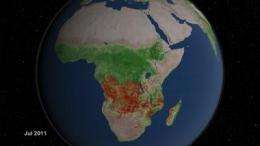
NASA has released a series of new satellite data visualizations that show tens of millions of fires detected worldwide from space since 2002. The visualizations show fire observations made by the MODerate Resolution Imaging Spectroradiometer, or MODIS, instruments onboard NASA's Terra and Aqua satellites.
NASA maintains a comprehensive research program using satellites, aircraft and ground resources to observe and analyze fires around the world. The research helps scientists understand how fire affects our environment on local, regional and global scales.
"What you see here is a very good representation of the satellite data scientists use to understand the global distribution of fires and to determine where and how fire distribution is responding to climate change and population growth," said Chris Justice of the University of Maryland, College Park, a scientist who leads NASA's effort to use MODIS data to study the world's fires.
One of the new visualizations takes viewers on a narrated global tour of fires detected between July 2002 and July 2011. The fire data is combined with satellite views of vegetation and snow cover to show how fires relate to seasonal changes. The Terra and Aqua satellites were launched in 1999 and 2002, respectively.
The tour begins by showing extensive grassland fires spreading across interior Australia and the eucalyptus forests in the northwestern and eastern part of the continent. The tour then shifts to Asia where large numbers of agricultural fires are visible first in China in June 2004, then across a huge swath of Europe and western
Russia in August. It then moves across India and Southeast Asia, through the early part of 2005. The tour continues across Africa, South America, and concludes in North America.
The global fire data show that Africa has more abundant burning than any other continent. MODIS observations have shown that some 70 percent of the world's fires occur in Africa. During a fairly average burning season from July through September 2006, the visualizations show a huge outbreak of savanna fires in Central Africa driven mainly by agricultural activities, but also driven by lightning strikes.
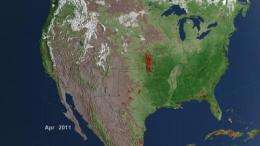
Fires are comparatively rare in North America, making up just 2 percent of the world's burned area each year. The fires that receive the most attention in the United States -- the uncontrolled forest fires in the West -- are less visible than the wave of agricultural fires prominent in the Southeast and along the Mississippi River Valley. Some of the large wildfires that ravaged Texas this year are visible in the animation.
NASA maintains multiple satellite instruments capable of detecting fires and supports a wide range of fire-related research. Such efforts have yielded the most widely used data records of global fire activity and burned area in the world. NASA-supported scientists use the data to advance understanding about Earth's climate system, ecosystem health, and the global carbon cycle.
NASA's Applied Sciences Program seeks out innovative and practical benefits that result from studying fires. For example, the program has found ways to integrate space-based wildfire observations into air quality models used by the U.S. Environmental Protection Agency that help protect public health.
NASA will extend the United States' capability to monitor and study global fires from space with the launch this month of the National Polar-orbiting Operational Environmental Satellite System Preparatory Project. The satellite is the first mission designed to collect data to increase our understanding of long-term climate change and improve weather forecasts.
One of National Polar-orbiting Operational Environmental Satellite System Preparatory Project's new, state-of-the-art science instruments will provide scientists with data to extend the long-term global fires data record. The satellite is targeted to launch from Vandenberg Air Force Base in California on Oct. 28. The mission is managed by NASA's Goddard Space Flight Center in Greenbelt, Md., for the Earth Science Division of the Science Mission Directorate at NASA Headquarters in Washington.
Provided by NASA's Goddard Space Flight Center


