NASA sees large Tropical Storm Banyan stretched over southern Philippines
Oct 11, 2011
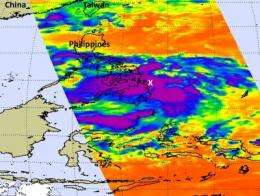
When NASA's Aqua satellite flew over Tropical Storm Banyan (Ramon) on Oct. 11, 2011, at 12:53 EDT, NASA AIRS infrared imagery showed Banyan's strong convection (purple) has strengthened and grown in area. Convection is slightly west of the center (marked with a white "X") which indicates wind shear from the east. Credit: Credit: NASA JPL, Ed Olsen

Tropical Storm Banyan's center may still be at sea, but NASA satellite data today shows the western edge of the storm already over the southern Philippines.

Banyan strengthened overnight into a tropical storm. It was born yesterday, Oct. 10, 2011 as 23W. The Philippines have also given Banyan a name, and call it Ramon.

At 10 a.m. EDT on Oct. 11, Banyan's (Ramon) are near 35 knots (40 mph/65 kmh), and Banyan is moving to the west-northwest near 14 knots (16 km/26 kmh). Banyan's center may 485 miles southeast of Manila, Philippines near 9.2 North and 126.4 East, but clouds already cover the southern Philippines.

When NASA's Aqua satellite flew over Tropical Storm Banyan today, Oct. 11, 2011 at 12:53 EDT (4:53 UTC), the Atmospheric Infrared Sounder (AIRS) instrument measured temperatures in and around the storm. AIRS showed Banyan's convection (rising air that forms thunderstorms that make up the tropical storm) has strengthened and grown in area. Cloud top temperatures exceed the -63F (-52C) threshold for strong convection, mostly in the eastern and western quadrants of the storm. also shows that the convection is slightly off-center - west of the center, which indicates from the east.

Warnings are in effect for a number of areas as heavy rainfall and gusty winds are possible. Public storm warning signal #2 is in effect in the Mindanao provinces of Surigao del Norte and Sur, Siargao Island and Dinagat Island.

Signal #1 is in effect for the Visayas provinces of Southern Leyte and Eastern Samar, and in the Mindanao provinces of Agusan Del Norte and Sur, Misamis Oriental and Camiguin Island; the Visayas provinces of Northern Leyte, Biliran Island, Bohol, Cebu, Northern Negros, Northern & Western Samar, Panay Island and Guimaras Island; and the Luzon provinces of Masbate, Ticao Island, Romblon and Sorsogon.

The Joint Typhoon Warning Center forecasts a landfall by Banyan by 11 p.m. EDT tonight (Oct. 12 at 0300 UTC) over northeastern Mindanao. It is expected to weaken over the Visayan Islands and move into the South China Sea, where warm waters are expected to re-strengthen it.

Explore further: Alaska volcano shoots ash 15,000 feet into the air

add to favorites email to friend print save as pdf

Related Stories

Ыatellite gets two tropical cyclones in one shot

Jun 23, 2011

The Northwestern Pacific Ocean is active with two tropical cyclones today, Tropical Storm Meari near the Philippines, and Tropical Depression Haima moving over China and now toward Vietnam. NASA's Aqua satellite ...

Typhoon Mirinae already raining on the Philippines

Oct 30, 2009

Infrared imagery from NASA's Aqua satellite revealed that Typhoon Mirinae's cold thunderstorm clouds were already over sections of the central and northern Philippines on October 30 at 4:53 p.m. (Asia/Manila) ...

Recommended for you

Alaska volcano shoots ash 15,000 feet into the air

3 hours ago

(AP)—One of Alaska's most restless volcanoes has shot an ash cloud 15,000 feet into the air in an ongoing eruption that has drawn attention from a nearby community but isn't expected to threaten air traffic.

NASA sees Cyclone Mahasen hit Bangladesh

15 hours ago

NASA's Tropical Rainfall Measuring Mission satellite known as TRMM measured Cyclone Mahasen's rainfall rates from space as it made landfall on May 16. Mahasen has since dissipated over eastern India.

Rapid climate change ruled out ice age trees

20 hours ago

Short, sharp fluctuations in the Earth's climate throughout the last ice age may have stopped trees from getting a foothold in Europe and northern Asia, scientists say.

Earth's iron core is surprisingly weak, researchers say

21 hours ago

The massive ball of iron sitting at the center of Earth is not quite as "rock-solid" as has been thought, say two Stanford mineral physicists. By conducting experiments that simulate the immense pressures deep in the planet's ...

User comments : 1

Adjust slider to filter visible comments by rank

Display comments: newest first

Vendicar_Decarian
not rated yet Oct 12, 2011
We can't allow government agencies to be practical and valuable to society.

The only legitimate purpose of government is to wage war.

Defund NASA NOW.

More news stories

Chinese, Indian airlines face EU pollution fines

Eight Chinese and two Indian airlines face fines of up to several million euros for not paying for their greenhouse gas emissions during flights within the bloc, the European Commission said on Friday.

Alaska volcano shoots ash 15,000 feet into the air

(AP)—One of Alaska's most restless volcanoes has shot an ash cloud 15,000 feet into the air in an ongoing eruption that has drawn attention from a nearby community but isn't expected to threaten air traffic.

Bright explosion on the Moon

For the past 8 years, NASA astronomers have been monitoring the Moon for signs of explosions caused by meteoroids hitting the lunar surface. "Lunar meteor showers" have turned out to be more common than anyone ...

Earth's iron core is surprisingly weak, researchers say

The massive ball of iron sitting at the center of Earth is not quite as "rock-solid" as has been thought, say two Stanford mineral physicists. By conducting experiments that simulate the immense pressures deep in the planet's ...

US seizes Bitcoin operator accounts

US authorities seized the accounts of a Bitcoin digital currency exchange operator, claiming it was functioning as an "unlicensed money service business," court documents showed Friday.

Temporal processing in the olfactory system

The neural machinery underlying our olfactory sense continues to be an enigma for neuroscience. A recent review in Neuron seeks to expand traditional ideas about how neurons in the olfactory bulb might encode information about ...