The Murcian flower has been 'revived' after 100 years
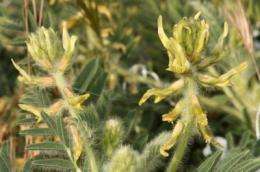
The species of legume known as 'Tallante's chickpea', which has not been seen for nearly a century, has finally been studied in detail. The species is thought to be in critical danger of extinction given that the only known population in the whole world is in Tallante, Murcia (Spain).
A study reveals its characteristics and the reasons as to why the Astragalus nitidiflorus legume, or Tallante's chickpea, remains critically endangered. Researchers wants to restore this floral plant which is unique to the region of Murcia, Spain and, up until recently, was thought to be extinct.
It reappeared in 2003 when a botany fan was riding their bike in the Cabezos de Pericón mountain area in Murcia and spotted a strange species of flower in a field. It was so strange that it has been nearly 100 years since it was last seen.
Juan José Martínez Sánchez, author of the study and researcher at the Polytechnic University of Cartagena (UPCT) says that "Astragalus nitidiflorus is a species that was picked for the first time in 1909 in Cartagena and described by the botanist Carlos Pau in 1910." In his description Pau did not document its exact location and this, along with its rareness, meant that it remained easily unseen for almost a century.
Once this elusive species had been 'revived', the Murcia Region Department of Agriculture funded basic studies on its biology and ecology which were carried out by the UPCT. Martínez explains that "these types of tests are vital for approving a recovery plan."
The study published in Flora brings together the most significant aspects of the plants life cycle: the phenology of flowering and fruiting times, the species' reproductive success and related factors, and the recruitment patterns of new specimens of the population.
According to Martínez Sánchez, "Here we are looking at a small fragmented metapopulation of small groups of individual plants. It is a perennial plant with a short life cycle of four years at most, with three flowering periods which last for at least two or three months."
The resurrection of Tallante's chickpea
In order to assess the possibility of restocking, researchers must pay special attention to the weak points that cause this species to be at risk. According to their report, the most critical part of the life cycle is the seedling stage and mortality rates at this point are very high. Furthermore, the reproductive success of the plant is low.
Martínez Sánchez explains that "the small population size is the main factor that threatens the species because changes in the region's environmental conditions or random demographic variations could cause its disappearance."
However, the researcher outlines that "managing the land where the species grows affects the plant's maintenance and means that it may not expand to outside its potential area. This emphasises the urgency of those studies that are geared towards determining the exact influence that soil management techniques (tilling, grazing, etc.) may have on maintaining the current population."
The Polytechnic University of Cartagena is conducting tests on the reintroduction of individual plants in field with the help of the environmental group ANSE in the hope of drawing up the recovery plans for this species, something that depends on the regional government.
"Knowing every single plant and the role that it plays in the ecosystem shows that any little herb is just as important and relevant as the biggest of trees," claims Martínez Sánchez. "As chinks appear in the ecosystem, it suffers and does not function properly. In this sense, the importance lies in preserving biodiversity as a whole, not as a collection of isolated components."
Provided by FECYT - Spanish Foundation for Science and Technology


