The moon is in the spotlight, or crosshairs, again
October 20, 2011 by Kim Newton
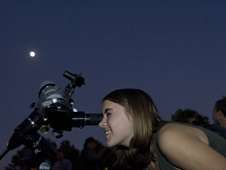
On Saturday, Oct. 8, over 580 International Observe the Moon Night events were held in 54 countries to bring renewed interest to Earth's oldest celestial neighbor. (NASA/MSFC)
On July 20, 1969, millions viewers all over the world gathered around the television to watch as two humans changed history by walking on the surface of the moon. It was an amazing time for space exploration and the moon.
Fast forward 42 years and the moon is back in the spotlight. On Saturday, Oct. 8, observers from more than 54 countries celebrated Earth's oldest neighbor by participating in the second International Observe the Moon Night. More than 580 events were held to raise awareness about the moon and the night sky.
The event, hosted by NASA's Marshall Space Flight Center and the Lunar Quest Program in Huntsville, Ala., was held at the Education Training Facility in Huntsville and drew more than 500 children and adults. Visitors were treated to a number of moon-related educational activities and scientific presentations to build awareness about the brightest object in the night's sky. Participants learned how the moon was formed, more about its numerous craters, how to observe the moon from Earth and about NASA's work in lunar research and exploration.
One of the biggest draws was a cluster of telescopes set up on the lawn staffed by lunar experts who knew how to zero in on the moon's prominent craters that night. Audible gasps were heard from visitors as they exclaimed in amazement at what they saw. "I can't believe it's not completely smooth and round like a bowling ball," said one child. "Look at all those craters! It's amazing," said another.
The clear night sky offered perfect viewing conditions and it almost seemed like the moon turned up its wattage, or reflection, showing off its many craters, hills and rills. Rills are snakelike depressions that wind across many areas of the maria, or dark areas on the surface of the moon.
The moon was definitely bright on Oct. 8, even though it doesn't give off any light of its own. Instead, it reflects light from the sun. Like Earth and the rest of the solar system, the moon is about 4.6 billion years old and Earth's only natural satellite.
The moon put on a visible display that night. Observers remarked about how impressed they were with what they saw and learned at the Observe the Moon event. Many remarked about how they took the moon for granted since it's always visible, even during the daytime, but they seem to never look up.
Many looked at our closest celestial neighbor with a bit more awe after that night. Amazing, it is.
Provided by Marshall Center News Releases
-
From lemons to lemonade: Reaction uses carbon dioxide to make carbon-based semiconductor,
32 comments
-
Thioridazine kills cancer stem cells in human while avoiding toxic side-effects of conventional cancer treatments,
3 comments
-
SpaceX private rocket blasts off for space station (Update),
42 comments
-
Climate scientists say they have solved riddle of rising sea,
31 comments
-
SpaceX capsule has 'new car' smell, astronauts say (Update),
3 comments
-
Distance of planets from stars and revolution
1 hour ago
-
revamping general concept and cosmological principle
May 25, 2012
-
Transiting Exoplanet Light Curve
May 25, 2012
-
Math behind Theoretical Physics
May 24, 2012
-
Do we know whats at the center of galaxies yet?
May 23, 2012
-
Structure of the Milky Way?
May 20, 2012
- More from Physics Forums - General Astronomy
More news stories
Yale study concludes public apathy over climate change unrelated to science literacy
Are members of the public divided about climate change because they don't understand the science behind it? If Americans knew more basic science and were more proficient in technical reasoning, would public consensus match ...
1 hour ago |
not rated yet |
8
|
10 million years needed to recover from mass extinction
It took some 10 million years for Earth to recover from the greatest mass extinction of all time, latest research has revealed.
Space & Earth / Earth Sciences
1 hour ago |
not rated yet |
1
|
Sophisticated simulations predict future warming
The chances of our planet being hit by a global warming of 3 degrees Celsius by 2050 is as likely as it being hit by an increase of 1.4 degrees, new research shows. Presented in the journal Nature Geoscience, the British study ...
Space & Earth / Earth Sciences
May 22, 2012 |
4.4 / 5 (9) |
51
Aliens don't want to eat us, says former SETI director
Alien life probably isnt interested in having us for dinner, enslaving us or laying eggs in our bellies, according to a recent statement by former SETI director Jill Tarter.
Space & Earth / Space Exploration
May 25, 2012 |
4.4 / 5 (14) |
39
Kyoto Protocol architect 'frustrated' by climate dialogue
UN climate talks are going nowhere, as politicians dither or bicker while the pace of warming dangerously speeds up, one of the architects of the Kyoto Protocol told AFP.
May 23, 2012 |
3.7 / 5 (7) |
39
'Unzipped' carbon nanotubes could help energize fuel cells, batteries
Multi-walled carbon nanotubes riddled with defects and impurities on the outside could replace some of the expensive platinum catalysts used in fuel cells and metal-air batteries, according to scientists at ...
T cells 'hunt' parasites like animal predators seek prey, study shows
By pairing an intimate knowledge of immune-system function with a deep understanding of statistical physics, a cross-disciplinary team at the University of Pennsylvania has arrived at a surprising finding: T cells use a movement ...
Computer model used to pinpoint prime materials for efficient carbon capture
When power plants begin capturing their carbon emissions to reduce greenhouse gases and to most in the electric power industry, it's a question of when, not if it will be an expensive undertaking.
Change in developmental timing was crucial in the evolutionary shift from dinosaurs to birds: study
At first glance, it's hard to see how a common house sparrow and a Tyrannosaurus Rex might have anything in common. After all, one is a bird that weighs less than an ounce, and the other is a dinosaur that ...
Same gene that stunts infants' growth also makes them grow too big: research
UCLA geneticists have identified the mutation responsible for IMAGe* syndrome, a rare disorder that stunts infants' growth. The twist? The mutation occurs on the same gene that causes Beckwith-Wiedemann syndrome, which makes ...
Scientists develop ultra-sensitive test that detects diseases in their earliest stages
Scientists have developed an ultra-sensitive test that should enable them to detect signs of a disease in its earliest stages, in research published today in the journal Nature Materials.