Meka's robot head makes eyes at next-wave users (w/ video)
October 14, 2011 by Nancy Owano report

Meka's robot head makes eyes at next-wave users (w/ video)

Enlarge

(PhysOrg.com) -- You've seen robots in the form of alpha dogs and insect swarms capable of military deployments but the next wave of robotics also includes a special breed of "sociable" robots for use in medicine, eldercare, and education. These are the robots that demand scientists’ skills toward making robotic parts that can mimic their human counterparts, and be responsive to social cues.

Small wonder that human heads were turning last month at the IROS (Intelligent Robots and Systems) 2011 event in San Francisco where visitors met the most sociable humanoid head around, attached to a torso and arm assembly. The robot belongs to Professor Luis Sentis of University of Texas at Austin.

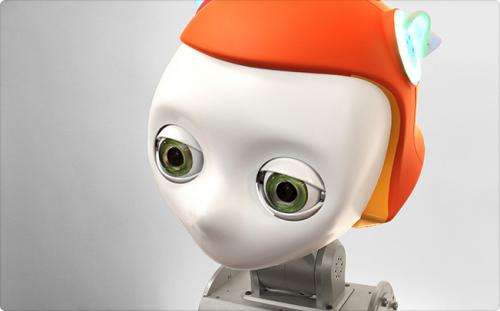
The Meka robot goal was to design a head that can elicit a sense of trust and sociability. In viewing the head, it is difficult not to feel an affinity, even though the head is not at all truly representational of a human head but rather is a curious blend of anime and cartoon character searching for a DreamWorks home.

The head carries much expressiveness and the focal resting points are the engaging eyes. Meka co-founder Aaron Edsinger fielded questions about the robot at the event, and provided technical details: The humanoid head is a seven degree-of-freedom robotic active vision head. Designed for a wide range of expressive postures, it is a useful platform for researchers interested in human-robot interaction and social robotics.

The system features high resolution FireWire cameras in each eye, integrated DSP controllers, zero-backlash Harmonic Drive gearheads in the neck, and Meka M3 and ROS software stacks. When asked why the little ears, he answered, "That was my idea. I had a puppy, so they were inspired by that."

Edsinger also noted that the robot involved the Meka team and the Human Centered Robotics Group at UT Austin. At UT Austin, Professor Luis Sentis is known for his work with force augmentation, which looks into how robots can help to augment the movements of humans. ”We worked closely with Professor Sentis to achieve a friendly anime aesthetic for the overall look, adding two 2DOF ears with RGB lighting for added expressive ability.”

Meka Robotics, in addition to the humanoid head, offers specialized parts--hands, grippers, arms, torsos. The company supports the Willow Garage Robot Operating System (ROS), an open source platform for personal robots, including RVIZ kinematic visualization, URDF descriptions, posture control of all joints, and common sensor interfaces.

Meka is a 2006 spin-off from the MIT Computer Science and Artificial Intelligence Lab, where its founders, Edsinger and Jeff Weber, developed the Domo humanoid . Weber’s work with prosthetic ankles and knees at the MIT Media Lab led to the first commercially available powered prosthetic ankle.

More information: http://mekabot.com/

© 2011 PhysOrg.com

Filter


Move the slider to adjust rank threshold, so that you can hide some of the comments.


Display comments: newest first

HealingMindN
Oct 14, 2011

Rank: 5 / 5 (1)
I don't trust it. Put the robot head from Lexx on it. That's a good reminder that it can't be trusted - not that Disney head.
Jotaf
Oct 14, 2011

Rank: not rated yet
That's really cool. Though for the engineer audience it would be much more interesting to focus on the control mechanisms that allow it to show compliant motion, which is by far the most impressive quality, rather than the more toy-like features, which are not really that new and probably took about 1% of the research effort :)

Come on people!! Your readers are tech-savvy ;)
Rank 5 /5 (2 votes)
Relevant PhysicsForums posts

More news stories

Nvidia trumpets Tegra 3 phone design wins for 2012

(Phys.org) -- Nvidia’s competitive war paint has a name, Tegra 3. On the heels of Nvidia announcements about lowering costs of its Tegra 3 processors and Nvidia-enabled tablets running Android Ice Cream ...

Electronics / Hardware

created 8 hours ago | popularity 5 / 5 (2) | comments 1 | with audio podcast report

Dell tablet leak: 10.1-inch display, two-battery choice

(Phys.org) -- Headline after headline talks about vendors’ tablets in the wings as likely number-one contenders for the iPad. Such claims have justifiably been taken with a grain of salt, considering ...

Electronics / Consumer & Gadgets

created 20 hours ago | popularity 5 / 5 (3) | comments 9 | with audio podcast report

Nvidia says Kai platform will turn price tide for tablets

(Phys.org) -- In March, Nvidia gave some signs that they were working to lower the cost of their Tegra 3 processors and they suggested consumers might see prices for Android tablets as low as $199. Connect ...

Electronics / Hardware

created May 24, 2012 | popularity 4.3 / 5 (4) | comments 3 | with audio podcast report

OmniVision tops up sensors for cameras, phones

(Phys.org) -- OmniVision has announced two high-resolution image sensors for the digital still and digital video camera market (DS/DVC) and higher end smartphones. In end-user language, it is a claim for superior ...

Electronics / Hardware

created May 25, 2012 | popularity 5 / 5 (6) | comments 3 | with audio podcast report

MIT researchers devise new means to synchronize a group of robots (w/ Video)

(Phys.org) -- For several years, roboticists have been working out ways to get a group of robots to perform synchronized activities as demonstrated most often in dance routines. It’s not just about trying ...

Electronics / Robotics

created May 25, 2012 | popularity 5 / 5 (1) | comments 1 | with audio podcast report


Computer model used to pinpoint prime materials for efficient carbon capture

When power plants begin capturing their carbon emissions to reduce greenhouse gases – and to most in the electric power industry, it's a question of when, not if – it will be an expensive undertaking.

'Unzipped' carbon nanotubes could help energize fuel cells, batteries

Multi-walled carbon nanotubes riddled with defects and impurities on the outside could replace some of the expensive platinum catalysts used in fuel cells and metal-air batteries, according to scientists at ...

T cells 'hunt' parasites like animal predators seek prey, study shows

By pairing an intimate knowledge of immune-system function with a deep understanding of statistical physics, a cross-disciplinary team at the University of Pennsylvania has arrived at a surprising finding: T cells use a movement ...

Yale study concludes public apathy over climate change unrelated to science literacy

Are members of the public divided about climate change because they don't understand the science behind it? If Americans knew more basic science and were more proficient in technical reasoning, would public consensus match ...

Same gene that stunts infants' growth also makes them grow too big: research

UCLA geneticists have identified the mutation responsible for IMAGe* syndrome, a rare disorder that stunts infants' growth. The twist? The mutation occurs on the same gene that causes Beckwith-Wiedemann syndrome, which makes ...

Change in developmental timing was crucial in the evolutionary shift from dinosaurs to birds: study

At first glance, it's hard to see how a common house sparrow and a Tyrannosaurus Rex might have anything in common. After all, one is a bird that weighs less than an ounce, and the other is a dinosaur that ...