Mass. schools team up for supercomputer center
(AP) -- At a gritty industrial site occupied a century ago by a textile mill, five universities are collaborating to install supercomputers that will recreate the start of the universe and perform other research.
The developers of the Massachusetts Green High Performance Computing Center, which is being built and is expected to be operating by the end of next year, were drawn to Holyoke for the same reason industrialists flocked to the city in the 19th century: cheap water power from the Connecticut River.
"It's coming full circle for us," said John Goodhue, executive director of the project.
Boston University, Harvard University, the Massachusetts Institute of Technology, Northeastern University and the University of Massachusetts formed the venture to boost academic research in protein structure, fluid flows, the dynamics of the earth's atmosphere, human social interaction, the evolution of the galaxy and other issues. The universities are each spending $10 million, the state of Massachusetts has committed $25 million and technology companies EMC Corp. and Cisco Systems Inc. are contributing $2.5 million apiece.
The universities will pool resources by using the 90,000-square-foot building, which will be larger than anything they could operate on their own, said Jim Kurose, executive associate dean of the College of Natural Sciences at UMass-Amherst.
Only about of dozen employees will work at the computing center, with the bulk of the research being done remotely from the campuses. The people who work at the center will include administrators responsible for finances and use of the center, security personnel and employees who oversee the building's operations and grounds.
With no employment boom at the computing center, Holyoke officials and its promoters say the center's real attraction for the area will be its ability to draw research companies and other businesses looking to establish a high-tech footprint in western Massachusetts.
"It's a catalyst for future development for people who want to be around researchers," said Kathleen Anderson, Holyoke's director of planning and economic development.
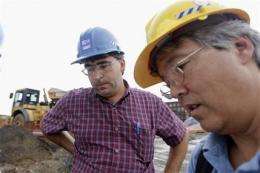
The nearly 9-acre site that will house the supercomputing center is now a construction zone with open pits, a stream of heavy equipment and piles of bricks that once formed the walls of the mill and will be used as fill. Signs of Holyoke's past are evident everywhere - in the obvious, such as a wire manufacturing plant nearby - or harder to see, a crumbling tar surface that exposes early 20th-century brick beneath.
"The cobblestone is holding up much better than the blacktop," Kurose said as he entered the construction in late August.
City officials and others are trying to reclaim Holyoke's history as an industrial powerhouse in the 19th century and early 20th century that drew top entrepreneurs and immigrants seeking work. It suffered "some disinvestment over the years" as paper manufacturers left, Anderson said. And many mills changed hands, were retooled for new types of business or shut down.
Holyoke's backers have high hopes for a modern resurgence. They're using waste heat from the center's computers for greenhouse and building heating systems and capitalizing on a proposed high-speed rail line to draw more business.
John Aubin is one of Holyoke's more passionate supporters. The owner and developer of Open Square, a residential and commercial center in what was Holyoke's first mill, said the computing center being built in his neighborhood will be a boon to Holyoke. The city's proximity to the University of Massachusetts at Amherst and Mount Holyoke College in South Hadley guarantees a well-educated work force, he said.
"There's a tremendous pool of talent in western Massachusetts, and Holyoke is the geographic center of western Massachusetts," he said.
Holyoke's hydropower generated by the falls over Connecticut River's 57-foot drop is a strong attraction, say Goodhue and others involved in planning the computing center, which has a generator on site that draws water power from a canal more than 100 years old. Holyoke's water power accounts for about two-thirds of locally generated electricity.
The relatively cheap electricity is particularly important for the computing center, which is expected to be able to use at any time up to 15 megawatts, the equivalent of powering as many as 15,000 homes.
The center helps meet a growing a demand for more powerful computers to do wider-ranging research, said Thom Dunning, director of the National Center for Supercomputing Applications at the University of Illinois.
"The driver is the complexity of scientific problems we're encountering," he said.
He cited molecular-level research, weather and climate change and health issues such as viruses and how infectious diseases affect populations. For example, researchers in Los Angeles are using a supercomputer to model the impact of an earthquake to help the city prepare for one, Dunning said.
In addition, rapidly increasing computing power "opens a whole new range of problems" that could not be solved by previous generations of computers, he said.
Goodhue said the Holyoke computing center is intended to capitalize on the "real tectonic shift" in the amount of computing power available for academic research.
"The use of machines has exploded on campus," he said. "We need a more cost-effective way to house this."
©2011 The Associated Press. All rights reserved. This material may not be published, broadcast, rewritten or redistributed.


