Tests to catch the makers of dangerous 'legal high' designer drugs
Oct 13, 2011
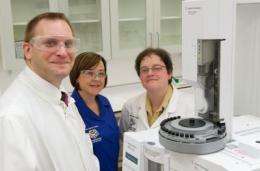
The photograph shows, left to right: Professor Oliver Sutcliffe; Dr Katy Savage; Professor Niamh Nic Daeid. Credit: Image courtesy of University of Strathclyde

Urgently needed tests which could help identify the manufacturers of designer 'legal high' drugs are being developed in research led at the University of Strathclyde in Glasgow.

The drugs, known by names such as 'ivory wave' and NRG-1" and sold labelled as , and incense, mimic the effects of illegal drugs such as , cocaine and ecstasy. Although these so-called 'designer drugs' can be dangerous, many have not yet been made illegal and are difficult to detect with current drug tests.

A means of potentially tracing the source of the raw materials, and consequently providing information as to who is making the 'bath salts,' is being developed by scientists at Strathclyde and The James Hutton Institute.

The bath salts drug can cause euphoria, paranoia, anxiety and . It often contains mephedrone, a structurally related to methcathinone, which is found in Khat - a plant which, like mephedrone itself, is illegal in many countries.

The bath salts drug is labelled as being not for human consumption and is not illegal in the UK but its import has been banned. The term 'bath salts' is used by those who sell the drug as a way of circumventing legislation when supplying it.

The researchers developing tests for the drug are using a technique known as isotope ratio mass spectrometry (IRMS) to reveal the course of a drug's manufacture.

The research is being carried out by Dr Oliver Sutcliffe, at the Strathclyde Institute of Pharmacy and Biomedical Sciences, and Professor Niamh Nic Daeid and Dr Katy Savage at the Centre for in the Department of Pure and Applied Chemistry, in collaboration with Dr Wolfram Meier-Augenstein at The James Hutton Institute.

Dr Sutcliffe said: "The legal status of varies around the world but they present many dangers to users and these are borne out by the Home Office's decision to ban the import of 'bath salts.'

"The new method we have used has enabled us to work backwards and trace the substances back to their starting materials. IRMS measures the relative amounts of an element's different forms- it is successful because these relative amounts are transferred like a fingerprint through the synthesis of the drug."

Explore further: Reading the unreadable

Provided by University of Strathclyde

not rated yet
add to favorites email to friend print save as pdf

Related Stories

White House warns of 'bath salt' stimulants

Feb 02, 2011

President Barack Obama's drug czar warned Americans Tuesday about the growing threat of designer drugs marketed as "bath salts" that are in fact dangerous amphetamine-type stimulants.

Buying 'legal highs' from the Internet is a risky business

May 20, 2011

Many drugs sold as 'legal highs' on the internet do not contain the ingredients they claim. Some instead contain controlled substances and are illegal to sell over the internet. These are findings of Dr. Mark Baron, who bought ...

EU wants ban on killer drug suspect 'meow meow'

Oct 20, 2010

The European Commission Wednesday called for a ban on suspected killer drug mephedrone, a popular ecstasy-like party drug known as "meow meow", sold on the Internet and available in 12 EU nations.

Officials: 'Bath salts' are growing drug problem

Jan 23, 2011

(AP) -- When Neil Brown got high on dangerous chemicals sold as bath salts, he took his skinning knife and slit his face and stomach repeatedly. Brown survived, but authorities say others haven't been so ...

Recommended for you

Attacking MRSA with metals from antibacterial clays

May 17, 2013

In the race to protect society from infectious microbes, the bugs are outrunning us. The need for new therapeutic agents is acute, given the emergence of novel pathogens as well as old foes bearing heightened antibiotic resistance.

Beautiful 'flowers' self-assemble in a beaker

May 16, 2013

By simply manipulating chemical gradients in a beaker of fluid, materials scientists at Harvard have found that they can control the growth behavior of crystals to create precisely tailored structures—such ...

Reading the unreadable

May 16, 2013

Pioneering X-ray technology is making it possible to read fragile rolled-up historical documents for the first time in centuries.

Keeping fruit, vegetables and cut flowers fresh longer

May 15, 2013

New technology offers the promise of reducing billions of dollars of losses that occur each year from the silent, invisible killer of fruits, vegetables and cut flowers—a gas whose effects are familiar to everyone who has ...

User comments : 1

Adjust slider to filter visible comments by rank

Display comments: newest first

that_guy
not rated yet Oct 13, 2011
So the government of britain, which bans imports of these "bath salts" wants to be able to test which manufacturer made which bath salt, after the fact?

Look, you (should) already know who makes which brands. They're all basically the same thing. What does it matter if idiot A died from brand 1 or brand 2?

If you don't know who is making the bath salts at all, then you've got bigger problems - it means your entire beauracracy doesn't know its head from its ass.

This seems to be an unnecesarily expensive splicing of an all or nothing issue. Either ban the offending substances or don't.

More news stories

Attacking MRSA with metals from antibacterial clays

In the race to protect society from infectious microbes, the bugs are outrunning us. The need for new therapeutic agents is acute, given the emergence of novel pathogens as well as old foes bearing heightened antibiotic resistance.

Beautiful 'flowers' self-assemble in a beaker

By simply manipulating chemical gradients in a beaker of fluid, materials scientists at Harvard have found that they can control the growth behavior of crystals to create precisely tailored structures—such ...

Making gold green: New non-toxic method for mining gold

Northwestern University scientists have struck gold in the laboratory. They have discovered an inexpensive and environmentally benign method that uses simple cornstarch—instead of cyanide—to isolate gold from raw materials ...

US seizes Bitcoin operator accounts

US authorities seized the accounts of a Bitcoin digital currency exchange operator, claiming it was functioning as an "unlicensed money service business," court documents showed Friday.

Morocco to harness the wind in energy hunt

Morocco is ploughing ahead with a programme to boost wind energy production, particularly in the southern Tarfaya region, where Africa's largest wind farm is set to open in 2014.