'Thinking machines' will run future power grids
October 13, 2011

'Thinking machines' will run future power grids

Enlarge

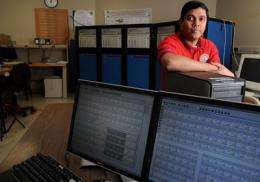
Dr. Ganesh Kumar Venayagamoorthy in his Real-Time Power and Intelligent Systems Lab at Missouri S&T

(PhysOrg.com) -- Plans to develop the "smart" grid - a system that uses intelligent computer networks to manage electric power - cannot succeed without the creation of new "thinking machines" that can learn and adapt to new situations, from power outages along the grid to fluctuations in the power supply. So says Dr. Ganesh Kumar Venayagamoorthy, a power engineering expert at Missouri University of Science and Technology, in an article published Wednesday, Oct. 12, 2011.

These new machines must take on almost human-like intelligent characteristics, such as the ability to make decisions, adapt to unfamiliar situations, learn from changes in their environments and make sense of how all of the electricity flows through the nation's , says Venayagamoorthy, a professor of electrical and at Missouri S&T.

"And those capabilities, in turn, will depend on subsystems that continuously improve their knowledge of grid dynamics, and not just gather data," Venayagamoorthy says in an article published in the latest issue of IEEE's Smart Grid newsletter, published online today.

In his article, Future Grids Will Not Be Controllable Without Thinking Machines, Venayagamoorthy examines the current state of computational intelligence - a field of computing that deals with creating systems that can make decisions "in complex, uncertain and changing environments" - and discusses that field's potential to give rise to what he calls "computational systems thinking machines," or CSTMs.

Venayagamoorthy says these machines will arise from research in two fields of computing: Computational intelligence (CI) and adaptive critic designs (ACDs).

"The research is already well under way" to support the development of thinking machines, he says. "As the smart grid evolves over time, and as we become more dependent on intermittent sources of energy such as wind and solar , we will see that traditional technology will not work."

Computational intelligence is the successor to artificial intelligence "and the way forward in future computing," Venayagamoorthy writes. Adaptive critic designs are based on "a teacher-student framework" in which one part of a computer network (the student) learns from another.

Such a computational systems thinking machine would be capable of managing complex power systems, Venayagamoorthy says. "Several research studies have reported using CI-based technologies to dynamically forecast wind and solar power, monitor voltage stability, and assess real-time stability" of power systems, he writes.

"In combination, CI and ACD technologies can provide a with capabilities for dynamic foresight, sense-making, situational awareness, rapid adaptation, fault-tolerance and robustness," Venayagamoorthy writes. For example, when the demand for is low, a thinking machine should be able to dispatch power from wind farms to storage units that can store the excess power for later use.

Venayagamoorthy is the founder of Missouri S&T's Real-Time Power and Intelligent Systems Laboratory and a principal investigator in the Brain2Grid project, an effort funded through the National Science Foundation's Office of Emerging Frontiers in Research and Innovation.

Through the Brain2Grid project, Venayagamoorthy is exploring the use living neural networks composed of thousands of brain cells from laboratory rats to control simulated power grids in the lab. From those studies, he hopes to create a "biologically inspired" computer program to manage and control complex power grids in Mexico, Brazil and elsewhere.

Venayagamoorthy is also a senior member of IEEE, the electrical engineering professional society.

Provided by Missouri University of Science and Technology search and more info website

Filter


Move the slider to adjust rank threshold, so that you can hide some of the comments.


Display comments: newest first

Isaacsname
Oct 13, 2011

Rank: 5 / 5 (1)
Maybe designing appliances to not draw phantom loads would be a good start ?
knikiy
Oct 14, 2011

Rank: not rated yet
Also, education in "developed" countries about wasteful practices and conservation.
Rank 5 /5 (5 votes)
Relevant PhysicsForums posts

More news stories

Browser wars flare in mobile space

The browser wars are heating up again, but this time the fight is for dominance of the mobile Internet.

Technology / Software

created 8 hours ago | popularity 5 / 5 (1) | comments 3

Probability of contamination from severe nuclear reactor accidents is higher than expected: study

Catastrophic nuclear accidents such as the core meltdowns in Chernobyl and Fukushima are more likely to happen than previously assumed. Based on the operating hours of all civil nuclear reactors and the number ...

Technology / Energy & Green Tech

created May 22, 2012 | popularity 3.6 / 5 (22) | comments 56 | with audio podcast

SpotterRF debuts Radar Backpack Kit (w/ Video)

(Phys.org) -- SpotterRF has announced a special radar backpack kit designed to enhance situational awareness for soldiers on the ground. The company says its special radar is designed for warfighters as part ...

Technology / Hi Tech & Innovation

created May 26, 2012 | popularity 5 / 5 (5) | comments 13 | with audio podcast report

HyperSolar shows dirty water no barrier to power world

(Phys.org) -- The Santa Barbara, California, company, HyperSolar, is set to transparently share the ups and downs of its research experiences toward the company’s ultimate vision, successfully producing ...

Technology / Energy & Green Tech

created May 24, 2012 | popularity 4.8 / 5 (16) | comments 17 | with audio podcast report

Tesla to launch electric sedan in US on June 22

Tesla Motors said Tuesday it would begin deliveries of "the world's first premium electric sedan" on June 22, slightly ahead of schedule.

Technology / Energy & Green Tech

created May 22, 2012 | popularity 4.5 / 5 (12) | comments 18


Computer model used to pinpoint prime materials for efficient carbon capture

When power plants begin capturing their carbon emissions to reduce greenhouse gases – and to most in the electric power industry, it's a question of when, not if – it will be an expensive undertaking.

'Unzipped' carbon nanotubes could help energize fuel cells, batteries

Multi-walled carbon nanotubes riddled with defects and impurities on the outside could replace some of the expensive platinum catalysts used in fuel cells and metal-air batteries, according to scientists at ...

T cells 'hunt' parasites like animal predators seek prey, study shows

By pairing an intimate knowledge of immune-system function with a deep understanding of statistical physics, a cross-disciplinary team at the University of Pennsylvania has arrived at a surprising finding: T cells use a movement ...

Yale study concludes public apathy over climate change unrelated to science literacy

Are members of the public divided about climate change because they don't understand the science behind it? If Americans knew more basic science and were more proficient in technical reasoning, would public consensus match ...

Same gene that stunts infants' growth also makes them grow too big: research

UCLA geneticists have identified the mutation responsible for IMAGe* syndrome, a rare disorder that stunts infants' growth. The twist? The mutation occurs on the same gene that causes Beckwith-Wiedemann syndrome, which makes ...

Change in developmental timing was crucial in the evolutionary shift from dinosaurs to birds: study

At first glance, it's hard to see how a common house sparrow and a Tyrannosaurus Rex might have anything in common. After all, one is a bird that weighs less than an ounce, and the other is a dinosaur that ...