Killer whales migrate, study finds, but why?
October 25, 2011 by Marlowe Hood
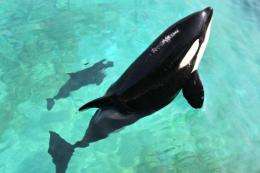
Some killer whales, a study published Wednesday shows for the first time, wander nearly 10,000 kilometres (6,200 miles) from Antarctica's Southern Ocean into tropical waters -- but not to feed or breed.
Rather, these fearsome predators at the apex of the marine food chain traverse the sea at top speed -- slowing as they reach warmer climes -- to exfoliate, the study speculates.
They are driven, in other words, by the urge or need to make their skin all shiny and new.
Despite our intense fascination with seal-chomping orcas, next to nothing was known about their long-haul movements, or whether they migrate at all.
To find out more, John Durban and Robert Pitman of the US National Marine Fisheries Service fitted a dozen so-called "type B" killer whales off the west coast of the Antarctic Peninsula with satellite transmitters.
In January 2009, the scientists used bolt-shooting crossbows to attached tags to the five-tonne mammals' dorsal fins from a distance of five to 15 metres (15 to 50 feet).
"Type B" orcas inhabit the inshore waters of Antarctica near pack ice, the better to feed on seals and penguins. Type A killer whales prefer open water and a diet of minke whales, and the smaller, fish-eating type C is most common in the eastern Antarctic.
Half the satellite tags stopped working after three weeks, but the remaining six revealed a remarkable and unexpected wanderlust over the following two years.
"Our tagged whales followed the most direct path to the nearest warm waters north of the subtropical convergence, with a gradual slowing of swim speed in progressively warmer water," the authors note.
The whales made a beeline, cruising at up to 10 km/hr (six mph), across the southwest Atlantic east of the Falkland Islands to the subtropical waters off the coasts of Uruguay and southern Brazil.
The study, published in the British Royal Society's journal Biology Letters, provides the first direct evidence of long-distance migration by killer whales.
But why they do it remains something of a mystery.
The speed and duration of the voyages, undertaken individually, did not leave enough time for prolonged foraging, and would have been too demanding for a new-born calf.
"Remarkably, one whale returned to Antarctica after completing a 9,400 kilometre (5,840 mile) trip in just 42 days," the study said.
The varied departure dates, between early February and late April, also suggested these expeditions were not annual migrations for feeding or breeding.
Which is where skin comes into the picture.
Durban and Pitman suspect that killer whales move into warmer waters in order to shed a layer -- along with an encrustation of single-celled algae called diatoms -- without freezing to death.
Orcas are the smallest cetaceans -- a group including whales and dolphins -- which live for extended periods in subzero Antarctic waters. Replacing and repairing outer skin in waters where the surface temperature is minus 1.9 degree Celsius (28.6 degree Fahrenheit) may be dangerous, even lethal.
Surface temperatures at the killer whales' tropical destinations, by contrast, were a balmy 20.9 to 24.2 C (69.6 to 75.6 F).
"We hypothesise that these migrations were thermally motivated," the authors conclude.
Killer whales (Orcinus orca) are the most widely distributed cetacean -- and perhaps mammal species -- in the world.
(c) 2011 AFP
-
From lemons to lemonade: Reaction uses carbon dioxide to make carbon-based semiconductor,
32 comments
-
Thioridazine kills cancer stem cells in human while avoiding toxic side-effects of conventional cancer treatments,
3 comments
-
SpaceX private rocket blasts off for space station (Update),
42 comments
-
Climate scientists say they have solved riddle of rising sea,
31 comments
-
SpaceX capsule has 'new car' smell, astronauts say (Update),
4 comments
-
What would stain as translucent on light-coloured fabric?
23 hours ago
-
How do I identify different bacteria on culture plates?
May 26, 2012
-
Why Do Dogs do Strange things...
May 25, 2012
-
What does exophillic and endophillic mean in terms of mosquito and their control?
May 24, 2012
-
Semen stains glows under black lights (uv light)?
May 23, 2012
-
Question on Human Chromosome 2
May 23, 2012
- More from Physics Forums - Biology
More news stories
Scientist: Evolution debate will soon be history
(AP) -- Richard Leakey predicts skepticism over evolution will soon be history. Not that the avowed atheist has any doubts himself.
22 hours ago |
3.5 / 5 (20) |
86
Manufacturing genes to attack flu virus
An international research team has manufactured a new protein that can combat deadly flu epidemics.
4 hours ago |
not rated yet |
0
|
More plant species responding to global warming than previously thought
(Phys.org) -- Far more wild plant species may be responding to global warming than previous large-scale estimates have suggested.
May 22, 2012 |
4.6 / 5 (14) |
18
|
Thousands of shellfish found dead in Peru
Thousands of crustaceans were found dead off the coast of Lima following the mystery mass death of dolphins and pelicans, the Peruvian Navy said Friday.
May 26, 2012 |
4.7 / 5 (6) |
7
For monogamous sparrows, it doesn't pay to stray (but they do it anyway)
It's quite common for a female song sparrow to stray from her breeding partner and mate with the male next door, but a new study shows that sleeping around can be costly.
May 22, 2012 |
5 / 5 (2) |
8
|
Land and sea species differ in climate change response: study
(Phys.org) -- Marine and terrestrial species will likely differ in their responses to climate warming, new research by Simon Fraser University and Australia’s University of Tasmania has found.
'Unzipped' carbon nanotubes could help energize fuel cells, batteries
Multi-walled carbon nanotubes riddled with defects and impurities on the outside could replace some of the expensive platinum catalysts used in fuel cells and metal-air batteries, according to scientists at ...
T cells 'hunt' parasites like animal predators seek prey, study shows
By pairing an intimate knowledge of immune-system function with a deep understanding of statistical physics, a cross-disciplinary team at the University of Pennsylvania has arrived at a surprising finding: T cells use a movement ...
Computer model used to pinpoint prime materials for efficient carbon capture
When power plants begin capturing their carbon emissions to reduce greenhouse gases and to most in the electric power industry, it's a question of when, not if it will be an expensive undertaking.
Change in developmental timing was crucial in the evolutionary shift from dinosaurs to birds: study
At first glance, it's hard to see how a common house sparrow and a Tyrannosaurus Rex might have anything in common. After all, one is a bird that weighs less than an ounce, and the other is a dinosaur that ...
Nvidia trumpets Tegra 3 phone design wins for 2012
(Phys.org) -- Nvidias competitive war paint has a name, Tegra 3. On the heels of Nvidia announcements about lowering costs of its Tegra 3 processors and Nvidia-enabled tablets running Android Ice Cream ...
Oct 25, 2011
Rank: 5 / 5 (2)
Oct 26, 2011
Rank: not rated yet