Among insects, 'chivalry' isn't dead (w/ video)
October 6, 2011

Is chivalry the norm for insects?

Enlarge

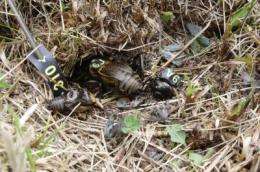
This image shows a female field cricket at the entrance of her burrow with the remains of her former partner after he was predated. Credit: University of Exeter

Some male crickets will apparently put the lives of their mating partners ahead of their own. When a mated pair is out together, a male will allow a female priority access to the safety of a burrow, even though it means a dramatic increase in his own risk of being eaten. That's according to infrared video observations of a wild population of field crickets (Gryllus campestris) reported online on October 6 the Cell Press journal Current Biology.

"Many people probably think that 'chivalrous' behavior is exclusive of humans or closely related , linking it in some way to education, , or ," said Rolando Rodríguez-Muñoz of the University of Exeter. "We show that even males of small insects, which we would not define as intelligent or affective, can be 'chivalrous' or protective with their partners. Perhaps it shines a light on the fact that apparently chivalrous acts may have ulterior motives. Did Sir Walter Raleigh throw his cape onto a muddy pool in front of Queen Elizabeth just because he was a nice guy? I think not."

The results are contrary to the usual interpretation of male guarding behavior as an attempt to manipulate females and prevent them from mating with rivals. However, the male crickets in this case are rewarded for their risky behavior, as their extended stays with females win them more offspring. Still, the new findings suggest that conflict between the sexes is not inevitable, the researchers say.

This video is not supported by your browser at this time.

Some male crickets will apparently put the lives of their mating partners ahead of their own. When a mated pair is out together, a male will allow a female priority access to the safety of a burrow, even though it means a dramatic increase in his own risk of being eaten. That's according to infrared video observations of a wild population of field crickets (Gryllus campestris) reported online on Oct. 6 the Cell Press journal Current Biology. Credit: Current Biology, Cell Press Rodríguez-Muņoz et al.

Most previous studies of cricket mating behavior had been conducted in the lab. Those findings had led researchers to conclude that male crickets coerce females into remaining with them to prevent the removal of their spermatophore (a small package of sperm that males insert into females) or to keep the female from mating with other males.

In the new study, Rodríguez-Muñoz, Amanda Bretman, and Tom Tregenza watched what happens in the wild as field crickets live their lives by marking and genotyping individual insects. They found that lone female and male crickets suffer similar rates of predation, but when a pair is attacked, the female's chances of survival increase as the male's chances drop. In compensation for their increased predation risk, paired males mate more frequently and father more of their partner's offspring.

Tregenza said males do tend to stay farther away from burrows when females are around, but that didn't seem to be enough to explain the findings. "It looks like males really wait until a female is under cover before getting themselves to safety," he said. "Guarding seems to be their top priority."

In effect, the male trade a longer life span for greater success in fathering offspring with each of their partners. The researchers suspect that the degree of chivalrous behavior among should vary depending on factors such as the size of the cricket and predator populations.

"We are looking forward to seeing whether chivalry prevails in future generations," Rodríguez-Muñoz said, noting that the current study is based on three consecutive mating seasons. "There may be some years when both sexes behave in a more obviously selfish fashion and attempt to escape down the burrow first."

Provided by Cell Press search and more info website


Rank not rated yet
Relevant PhysicsForums posts

More news stories

Scientist: Evolution debate will soon be history

(AP) -- Richard Leakey predicts skepticism over evolution will soon be history. Not that the avowed atheist has any doubts himself.

Biology / Evolution

created 22 hours ago | popularity 3.5 / 5 (20) | comments 86

Manufacturing genes to attack flu virus

An international research team has manufactured a new protein that can combat deadly flu epidemics.

Biology / Biotechnology

created 4 hours ago | popularity not rated yet | comments 0 | with audio podcast

More plant species responding to global warming than previously thought

(Phys.org) -- Far more wild plant species may be responding to global warming than previous large-scale estimates have suggested.

Biology / Ecology

created May 22, 2012 | popularity 4.6 / 5 (14) | comments 18 | with audio podcast

Thousands of shellfish found dead in Peru

Thousands of crustaceans were found dead off the coast of Lima following the mystery mass death of dolphins and pelicans, the Peruvian Navy said Friday.

Biology / Ecology

created May 26, 2012 | popularity 4.7 / 5 (6) | comments 7

For monogamous sparrows, it doesn't pay to stray (but they do it anyway)

It's quite common for a female song sparrow to stray from her breeding partner and mate with the male next door, but a new study shows that sleeping around can be costly.

Biology / Plants & Animals

created May 22, 2012 | popularity 5 / 5 (2) | comments 8 | with audio podcast


Land and sea species differ in climate change response: study

(Phys.org) -- Marine and terrestrial species will likely differ in their responses to climate warming, new research by Simon Fraser University and Australia’s University of Tasmania has found.

'Unzipped' carbon nanotubes could help energize fuel cells, batteries

Multi-walled carbon nanotubes riddled with defects and impurities on the outside could replace some of the expensive platinum catalysts used in fuel cells and metal-air batteries, according to scientists at ...

T cells 'hunt' parasites like animal predators seek prey, study shows

By pairing an intimate knowledge of immune-system function with a deep understanding of statistical physics, a cross-disciplinary team at the University of Pennsylvania has arrived at a surprising finding: T cells use a movement ...

Computer model used to pinpoint prime materials for efficient carbon capture

When power plants begin capturing their carbon emissions to reduce greenhouse gases – and to most in the electric power industry, it's a question of when, not if – it will be an expensive undertaking.

Change in developmental timing was crucial in the evolutionary shift from dinosaurs to birds: study

At first glance, it's hard to see how a common house sparrow and a Tyrannosaurus Rex might have anything in common. After all, one is a bird that weighs less than an ounce, and the other is a dinosaur that ...

Nvidia trumpets Tegra 3 phone design wins for 2012

(Phys.org) -- Nvidia’s competitive war paint has a name, Tegra 3. On the heels of Nvidia announcements about lowering costs of its Tegra 3 processors and Nvidia-enabled tablets running Android Ice Cream ...