Kicking hybrids out of carpool lanes backfires, slowing traffic for all
October 11, 2011 By Sarah Yang
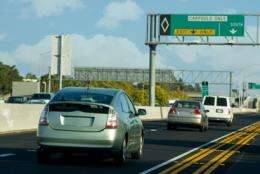
UC Berkeley transportation researchers found that after single-occupant hybrids got kicked out of the carpool lanes, traffic slowed for everyone.
(PhysOrg.com) -- The end of a California program granting free access to carpool lanes by solo drivers of hybrid cars has unintentionally slowed traffic in all lanes, according to transportation engineers at the University of California, Berkeley.
The program, which began in 2005 and ended on July 1, gave consumers an extra incentive to buy low-emission cars. By 2011, some 85,000 low-emission vehicles had gotten the coveted yellow stickers that gave them entry into the carpool lanes, but critics of the perk argued that solo drivers of hybrid cars were clogging up the lanes for carpoolers.
Researchers at UC Berkeleys Institute of Transportation Studies (ITS) used traffic flow theories and six months of data from roadway sensors measuring speed and congestion along all freeway carpool lanes in the San Francisco Bay Area. They used the information to predict the impact on vehicle speed of the hybrids removal from carpool lanes. Additional data collected after the programs July 1 expiration supported their predictions.
Michael Cassidy, UC Berkeley professor of civil and environmental engineering, and Kitae Jang, a doctoral student in civil and environmental engineering, presented their analysis in a new report released by ITS.
Our results show that everybody is worse off with the programs ending, said Cassidy. Drivers of low-emission vehicles are worse off, drivers in the regular lanes are worse off, and drivers in the carpool lanes are worse off. Nobody wins.
A carpool lane along a four-mile stretch of I-880 in Hayward, for instance, saw a 15 percent reduction in speed after single-occupant hybrids were expelled after July 1.
The counterintuitive results reflect dual and opposing influences on traffic speed in the carpool lanes, the researchers explained. One factor is the presence of additional cars, including hybrids, which slow down traffic. One might think that moving vehicles out would allow the remaining cars in the lane to go faster.
But the data show that traffic speed in the carpool lane is also influenced by the speed of the adjacent lanes. Moving the hybrids into the neighboring lanes increases congestion in those lanes, which in turn slows down the carpoolers.
As vehicles move out of the carpool lane and into a regular lane, they have to slow down to match the speed of the congested lane, explained Jang. Likewise, as cars from a slow-moving regular lane try to slip into a carpool lane, they can take time to pick up speed, which also slows down the carpool lane vehicles.
Human nature likely plays a role, too, the researchers said. Drivers probably feel nervous going 70 miles per hour next to lanes where traffic is stopped or crawling along at 10 or 20 miles per hour, said Cassidy. Carpoolers may slow down for fear that a regular-lane car might suddenly enter their lane.
Currently, the only single-occupancy vehicles allowed in Californias carpool lanes are federally approved Inherently Low Emission Vehicles, or ILEVs, such as hydrogen fuel cell, 100 percent battery electric, and compressed natural gas vehicles with white clean air vehicle stickers. According to the California Air Resources Board, only 14,000 vehicles in the state have qualified thus far.
A new program, pending federal approval next January, will allow 40,000 super-clean plug-in-hybrids or hydrogen-powered internal combustion engine vehicles to claim green clean air vehicle stickers and enter carpool lanes.
But the researchers predict that this will not be enough. They argue that freeway traffic conditions will improve for everyone by increasing, not decreasing, the numbers allowed access to carpool lanes.
I think we need to start managing carpool facilities in a smarter way, and letting those hybrids back in the carpool lane would be a good first step, said Cassidy. And given the way that regular-lane speeds influence carpool lanes, added efforts to alleviate congestion in regular lanes could benefit all drivers.
Provided by
University of California - Berkeley
-
From lemons to lemonade: Reaction uses carbon dioxide to make carbon-based semiconductor,
32 comments
-
Thioridazine kills cancer stem cells in human while avoiding toxic side-effects of conventional cancer treatments,
3 comments
-
SpaceX private rocket blasts off for space station (Update),
42 comments
-
Climate scientists say they have solved riddle of rising sea,
31 comments
-
SpaceX capsule has 'new car' smell, astronauts say (Update),
4 comments
-
Need a rigid insulation material???
18 hours ago
-
magnets or EMF in car bumpers to protect from fender bender
May 26, 2012
-
length of wire in a coil of known dimensions?
May 25, 2012
-
India Engineering Powerhouse
May 25, 2012
-
electromagnet core dereference between hard and soft iron
May 25, 2012
-
Measuring water pressure in an open tank
May 24, 2012
- More from Physics Forums - General Engineering
More news stories
Browser wars flare in mobile space
The browser wars are heating up again, but this time the fight is for dominance of the mobile Internet.
11 hours ago |
5 / 5 (1) |
3
Probability of contamination from severe nuclear reactor accidents is higher than expected: study
Catastrophic nuclear accidents such as the core meltdowns in Chernobyl and Fukushima are more likely to happen than previously assumed. Based on the operating hours of all civil nuclear reactors and the number ...
Technology / Energy & Green Tech
May 22, 2012 |
3.6 / 5 (22) |
56
|
HyperSolar shows dirty water no barrier to power world
(Phys.org) -- The Santa Barbara, California, company, HyperSolar, is set to transparently share the ups and downs of its research experiences toward the companys ultimate vision, successfully producing ...
SpotterRF debuts Radar Backpack Kit (w/ Video)
(Phys.org) -- SpotterRF has announced a special radar backpack kit designed to enhance situational awareness for soldiers on the ground. The company says its special radar is designed for warfighters as part ...
Tesla to launch electric sedan in US on June 22
Tesla Motors said Tuesday it would begin deliveries of "the world's first premium electric sedan" on June 22, slightly ahead of schedule.
Technology / Energy & Green Tech
May 22, 2012 |
4.5 / 5 (12) |
18
Land and sea species differ in climate change response: study
(Phys.org) -- Marine and terrestrial species will likely differ in their responses to climate warming, new research by Simon Fraser University and Australia’s University of Tasmania has found.
'Unzipped' carbon nanotubes could help energize fuel cells, batteries
Multi-walled carbon nanotubes riddled with defects and impurities on the outside could replace some of the expensive platinum catalysts used in fuel cells and metal-air batteries, according to scientists at ...
T cells 'hunt' parasites like animal predators seek prey, study shows
By pairing an intimate knowledge of immune-system function with a deep understanding of statistical physics, a cross-disciplinary team at the University of Pennsylvania has arrived at a surprising finding: T cells use a movement ...
Computer model used to pinpoint prime materials for efficient carbon capture
When power plants begin capturing their carbon emissions to reduce greenhouse gases and to most in the electric power industry, it's a question of when, not if it will be an expensive undertaking.
Change in developmental timing was crucial in the evolutionary shift from dinosaurs to birds: study
At first glance, it's hard to see how a common house sparrow and a Tyrannosaurus Rex might have anything in common. After all, one is a bird that weighs less than an ounce, and the other is a dinosaur that ...
Nvidia trumpets Tegra 3 phone design wins for 2012
(Phys.org) -- Nvidias competitive war paint has a name, Tegra 3. On the heels of Nvidia announcements about lowering costs of its Tegra 3 processors and Nvidia-enabled tablets running Android Ice Cream ...
Oct 11, 2011
Rank: not rated yet
Oct 11, 2011
Rank: not rated yet
Oct 12, 2011
Rank: not rated yet
Oct 13, 2011
Rank: not rated yet