Humans like to work together in solving tasks, chimps don't
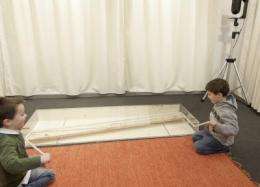
Cooperation is child's play: children that are presented with a task that they can perform on their own or with a partner show a preference to cooperate. Credit: Image courtesy of the Max Planck Institute for Evolutionary Anthropology
Recent studies have shown that chimpanzees possess many of the cognitive prerequisites necessary for humanlike collaboration. Cognitive abilities, however, might not be all that differs between chimpanzees and humans when it comes to cooperation. Researchers from the MPI for Evolutionary Anthropology in Leipzig and the MPI for Psycholinguistics in Nijmegen have now discovered that when all else is equal, human children prefer to work together in solving a problem, rather than solve it on their own. Chimpanzees, on the other hand, show no such preference according to a study of 3-year-old German kindergarteners and semi-free ranging chimpanzees, in which the children and chimps could choose between a collaborative and a non-collaboration problem-solving approach.
Human societies are built on collaboration. From a young age, children will recognize the need for help, actively recruit collaborators, make agreements on how to proceed, and recognize the roles of their peers to ensure success. Chimpanzees are cooperative too, working together in border patrols and group hunting, for instance. Still, humans might have greater motivation to cooperate than chimpanzees do." A preference for doing things together instead of alone differentiates humans from one of our closely related primate cousins," says Daniel Haun of the Max Planck Institute for Evolutionary Anthropology in Leipzig, Germany and the Max Planck Institute for Psycholinguistics in Nijmegen, The Netherlands. "We expected to find differences between human and chimpanzee cooperation, because humans cooperate in a larger variety of contexts and in more complex forms than chimpanzees."
The research team presented 3-year-old German children and chimpanzees living in a Congo Republic sanctuary with a task that they could perform on their own or with a partner. Specifically, they could either pull two ends of a rope themselves in order to get a food reward or they could pull one end while a companion pulled the other. The task was carefully controlled to ensure there were no obvious incentives for the children or chimpanzees to choose one strategy over the other. "In such a highly controlled situation, children showed a preference to cooperate; chimpanzees did not", Haun points out.
The children cooperated more than 78 percent of the time compared to about 58 percent for the chimpanzees. These statistics show that the children actively chose to work together, while chimps appeared to choose between their two options randomly. "Our findings suggest that behavioral differences between humans and other species might be rooted in apparently small motivational differences", says Haun.
Future work should compare cooperative motivation across primate species in an effort to reconstruct the evolutionary history of the trait, the researchers say. "Especially interesting would be other cooperative-breeding primates, or our other close relatives, the bonobos, who have both previously been argued to closely match some of the human pro-social motivations," says Yvonne Rekers of the Max Planck Institute for Evolutionary Anthropology and first author of the study.
More information: Yvonne Rekers, Daniel B.M. Haun and Michael Tomasello Children, but Not Chimpanzees, Prefer to Collaborate Current Biology (2011), doi:10.1016/j.cub.2011.08.066
Provided by
Max-Planck-Gesellschaft
-
From lemons to lemonade: Reaction uses carbon dioxide to make carbon-based semiconductor,
32 comments
-
Thioridazine kills cancer stem cells in human while avoiding toxic side-effects of conventional cancer treatments,
3 comments
-
SpaceX private rocket blasts off for space station (Update),
42 comments
-
Climate scientists say they have solved riddle of rising sea,
31 comments
-
SpaceX capsule has 'new car' smell, astronauts say (Update),
4 comments
-
What would stain as translucent on light-coloured fabric?
23 hours ago
-
How do I identify different bacteria on culture plates?
May 26, 2012
-
Why Do Dogs do Strange things...
May 25, 2012
-
What does exophillic and endophillic mean in terms of mosquito and their control?
May 24, 2012
-
Semen stains glows under black lights (uv light)?
May 23, 2012
-
Question on Human Chromosome 2
May 23, 2012
- More from Physics Forums - Biology
More news stories
Scientist: Evolution debate will soon be history
(AP) -- Richard Leakey predicts skepticism over evolution will soon be history. Not that the avowed atheist has any doubts himself.
22 hours ago |
3.5 / 5 (20) |
86
Manufacturing genes to attack flu virus
An international research team has manufactured a new protein that can combat deadly flu epidemics.
4 hours ago |
not rated yet |
0
|
More plant species responding to global warming than previously thought
(Phys.org) -- Far more wild plant species may be responding to global warming than previous large-scale estimates have suggested.
May 22, 2012 |
4.6 / 5 (14) |
18
|
Thousands of shellfish found dead in Peru
Thousands of crustaceans were found dead off the coast of Lima following the mystery mass death of dolphins and pelicans, the Peruvian Navy said Friday.
May 26, 2012 |
4.7 / 5 (6) |
7
For monogamous sparrows, it doesn't pay to stray (but they do it anyway)
It's quite common for a female song sparrow to stray from her breeding partner and mate with the male next door, but a new study shows that sleeping around can be costly.
May 22, 2012 |
5 / 5 (2) |
8
|
Land and sea species differ in climate change response: study
(Phys.org) -- Marine and terrestrial species will likely differ in their responses to climate warming, new research by Simon Fraser University and Australia’s University of Tasmania has found.
'Unzipped' carbon nanotubes could help energize fuel cells, batteries
Multi-walled carbon nanotubes riddled with defects and impurities on the outside could replace some of the expensive platinum catalysts used in fuel cells and metal-air batteries, according to scientists at ...
T cells 'hunt' parasites like animal predators seek prey, study shows
By pairing an intimate knowledge of immune-system function with a deep understanding of statistical physics, a cross-disciplinary team at the University of Pennsylvania has arrived at a surprising finding: T cells use a movement ...
Computer model used to pinpoint prime materials for efficient carbon capture
When power plants begin capturing their carbon emissions to reduce greenhouse gases and to most in the electric power industry, it's a question of when, not if it will be an expensive undertaking.
Change in developmental timing was crucial in the evolutionary shift from dinosaurs to birds: study
At first glance, it's hard to see how a common house sparrow and a Tyrannosaurus Rex might have anything in common. After all, one is a bird that weighs less than an ounce, and the other is a dinosaur that ...
Nvidia trumpets Tegra 3 phone design wins for 2012
(Phys.org) -- Nvidias competitive war paint has a name, Tegra 3. On the heels of Nvidia announcements about lowering costs of its Tegra 3 processors and Nvidia-enabled tablets running Android Ice Cream ...
Oct 13, 2011
Rank: 2.6 / 5 (7)
Bull!!
I hate working with others, and so do lots of other people. Making such a wide-ranging and generalized statement from this research is not valid. Saying that humans co-operate more effectively than chimps would seem to be a more accurate summary of the research.
Oct 13, 2011
Rank: 2.3 / 5 (3)
Oct 13, 2011
Rank: 5 / 5 (3)
Try to build a house on your own.
Oct 13, 2011
Rank: 2.3 / 5 (3)
Oct 13, 2011
Rank: 2 / 5 (4)
When you have an idea, and you know for a fact it's better than the ideas of the other people in the group, but they want to do their idea anyway, maybe just because the most popular person, or the most senior person had the idea, etc, then it's pretty hard to be motivated about it.
People will follow the jock, the cheerleader, the actor, and even the class clown before they do what the smart guy says. Hey, just look at politics at any level of government, and you'll see the same thing.
In group work, nobody ever did what I said anyway, not in school, and not in any job.
Come test day, well then they wanted me to help. And do you get any thanks? Not really. If you get a "thank you" that's a stretch, if you get "real" thanks, well that's extremely rare.
People do things that are just flat out irrational and even unhealthy, and moreover, they like to encourage one another in doing that.
Oct 13, 2011
Rank: 5 / 5 (1)
It takes a village.
Oct 13, 2011
Rank: 1 / 5 (1)
Breathing, eating, drinking etc.
Those are the physical manifestations of what you have come to label 'human will'.
The associations for 'will' do not stop at the physical.
Combining other associations to the associations of will (first created by physical processes) creates new wills:
The will to work together.
The will to work alone.
Motivations are the additional associations needed to create new wills.
(If you read a Wikipedia explanation of motivation, I promise you, you will be lost and set astray forever)
Both, motivation(s) and will(s), all have their origins in the associations you have accumulated while living.
The 'small' motivational differences come from the BIG living conditions.
Oct 13, 2011
Rank: not rated yet
"from the BIG difference in living conditions"
Typo correction
Oct 14, 2011
Rank: 3 / 5 (2)
There's no need to write comments here... to people.
Thank you
Oct 14, 2011
Rank: 2.3 / 5 (3)
Oct 14, 2011
Rank: 5 / 5 (2)
Therein may lie the problem. The bias in your observational experiment is: you.
The kids did not want to share...with you. (You do not know if they shared when you weren't around)
Maybe it's you who are the problem?
Luckily I trust reviewed articles on wikipedia more than I trust you.
Oct 14, 2011
Rank: not rated yet
Oct 15, 2011
Rank: 5 / 5 (1)
Oct 15, 2011
Rank: 5 / 5 (1)
But they also conduct well coordinated raiding/hunting parties, this can only be done with cooperation. So,imnsho summing it up with one test involving pulling a rope is rather narrow-sighted.
Oct 16, 2011
Rank: not rated yet
Give a chimp a jawbone....
There is no need to go to a zoo to watch chimps in action. Observing human society is pretty much all you need do.
The vast majority of people spend their days blissfully unaware of their own existence, or any of the other higher order thoughts.
This is especially true for Republicans and Bjorn again Religionists of course who have reality as their primary enemy.
Oct 16, 2011
Rank: not rated yet
Personally, I'd prefer the bonobo methodology of problem resolution...