Radiation hotspot detected in Tokyo: reports
October 13, 2011

A radiation hotspot has been detected in Tokyo, reports said

Enlarge

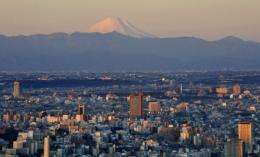
A view of Tokyo with Japan's highest mountain, Mt. Fuji in the background. A radiation hotspot has been detected in Tokyo, reports said Thursday as researchers carry out stringent tests to map how far contamination has spread from the crippled Fukushima nuclear plant.

A radiation hotspot has been detected in Tokyo, reports said Thursday as researchers carry out stringent tests to map how far contamination has spread from the crippled Fukushima nuclear plant.

Japanese media said researchers found of 3.35 microsieverts per hour along a street in the west of the capital -- 220 kilometres (136 miles from Fukushima -- much higher than previously reported levels.

According to calculations based on the Japanese science ministrya's criteria, the equivalent annual dose in the hotspot would be 17.6 millisieverts, just below the 20 millisieverts per year threshold that requires evacuation.

The reading is also higher than levels measured recently at Iitate, an area in Fukushima prefecture that has been evacuated.

The reading in Setagaya was taken one metre above the ground near a hedge, national broadcaster NHK said, while other parts of the same sidewalk showed lower readings.
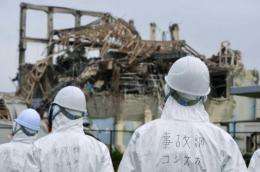
Radiation forced the evacuation of tens of thousands around the Fukushima nuclear plant earlier this year
Enlarge

File photo of Japanese government officials inspecting the accident at Fukushima nuclear power plant. The March 11 earthquake triggered a tsunami that tore into Japan's northeast coast, leaving 20,000 people dead or missing, while sparking meltdowns and explosions at the Fukushima Daiichi nuclear power plant.

The reading came after ward authorities said Wednesday that levels of 2.7 microsieverts per hour had been detected on October 6, higher than levels of less than 0.1 microsieverts in other parts of Setagaya according to official data.

The higher readings come as more tests illustrate how far fall-out from the Fukushima disaster have spread, with elevated levels of radioactive recently found as far away as Yokohama, more than 241 kilometres (150 miles) from the plant.

Radiation fears are a daily fact of life in many parts of Japan following the earthquake and tsunami-sparked meltdowns at the plant, with reported cases of , beef, vegetables, tea and seafood.

Variable winds, weather and topography result in an uneven spread of contamination, experts say, and tend to concentrate in places where dust and accumulate such as drains and ditches.

Radiation fears are a daily fact of life in parts of Japan, with reported cases of contaminated water, beef, vegetables
Enlarge

File photo shows a shopper buying cabbages at a supermarket in Tokyo. Radiation fears are a daily fact of life in many parts of Japan following the earthquake and tsunami-sparked meltdowns at the plant, with reported cases of contaminated water, beef, vegetables, tea and seafood.

Setagaya ward did not immediately confirm Thursday's reading. "We don't know the cause (of the high radiation levels) yet. We are asking experts to find it urgently and decontaminate the area," a spokeswoman said.

She added that the high readings have been shown only in a two-metre long area and below 1.5 metres from the ground.

"We also plan to check sand in the ward's 258 parks over one month from late October," she told AFP.

Radiation levels in the area have not fallen since the ward's efforts to decontaminate it on October 6, and authorities are instructing children to avoid the walkway as they go to school.

Setagaya Mayor Nobuto Hosaka told TBS: "I thought the reading must be a mistake when I first heard. We will push ahead with decontamination after confirming levels are high."

The March 11 earthquake triggered a tsunami that tore into Japan's northeast coast, leaving 20,000 people dead or missing, while sparking meltdowns and explosions at the Fukushima Daiichi nuclear power plant.

The subsequent release of radiation forced the evacuation of tens of thousands from a 20 kilometre (12 mile) radius from the plant and spots beyond in the world's worst nuclear accident since the Chernobyl disaster in 1986.

(c) 2011 AFP


Rank 5 /5 (1 vote)
Relevant PhysicsForums posts

More news stories

Land and sea species differ in climate change response: study

(Phys.org) -- Marine and terrestrial species will likely differ in their responses to climate warming, new research by Simon Fraser University and Australia’s University of Tasmania has found.

Space & Earth / Environment

created 2 hours ago | popularity not rated yet | comments 1 | with audio podcast

Yale study concludes public apathy over climate change unrelated to science literacy

Are members of the public divided about climate change because they don't understand the science behind it? If Americans knew more basic science and were more proficient in technical reasoning, would public consensus match ...

Space & Earth / Environment

created 4 hours ago | popularity 4 / 5 (1) | comments 10 | with audio podcast

10 million years needed to recover from mass extinction

It took some 10 million years for Earth to recover from the greatest mass extinction of all time, latest research has revealed.

Space & Earth / Earth Sciences

created 4 hours ago | popularity not rated yet | comments 1 | with audio podcast

Sophisticated simulations predict future warming

The chances of our planet being hit by a global warming of 3 degrees Celsius by 2050 is as likely as it being hit by an increase of 1.4 degrees, new research shows. Presented in the journal Nature Geoscience, the British study ...

Space & Earth / Earth Sciences

created May 22, 2012 | popularity 4.4 / 5 (9) | comments 51

Aliens don't want to eat us, says former SETI director

Alien life probably isn’t interested in having us for dinner, enslaving us or laying eggs in our bellies, according to a recent statement by former SETI director Jill Tarter.

Space & Earth / Space Exploration

created May 25, 2012 | popularity 4.4 / 5 (14) | comments 40


'Unzipped' carbon nanotubes could help energize fuel cells, batteries

Multi-walled carbon nanotubes riddled with defects and impurities on the outside could replace some of the expensive platinum catalysts used in fuel cells and metal-air batteries, according to scientists at ...

T cells 'hunt' parasites like animal predators seek prey, study shows

By pairing an intimate knowledge of immune-system function with a deep understanding of statistical physics, a cross-disciplinary team at the University of Pennsylvania has arrived at a surprising finding: T cells use a movement ...

Computer model used to pinpoint prime materials for efficient carbon capture

When power plants begin capturing their carbon emissions to reduce greenhouse gases – and to most in the electric power industry, it's a question of when, not if – it will be an expensive undertaking.

Change in developmental timing was crucial in the evolutionary shift from dinosaurs to birds: study

At first glance, it's hard to see how a common house sparrow and a Tyrannosaurus Rex might have anything in common. After all, one is a bird that weighs less than an ounce, and the other is a dinosaur that ...

Nvidia trumpets Tegra 3 phone design wins for 2012

(Phys.org) -- Nvidia’s competitive war paint has a name, Tegra 3. On the heels of Nvidia announcements about lowering costs of its Tegra 3 processors and Nvidia-enabled tablets running Android Ice Cream ...

Scientist: Evolution debate will soon be history

(AP) -- Richard Leakey predicts skepticism over evolution will soon be history. Not that the avowed atheist has any doubts himself.