Greenpeace's Rainbow Warrior III makes maiden voyage
October 20, 2011 by Yannick Pasquet

Greenpeace's latest campaign ship, Rainbow Warrior III, made its maiden voyage Wednesday

Enlarge

The new campaign ship Rainbow Warrior III of environmental organisation Greenpeace is launched in Berne/Motzen, northern Germany on October 19, 2011. The 58-meter (190 foot) ship was constructed at the 161-year-old German shipyard Fassmer, with more than 100,000 individual donations contributing to the estimated 23 million euros (32 million dollars) needed for the construction work.

Purpose-built, ultra-modern and ready to fight environmental destruction on the high seas, Greenpeace's latest campaign ship, Rainbow Warrior III, made its maiden voyage Wednesday.

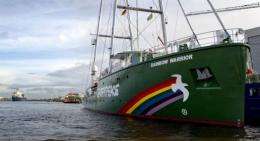
"It's a beautiful boat," captain Joel Stewart enthused as the ropes were untied to launch the 58-metre (190-foot) long sailing ship, distinct with its green hull, colourful rainbow and white dove on the side, into the River Weser towards the northern German port of Bremerhaven.

Twenty-six years after the original was sunk by French agents in New Zealand while attempting to stop France's in the Pacific, Greenpeace supporters enthusiastically showed their support.

As the new multi-million-euro vessel passed by, some had gathered on the bank, letting off a firecracker and writing the words "We will be with you" in the sand.

The ship was constructed at the 161-year-old German shipyard Fassmer, with three million donors contributing to the initially estimated 23 million euros (32 million dollars) needed for the construction work.

The new ship is heading to its home port and home of Greenpeace's headquarters in Amsterdam
Enlarge

The new campaign ship Rainbow Warrior III of environmental organisation Greenpeace is launched in Berne/Motzen, northern Germany on October 19, 2011. Twenty-six years after the original Rainbow Warrior was sunk by French agents in New Zealand while attempting to stop France's nuclear testing in the Pacific, Greenpeace supporters enthusiastically showed their support for the new ship

In the end it cost less, Brigitte Behrens, Greenpeace's director in Germany said.

"For me, a Greenpeace militant for 25 years, this day is very, very important," she said.

"We are continuing what colleagues began many years ago by using a boat to denounce attacks on the environment," she added, recalling that one person had died in the 1985 operation by French operatives.

The new ship was due in Hamburg Thursday and in Amsterdam -- its home port and Greenpeace's headquarters -- on October 28.

After an initial tour in Europe, the 680-tonne ship's first mission will be to set sail for the American coast before heading along the in Brazil to campaign against .

For its American captain, a stalwart of 22 years, the ship is perfect for this kind of campaign, being a sailboat and therefore leaving a very small .

After an initial tour in Europe, the 680-tonne ship's first mission will be to set sail for the American coast
Enlarge

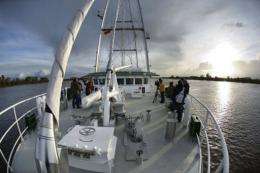
The new campaign ship Rainbow Warrior III of the environmental organisation Greenpeace makes its way over the river Weser during it's maiden voyage from the shipyard in Berne to Bremerhaven, northern Germany, on October 19, 2011.

The boat is powered by sails on its 50-metre masts, an electric motor allowing it to reach a top speed of 10 knots and a diesel engine giving it 15 knots. The hull was made in the Polish port of Gdansk.

Constructed to meet strict environmental demands, heat from the ship's engine, for example, is recycled to heat the cabins, while used water is treated and purified by a biological system.

Rainbow Warrior III is also equipped with a helipad, and a mast with a 50-metre-high crow's nest allowing boats involved in illegal fishing to be spotted up to 24 kilometres away.

(c) 2011 AFP


Rank 3 /5 (4 votes)
Relevant PhysicsForums posts

More news stories

Land and sea species differ in climate change response: study

(Phys.org) -- Marine and terrestrial species will likely differ in their responses to climate warming, new research by Simon Fraser University and Australia’s University of Tasmania has found.

Space & Earth / Environment

created 2 hours ago | popularity not rated yet | comments 1 | with audio podcast

Yale study concludes public apathy over climate change unrelated to science literacy

Are members of the public divided about climate change because they don't understand the science behind it? If Americans knew more basic science and were more proficient in technical reasoning, would public consensus match ...

Space & Earth / Environment

created 4 hours ago | popularity 4 / 5 (1) | comments 10 | with audio podcast

10 million years needed to recover from mass extinction

It took some 10 million years for Earth to recover from the greatest mass extinction of all time, latest research has revealed.

Space & Earth / Earth Sciences

created 4 hours ago | popularity not rated yet | comments 1 | with audio podcast

Sophisticated simulations predict future warming

The chances of our planet being hit by a global warming of 3 degrees Celsius by 2050 is as likely as it being hit by an increase of 1.4 degrees, new research shows. Presented in the journal Nature Geoscience, the British study ...

Space & Earth / Earth Sciences

created May 22, 2012 | popularity 4.4 / 5 (9) | comments 51

Aliens don't want to eat us, says former SETI director

Alien life probably isn’t interested in having us for dinner, enslaving us or laying eggs in our bellies, according to a recent statement by former SETI director Jill Tarter.

Space & Earth / Space Exploration

created May 25, 2012 | popularity 4.4 / 5 (14) | comments 40


'Unzipped' carbon nanotubes could help energize fuel cells, batteries

Multi-walled carbon nanotubes riddled with defects and impurities on the outside could replace some of the expensive platinum catalysts used in fuel cells and metal-air batteries, according to scientists at ...

T cells 'hunt' parasites like animal predators seek prey, study shows

By pairing an intimate knowledge of immune-system function with a deep understanding of statistical physics, a cross-disciplinary team at the University of Pennsylvania has arrived at a surprising finding: T cells use a movement ...

Computer model used to pinpoint prime materials for efficient carbon capture

When power plants begin capturing their carbon emissions to reduce greenhouse gases – and to most in the electric power industry, it's a question of when, not if – it will be an expensive undertaking.

Change in developmental timing was crucial in the evolutionary shift from dinosaurs to birds: study

At first glance, it's hard to see how a common house sparrow and a Tyrannosaurus Rex might have anything in common. After all, one is a bird that weighs less than an ounce, and the other is a dinosaur that ...

Nvidia trumpets Tegra 3 phone design wins for 2012

(Phys.org) -- Nvidia’s competitive war paint has a name, Tegra 3. On the heels of Nvidia announcements about lowering costs of its Tegra 3 processors and Nvidia-enabled tablets running Android Ice Cream ...

Scientist: Evolution debate will soon be history

(AP) -- Richard Leakey predicts skepticism over evolution will soon be history. Not that the avowed atheist has any doubts himself.