The green look for EV charging stations
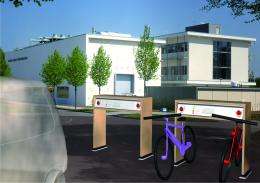
The network of electric-vehicle (EV) charging stations in Germany is still relatively sparse, but their number is growing rapidly. The majority of roadside charging points take the form of steel-clad pillars. A group of researchers has set out to develop an alternative design based on environmentally compatible materials.
Our cityscapes will soon be dominated by a new feature: EV charging points. At present they usually feature a steel- or aluminum-clad housing. Researchers at the Fraunhofer Institute for Mechanics of Materials IWM in Halle want to improve their green credentials. In collaboration with industrial partner Bosecker Verteilerbau Sachsen GmbH, they are developing an alternative solution based on eco-friendly materials. Their idea is to replace the steel cladding that protects cables, power outlets and electronic switchgear with honeycomb panels made of a wood-plastic composite (WPC). At present, the main application for this type of reconstituted wood product is weather-resistant decking for patios.
WPC is a natural fiber composite made up of 70 parts of cellulosic wood fiber derived from sustainable resources to 30 parts of thermoplastic polypropylene. Its advantages, apart from the high proportion of sustainable raw materials, are that it is 100% recyclable and contains no tropical timber. Wood-plastic composites can be repeatedly recycled into new products and have a neutral carbon footprint. As Sven Wüstenhagen, one of the IWM researchers in Halle, explains: “Trees extract huge quantities of carbon dioxide from the atmosphere as they grow, and sequester carbon in their ligneous fibers. It is therefore probable that the use of WPC in this new application will result in lower CO2 emissions compared with the use of steel.”
Another advantage of the composite material, according to Wüstenhagen, is that its production is more energy-efficient than that of steel or other metal cladding materials. WPC is produced using an extrusion process that involves melting a mixture of wood fibers and thermoplastic resin under high pressure and at high temperature and feeding the resulting viscous product into a continuous mold. With modern processing technologies, the fibers can be added to the mixture in their natural state, without first being transformed into granulate, thus eliminating an energy-intensive intermediate stage and preserving the quality of the fibers. Because wood has a high thermal sensitivity, it has to be processed at temperatures below 200 degrees Celsius.
The housings are manufactured in the form of modular components that can be clipped together as required to create a wide variety of different designs, thus allowing them to blend in with the surrounding architecture. Their modular structure also enables the composite panels to be removed easily during repairs. Industrial design expert Wüstenhagen is already thinking about other possible new applications for the WPC components: “They could be used, for instance, to construct street furniture such as park benches or bus shelters. That’s one of our next objectives. Another of our ideas is to integrate functional elements such as cable holders and cable management systems in the components for EV charging stations. This is a viable proposition because WPC can be formed into almost any shape, unlike the metal sheeting used in currently available housings.”
Nonetheless, the WPC cladding has to live up to some very demanding requirements. It must be shatterproof and sufficiently elastic to withstand impact without damage, and it must be capable of resisting wide variations in temperature, high levels of humidity and prolonged UV exposure. The researchers are therefore testing samples of the material in a climate chamber to assess its resistance to extreme temperature conditions and determine which additives or types of coating provide the best weather protection. The IWM experts have almost completed their first prototype of the new WPC housing and are about to start outdoor testing. Sven Wüstenhagen and his team are confident that it won’t be long before the first “all-green” EV charging stations appear on our streets.
Provided by Fraunhofer-Gesellschaft


