Graphene shows unusual thermoelectric response to light
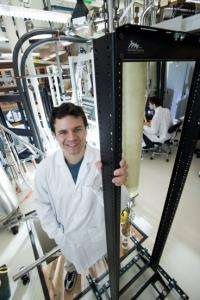
October 7, 2011 by David L. Chandler
Photo: Len Rubenstein
Graphene, an exotic form of carbon consisting of sheets a single atom thick, exhibits a novel reaction to light, MIT researchers have found: Sparked by lights energy, the material can produce electric current in unusual ways. The finding could lead to improvements in photodetectors and night-vision systems, and possibly to a new approach to generating electricity from sunlight.
This current-generating effect had been observed before, but researchers had incorrectly assumed it was due to a photovoltaic effect, says Pablo Jarillo-Herrero, an assistant professor of physics at MIT and senior author of a new paper published in the journal Science. The papers lead author is postdoc Nathaniel Gabor; co-authors include four MIT students, MIT physics professor Leonid Levitov and two researchers at the National Institute for Materials Science in Tsukuba, Japan.
Instead, the MIT researchers found that shining light on a sheet of graphene, treated so that it had two regions with different electrical properties, creates a temperature difference that, in turn, generates a current. Graphene heats inconsistently when illuminated by a laser, Jarillo-Herrero and his colleagues found: The materials electrons, which carry current, are heated by the light, but the lattice of carbon nuclei that forms graphenes backbone remains cool. Its this difference in temperature within the material that produces the flow of electricity. This mechanism, dubbed a hot-carrier response, is very unusual, Jarillo-Herrero says.
Such differential heating has been observed before, but only under very special circumstances: either at ultralow temperatures (measured in thousandths of a degree above absolute zero), or when materials are blasted with intense energy from a high-power laser. This response in graphene, by contrast, occurs across a broad range of temperatures all the way up to room temperature, and with light no more intense than ordinary sunlight.
The reason for this unusual thermal response, Jarillo-Herrero says, is that graphene is, pound for pound, the strongest material known. In most materials, superheated electrons would transfer energy to the lattice around them. In the case of graphene, however, thats exceedingly hard to do, since the materials strength means it takes very high energy to vibrate its lattice of carbon nuclei so very little of the electrons heat is transferred to that lattice.
Because this phenomenon is so new, Jarillo-Herrero says it is hard to know what its ultimate applications might be. Our work is mostly fundamental physics, he says, but adds that many people believe that graphene could be used for a whole variety of applications.
But there are already some suggestions, he says: Graphene could be a good photodetector because it produces current in a different way than other materials used to detect light. It also can detect over a very wide energy range, Jarillo-Herrero says. For example, it works very well in infrared light, which can be difficult for other detectors to handle. That could make it an important component of devices from night-vision systems to advanced detectors for new astronomical telescopes.
The new work suggests graphene could also find uses in detection of biologically important molecules, such as toxins, disease vectors or food contaminants, many of which give off infrared light when illuminated. And graphene, made of pure and abundant carbon, could be a much cheaper detector material than presently used semiconductors that often include rare, expensive elements.
The research also suggests graphene could be a very effective material for collecting solar energy, Jarillo-Herrero says, because it responds to a broad range of wavelengths; typical photovoltaic materials are limited to specific frequencies, or colors, of light. But more research will be needed, he says, adding, It is still unclear if it could be used for efficient energy generation. Its too early to tell.
This is the absolute infancy of graphene photodetectors, Jarillo-Herrero says. There are many factors that could make it better or faster, which will now be the subject of further research.
Philip Kim, an associate professor of physics at Columbia University who was not involved in this research, says the work represents extremely important progress toward optoelectric and energy-harvesting applications based on graphene. He adds that because of this teams work, we now have better understanding of photo-generated hot electrons in graphene, excited by light.
This story is republished courtesy of MIT News (http://web.mit.edu/newsoffice/), a popular site that covers news about MIT research, innovation and teaching.
Provided by
Massachusetts Institute of Technology
-
From lemons to lemonade: Reaction uses carbon dioxide to make carbon-based semiconductor,
32 comments
-
Thioridazine kills cancer stem cells in human while avoiding toxic side-effects of conventional cancer treatments,
3 comments
-
SpaceX private rocket blasts off for space station (Update),
42 comments
-
Climate scientists say they have solved riddle of rising sea,
31 comments
-
SpaceX capsule has 'new car' smell, astronauts say (Update),
4 comments
-
microstructure of titanium
May 26, 2012
-
Steam in My Espresso Machine
May 26, 2012
-
Density question
May 24, 2012
-
Mass transport originating from a point source at a solid gas interface
May 22, 2012
-
Ammonia dispersion in Air
May 22, 2012
-
Multi Choice Help
May 21, 2012
- More from Physics Forums - Materials & Chemical Engineering
More news stories
'Unzipped' carbon nanotubes could help energize fuel cells, batteries
Multi-walled carbon nanotubes riddled with defects and impurities on the outside could replace some of the expensive platinum catalysts used in fuel cells and metal-air batteries, according to scientists at ...
Nanotechnology / Nanomaterials
3 hours ago |
not rated yet |
0
|
Dopant gives graphene solar cells highest efficiency yet
(Phys.org) -- By taking advantage of graphenes favorable electrical and optical properties, and then adding an organic dopant, researchers have achieved the highest power conversion efficiency yet for ...
In nanorod crystal growth, nanoparticles seen as artificial atoms
In the growth of crystals, do nanoparticles act as "artificial atoms" forming molecular-type building blocks that can assemble into complex structures? This is the contention of a major but controversial theory ...
May 24, 2012 |
4.8 / 5 (6) |
0
|
First direct observation of oriented attachment in nanocrystal growth
Berkeley Lab researchers have reported the first direct observation of nanoparticles undergoing oriented attachment, the critical step in biomineralization and the growth of nanocrystals. A better understanding ...
May 24, 2012 |
4.7 / 5 (3) |
0
|
Synthetic nano-waste does not disappear
(Phys.org) -- Tiny particles of cerium oxide do not burn or change in the heat of a waste incineration plant. They remain intact on combustion residues or in the incineration system, as a new study by Swiss ...
Nanotechnology / Bio & Medicine
May 25, 2012 |
5 / 5 (2) |
1
|
Land and sea species differ in climate change response: study
(Phys.org) -- Marine and terrestrial species will likely differ in their responses to climate warming, new research by Simon Fraser University and Australia’s University of Tasmania has found.
T cells 'hunt' parasites like animal predators seek prey, study shows
By pairing an intimate knowledge of immune-system function with a deep understanding of statistical physics, a cross-disciplinary team at the University of Pennsylvania has arrived at a surprising finding: T cells use a movement ...
Computer model used to pinpoint prime materials for efficient carbon capture
When power plants begin capturing their carbon emissions to reduce greenhouse gases and to most in the electric power industry, it's a question of when, not if it will be an expensive undertaking.
Change in developmental timing was crucial in the evolutionary shift from dinosaurs to birds: study
At first glance, it's hard to see how a common house sparrow and a Tyrannosaurus Rex might have anything in common. After all, one is a bird that weighs less than an ounce, and the other is a dinosaur that ...
Nvidia trumpets Tegra 3 phone design wins for 2012
(Phys.org) -- Nvidias competitive war paint has a name, Tegra 3. On the heels of Nvidia announcements about lowering costs of its Tegra 3 processors and Nvidia-enabled tablets running Android Ice Cream ...
Yale study concludes public apathy over climate change unrelated to science literacy
Are members of the public divided about climate change because they don't understand the science behind it? If Americans knew more basic science and were more proficient in technical reasoning, would public consensus match ...
Oct 07, 2011
Rank: 5 / 5 (8)
"Man, do you remember back when we had stuff that wasn't made of graphene?"
Oct 07, 2011
Rank: 3 / 5 (2)
This is similar to an article from almost a year ago about optical antennae from Carbon Nanotubes.
Back then, I suggested the multi-phasic optical array detector at the nano scale for cameras and science instruments. It would seem to offer near-infinite resolution, if you follow a design similar to multi-phasic radar devices.
This phenomenon with the graphene seems to be perfect for just that sort of application.
Perhaps by using oriented strips or circular, triangular, square, etc, shaped detectors you may even be able to tweak it for determining polarization and other properties of light besides color.
Imagine a single camera on a telescope capable of taking a one multi-spectral exposure of a distant galaxy, simultaneously serving as spectrometer, infrared, and visible telescope in one analog frame, instead of digital composite.
Oct 07, 2011
Rank: 5 / 5 (1)
Oct 07, 2011
Rank: 1 / 5 (1)
Oct 07, 2011
Rank: 1 / 5 (1)
As a real life analogy of Dirac electrons could serve the people under (social) stress. Such people are acting confusedly, impulsively and they often don't follow rational motivations of their neighbours. When they're excited, their reaction can have devastating consequences.
http://en.wikiped...ing_Down
Oct 07, 2011
Rank: 1 / 5 (1)
Oct 07, 2011
Rank: 5 / 5 (2)
Oct 07, 2011
Rank: 1 / 5 (1)
After all, this is a reason, why sodium never becomes superconductor, even under high pressure. Its orbitals are full of electrons, but they're of spherical shape - there are no binding sites. Whereas the niobium has both spherical orbitals, both elongated orbitals, which are serving like hooks binding atoms together.
Oct 07, 2011
Rank: 1 / 5 (1)
The symptomatic for contemporary physics is, these effects are of extremely low grant support and their research stagnates in the same way, like the research of cold fusion. The mainstream physicists are really scared with them.
Oct 08, 2011
Rank: 1 / 5 (2)
Oct 08, 2011
Rank: not rated yet
LMAO .. This discovery has just made the $5bn James Web Telescope obselete even before it's launched.
Oct 08, 2011
Rank: 2.5 / 5 (2)
Not entirely, but basically you're right.
If you made an array of telescopes based on these effect, you'd get very good results.
If you put an telescope or an array of such telescopes in space, you'd still want to put it in a heavily shaded location to minimize any background energy pollution from the Sun.
You have to figure they still need to build test instruments and do enough testing and researching to learn how to calibrate devices made with this technology, and what can and can't be done reliably. That would probably take 5 to 10 years research to get quality worthy of a NASA telescope.
Then you need a computer that is powerful enough with the hardware, firmware, and software to receive and interpret the inputs. Somebody has to learn to program those systems.
Oct 09, 2011
Rank: 5 / 5 (1)
Oct 09, 2011
Rank: 1 / 5 (1)
Oct 09, 2011
Rank: 1 / 5 (1)
Oct 09, 2011
Rank: not rated yet
-And your opinions carry much authority because you have spent many years of hard work and study to become a physmatist, learning to use words like phasic with, uh, authority.
STFU
Oct 09, 2011
Rank: not rated yet
Unlike you, I can think for my own damn self, instead of only being able to quote some authority.
Oct 09, 2011
Rank: 4 / 5 (1)
Oct 09, 2011
Rank: not rated yet
Not in mass production yet. Graphene is the DOH! of our generation. It's been there right under our noses all this time and we are still learning a lot about what it's capable of. For some more info see: http://dailyrecko...silicon/
What I'd love to see is a graphine mass production plant hooked up to the exhaust of industrial/commercial carbon-based fuel burning power plants. Talk about carbon capture...
Oct 10, 2011
Rank: not rated yet