GPM satellite takes a spin on the high capacity centrifuge
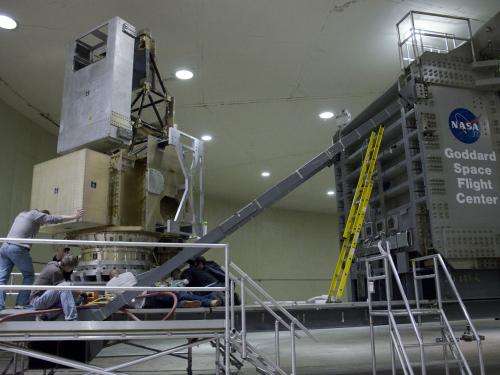
In the clean room at NASA Goddard Space Flight Center in Greenbelt Md., the Global Precipitation Measurement (GPM) mission's Core satellite is steadily taking shape. Set to measure rainfall worldwide after launch in 2014, GPM's two solar panels are the latest components currently undergoing rigorous testing before being integrated with the spacecraft, a process that began seven months ago when the main structural elements went on an unusual ride.
Although it was still dark outside on the morning of March 28, 2011, Building 15's test facility was already abuzz with activity. "You want it at 8 a.m., we'll start at six," said engineer Bill Chambers. He’s been running the High Capacity Centrifuge at Goddard for the past 22 years.
Chambers was standing in a massive circular room that looks a little like the inside of a circus tent. But this circus has only one attraction: the High Capacity Centrifuge. It’s a steel bridge-like structure attached to the center of the floor on a giant rotating bearing. Now, as part of the two-hour checklist the technicians follow to get the centrifuge up and spinning, lubricant oil was pumping through that giant bearing because this massive, 600,000 pound piece of machinery would ultimately spin up to 15 rotations per minute.
The centrifuge spans the entire width of the room like outstretched arms. At the end of one arm is a bulbous chamber. At the other, a platform where the heaviest structure ever to be tested would soon sit: GPM's 8,000-pound Core satellite.
The GPM mission was initiated by NASA and the Japanese Aerospace Exploration Agency and has many international partners. It will provide rainfall data worldwide, including information on tropical cyclones and hurricanes. The successor to the Tropical Rainfall Measuring Mission (TRMM), the GPM mission expands on TRMM's coverage by using a constellation of existing partner satellites that take similar measurements and unifying them into one global data set every three hours.
Built at NASA Goddard, the Core satellite has three major structural sections: propulsion, the lower bus, and the upper bus. The bus is the infrastructure of a spacecraft, usually providing locations for instruments. Together, they make up the body of the spacecraft and each part will undergo three to six times the force of normal gravity when it launches into space. During this March test, the centrifuge would test their mettle.
Buckle Up
Just inside the 30-foot doors to the centrifuge, a crane in the ceiling lifted the spacecraft onto the platform. The upper bus and qualifying duplicates of the lower bus and propulsion sections were attached to mock-ups of the other parts of the satellite, including the instruments, to simulate all the weight the spacecraft's body has to bear. Once in place, the team bolted the satellite into a fixture that’s specially designed to hold it on the centrifuge. Then they connected a bundle of wires that ran from the 120 sensors on the satellite to the centrifuge computer.
Meanwhile, the centrifuge bearing had been lubed up and every moving part of the centrifuge had been checked out. With the satellite secured, the room cleared for the balance run.
The first step was a phone call. Bill Chambers needed to tell Goddard's power substation that the centrifuge would cause a power spike equal to turning on 16.6 million 60-watt incandescent light bulbs at once. "For less than a nano-second, we're going to ask for one gigawatt -- one billion watts of energy," said Chambers. That’s needed just to turn on the system because, as Chambers said, "600,000 pounds is sitting there going "I don't want to move.""
The centrifuge slowly began to revolve at a lazy three rotations per minute. As it moved, a sensor located near the central bearing measured how much each of the two arms bend under the weight they’re carrying. Like an unbalanced washing machine, an unbalanced centrifuge will wobble and throw off its load. And that’s dangerous because it could destroy not only the satellite but also the centrifuge itself and maybe even Building 15.
Once the right amount of weight was added or subtracted to get everything balanced, the centrifuge techs closed the room’s 30-foot tall doors. Then, the entire hallway outside the centrifuge was cleared out because, if something went wrong, metal could blow right through them.
The GPM engineers and the centrifuge team retreated to the safety of the control room and gathered around two live feeds -- one was video of the satellite on the platform and the other was live data streaming wirelessly from the centrifuge computer.
Ready to go, they made one more call down to the power substation, and the centrifuge spun to life.
Put Some Spin On It
If you've ever taken a fast curve in a car, you've felt your body pushed outward, away from the curve. That outward push is centrifugal force, and the faster you turn, the more it pushes you away from the center. Spinning on the centrifuge does the same thing to the satellite -- except the centrifugal forces are a lot bigger -- capable of going up to 30 times the force of gravity, or "g's." GPM's test went up to seven g's.
But simply spinning the spacecraft isn't enough. The g forces only push outward, and the engineers need to test the satellite from all directions to see how the metal frame and the bolts that hold the parts together withstand the stress. So the test actually consisted of five separate centrifuge runs, each with the spacecraft in a different orientation.
If the satellite were a person the blocky instrument mock-ups would be GPM's belly and the upper bus its spine. During one run, GPM faced the center of the centrifuge, and its belly pushes outward and the upper bus spine pulls away. The next orientation had GPM turned 90 degrees to face the direction of spin -- the car scenario -- where its inside shoulder pushed outward on the shoulder next to the wall.
But in a vertical position, the centrifuge can't test what would happen if a force pushed the satellite straight down.
"Imagine a spacecraft launching," said Bill Chambers. The largest force on the spacecraft will be a compressive force pushing down on its head as the rocket breaks free of Earth's gravity, he said. To simulate that compressive force on the centrifuge, they tilt the satellite.
That specially-designed fixture that held the spacecraft to the platform can not only rotate the satellite, but also tilt it -- outward toward the wall, creating a stretching force, or in toward the center, creating a compressive force.
The GPM engineering team carefully calculated what the forces should be for each inch of the spacecraft before the test. It's not simple, said GPM project manager, Art Azarbarzin at NASA Goddard. This essential test of the GPM Core satellite was also unusual because the engineers decided to use the centrifuge instead of other testing methods.
The same forces can be reached in a static test by tilting the satellite in different orientations and using a machine called a hydraulic actuator to put weight on different points. If you do this once, this test is cheaper than one run on the centrifuge. But for GPM to get the equivalent g's, the testing would have taken a time consuming 20 configurations, said GPM's chief mechanical engineer Jay Parker at NASA Goddard. "I probably saved a quarter of a million dollars by doing the testing on the centrifuge," he said.
Centrifuge Control – Accepting all Orientations
For every orientation of the satellite, each test started out slow with the centrifuge spinning at 10 percent of full speed. Data streamed into the control room from the 120 sensors. The sensors are strain gauges, Chambers said, "little tiny things that look like a piece of copper foil." Each sensor has two pieces of metal with an electrical resistor in-between. They’re glued to the satellite’s metal frame, and as the metal stretches or compresses, the electrical signal from the gauge changes -- indicating the g forces pulling on the satellite.
Hunched over their laptops, GPM project engineers compared the strain gauge data to their predictions. If the data looked good, they gave the thumbs up to Don Benner, project engineer for the centrifuge test group. He ramped up the speed in ten percent intervals. At 40 percent of full speed, Benner took the centrifuge back down to zero and everyone went back into the chamber to visually inspect the satellite to see how it was doing. When it checked out, they closed back up and it was full speed ahead.
Ultimately, GPM had between 3.0 to 6.2 g's of force put on it, depending on its orientation. "It was a very successful test," said Parker. The satellite "behaved as predicted, which is always a good thing." The entire spacecraft structure passed and qualified for flight.
After three dizzying days in Building 15, the mock-ups were unbolted and GPM's upper bus was sent off to the clean room where it was fully integrated with the lower bus and propulsion sections of the spacecraft in May, 2011.
Provided by JPL/NASA


