New way to funnel light could have infrared applications
October 25, 2011 by Lisa Zyga feature

New way to funnel light could have infrared applications

Enlarge

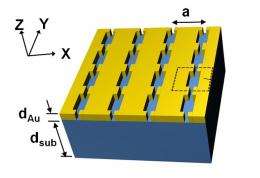
The proposed light-funneling structure consists of an alternating pattern of large and small slits engraved on a thin gold film on a substrate. The large slits increase the efficiency of the light funneling through the small slits, while the small slits provide tighter confinement for greater light enhancement. Image credit: G. Subramania, et al. ©2011 American Physical Society

(PhysOrg.com) -- Taking light control to a new level, scientists have proposed a technique for confining light into an area just 1/500th the size of the light's wavelength. Since funneling light through such tiny spaces enhances the optical fields and increases the light's transmission, it could lead to a variety of new optical applications.

The researchers, G. Subramania from Sandia National Laboratories and the University of New Mexico, S. Foteinopoulou from the University of Exeter, UK, and I. Brener from Sandia National Laboratories, have published their study on the new light funneling technique in a recent issue of .

In the efficient power funneling of light, the amount of transmitted light is larger than predicted based on the area of the holes through which the light travels. This phenomenon, which was first demonstrated in 1998, is called extraordinary (EOT) and has been produced by surface plasmons excited on the surface of thin metal films patterned with tiny holes. However, this process is resonant, meaning it only works with light of a very narrow spectrum. Since funneling light of a wide range of wavelengths could be very useful for applications, scientists are interested in alternative techniques for funneling light that are nonresonant, and therefore, broadband.

“The broadband functionality [of a nonresonant device] allows for flexible utilization in many applications, thus considerably relaxing the stringent design requirements of resonant devices,” the authors wrote in their study.

Toward this goal, the scientists proposed a structure consisting of ultra-subwavelength channels that, according to calculations, can efficiently funnel and enhance the intensity of light by a nonresonant mechanism. The device is composed of a periodic pattern of alternating small and large rectangular slits engraved on a thin gold film that rests on a substrate. While the large slits enable a more efficient funneling of light through the small slits, the smaller slits provide tighter confinement for greater light enhancement.

The proposed structure demonstrates a high power confinement factor (PCF), which serves as a figure-of-merit. The PCF is defined as the fraction of incident power that gets funneled through the small-slit region divided by the area of the small-slit region. The higher the PCF, the greater the enhancement of the optical fields.

The scientists calculated that these structures should be able to enhance light with a PCF of 13-20 over a broad range of 3-20 micrometers. The lower part of this range is the mid-infrared, which is particularly useful for applications such as molecular fingerprinting or sensing, as well as infrared detectors. The structures could also have applications in optofluidic devices and the enhancement of nonlinear phenomena.

Since nanofabrication techniques are constantly improving, the scientists predict that it should be possible to fabricate these structures in the near future. While decreasing the width of the small slit could allow for greater enhancement, the researchers note that there exists a lower bound on the width due to the onset of quantum tunneling, as well as fabrication constraints.

More information: G. Subramania, et al. “Nonresonant Broadband Funneling of Light via Ultrasubwavelength Channels.” Physical Review Letters, 107, 163902 (2011). DOI:10.1103/PhysRevLett.107.163902

Copyright 2011 PhysOrg.com.
All rights reserved. This material may not be published, broadcast, rewritten or redistributed in whole or part without the express written permission of PhysOrg.com.

4.7 /5 (7 votes)  

Filter


Move the slider to adjust rank threshold, so that you can hide some of the comments.


Display comments: newest first

hyongx
Oct 25, 2011

Rank: not rated yet
for 10micron wavelength, 1/500th of this is ~20nm. 20nm structures seems possible. let's combine this with quantum-confined semiconducting lasers to get some really crazy stuff.
Rank 4.7 /5 (7 votes)
Relevant PhysicsForums posts
  • Water flow question
    created3 hours ago
  • [Drift velocity] Factors affecting velocity
    created6 hours ago
  • does cold gasoline have less energy
    created6 hours ago
  • distribution of molecules throughout the atmosphere
    created8 hours ago
  • The Global Positioning System !
    created9 hours ago
  • A Question relating Power
    created10 hours ago
  • More from Physics Forums - General Physics

More news stories

Is a classical electrodynamics law incompatible with special relativity?

(Phys.org) -- The laws of classical electromagnetism that were developed in the 19th century are the same laws that scientists use today. They include Maxwell’s four equations along with the Lorentz la ...

Physics / General Physics

created May 24, 2012 | popularity 4.7 / 5 (17) | comments 43 | with audio podcast feature

Landmark calculation clears the way to answering how matter is formed

(Phys.org) -- An international collaboration of scientists, including Thomas Blum, associate professor of physics, is reporting in landmark detail the decay process of a subatomic particle called a kaon – ...

Physics / General Physics

created May 25, 2012 | popularity 4.3 / 5 (22) | comments 50 | with audio podcast

Lying in wait for WIMPs: Researchers seek to dramatically increase sensitivity of Large Underground Xenon detector

Although it's invisible, dark matter accounts for at least 80 percent of the matter in the universe. No one knows what it is, but most scientists would bet on weakly interacting massive particles, or WIMPs.

Physics / General Physics

created May 23, 2012 | popularity 4 / 5 (7) | comments 15 | with audio podcast

Hawaii lab turns laser-powered bubbles into microrobots

(Phys.org) -- A team of scientists from the University of Hawaii are working on microrobots created from bubbles of air in a saline solution. The bubbles take on their title of “robots” as a laser ...

Physics / General Physics

created May 23, 2012 | popularity 5 / 5 (4) | comments 2 | with audio podcast weblog

Sound increases the efficiency of boiling

Scientists at the Georgia Institute of Technology achieved a 17-percent increase in boiling efficiency by using an acoustic field to enhance heat transfer. The acoustic field does this by efficiently removing vapor bubbles ...

Physics / Soft Matter

created May 24, 2012 | popularity 5 / 5 (2) | comments 2


Computer model used to pinpoint prime materials for efficient carbon capture

When power plants begin capturing their carbon emissions to reduce greenhouse gases – and to most in the electric power industry, it's a question of when, not if – it will be an expensive undertaking.

'Unzipped' carbon nanotubes could help energize fuel cells, batteries

Multi-walled carbon nanotubes riddled with defects and impurities on the outside could replace some of the expensive platinum catalysts used in fuel cells and metal-air batteries, according to scientists at ...

T cells 'hunt' parasites like animal predators seek prey, study shows

By pairing an intimate knowledge of immune-system function with a deep understanding of statistical physics, a cross-disciplinary team at the University of Pennsylvania has arrived at a surprising finding: T cells use a movement ...

Yale study concludes public apathy over climate change unrelated to science literacy

Are members of the public divided about climate change because they don't understand the science behind it? If Americans knew more basic science and were more proficient in technical reasoning, would public consensus match ...

Same gene that stunts infants' growth also makes them grow too big: research

UCLA geneticists have identified the mutation responsible for IMAGe* syndrome, a rare disorder that stunts infants' growth. The twist? The mutation occurs on the same gene that causes Beckwith-Wiedemann syndrome, which makes ...

Change in developmental timing was crucial in the evolutionary shift from dinosaurs to birds: study

At first glance, it's hard to see how a common house sparrow and a Tyrannosaurus Rex might have anything in common. After all, one is a bird that weighs less than an ounce, and the other is a dinosaur that ...