Fiery volcano offers geologic glimpse into land that time forgot
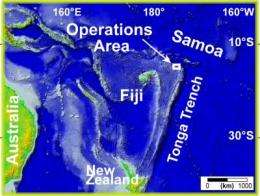
The operations area at West Mata volcano during the 2009 expedition is part of the Lau Basin, bounded by Samoa, Tonga and Fiji. Credit: NSF/NOAA
The first scientists to witness exploding rock and molten lava from a deep sea volcano, seen during a 2009 expedition, report that the eruption was near a tear in the Earth's crust that is mimicking the birth of a subduction zone.
Scientists on the expedition collected boninite, a rare, chemically distinct lava that accompanies the formation of Earth's subduction zones.
Nobody has ever collected fresh boninite and scientists never had the opportunity to monitor its eruption before, said Joseph Resing, University of Washington oceanographer and lead author of an online article on the findings in Nature Geoscience. Earth's current subduction zones are continually evolving but most formed 5 million to 200 million years ago. Scientists have only been able to study boninite collected from long-dead, relic volcanos millions of years old.
This video is not supported by your browser at this time.
Video of erupting lava
Resing was chief scientist on the expedition, funded by the National Oceanic and Atmospheric Administration and the National Science Foundation, that pinpointed the location of the West Mata volcano, erupting 4,000 feet (1,200 meters) below the surface in the Southwest Pacific Ocean. Watch clip of eruption on YouTube at http://www.youtube.com/watch?v=qaKnWF5ORsU."Everything about the eruption itself how fast, how intense, the ratio of lava to explosive fragments, the amount and composition of gas released is new to us," said co-author Kenneth Rubin, University of Hawaii geologist. "Plus, having a young, fresh occurrence of this very rare rock type to study gives us the opportunity to examine subtle chemical and mineralogical variations in a pristine specimen."
At subduction zones the oceanic crust on one tectonic plate slides beneath another, producing abundant volcanism and contributing heat, gases and mineral-laden fluids to ocean waters. Scientists have long studied the impact of subduction zones on geological and geochemical cycles. To puzzle out how subduction zones form and evolve they study inactive contemporary marine volcanos that do not produce boninite and they collect and study boninite lavas collected on land and examine cores collected from the deep sea.
"West Mata lies above the subducting Pacific plate and is part of the rapidly expanding Lau Basin, which is bounded by Samoa, Tonga and Fiji," Resing said. "The large bend at the northern end of the Tonga trench produces a tear in the Pacific plate and creates unusual lavas that usually only form at very young subduction zones."
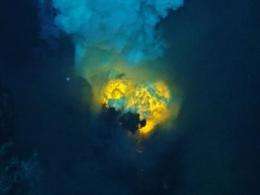
A double magma bubble, about 1 ½ feet across at its base, emerges from the vent that scientists named Hades at the West Mata submarine volcano. Credit: NSF/NOAA
Conditions are right for boninite to form, there's lots of seawater released from subducting rock that mixes into relatively shallow mantle that has previously melted, causing the mantle to remelt at high temperatures. Boninite lavas are believed to be among the hottest from volcanos that erupt on Earth."What makes this exciting is how uncommon these eruptions of boninite are, both now and in the past," Rubin said. "Locked within the boninite is critical information about the rates and magnitudes of subduction-zone magmatism and global geochemical cycles."
The scientists writing in Nature Geoscience think the release of gaseous water, carbon dioxide and sulfur dioxide from the slab is the reason the eruption was so explosive. No one realized such energetic eruptions happened so deep, Resing says. Streams of red and gold lava 35 feet long shot through the water and lava-skinned bubbles some three feet across emerged.
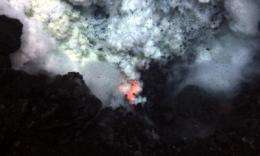
West Mata is an elongated submarine volcano almost two miles long and 5,000 feet tall. There are two large eruptive vents at its summit, here the vent named Prometheus ejects gas, rocky debris and a shower of white sulphur. Credit: NSF/NOAA
West Mata, which the scientists estimate has been erupting for at least three years, and eight other elongated volcanoes that overlap each other in the northeast Lau Basin sit within one of the most magmatically active areas on Earth, Resing says.
"The basin may prove an important place to study submarine volcanic eruptions in relation to early stages of subduction," he said.
Rubin and Robert Embley, with NOAA's Pacific Marine Environmental Laboratory, Newport, Ore., and co-author on the paper, will return to the area in November for further study and to try to determine if the volcano is still actively erupting.
"Observing the eruption in real time was a rare and special opportunity because we know so little about how submarine volcanic activity behaves," Embley said. "This is one of only a handful of 'glimpses' of the process we've had to date and is the first time we've actually observed natural submarine light from the glowing magma."
Provided by
University of Washington
-
From lemons to lemonade: Reaction uses carbon dioxide to make carbon-based semiconductor,
32 comments
-
Thioridazine kills cancer stem cells in human while avoiding toxic side-effects of conventional cancer treatments,
3 comments
-
SpaceX private rocket blasts off for space station (Update),
42 comments
-
Climate scientists say they have solved riddle of rising sea,
31 comments
-
SpaceX capsule has 'new car' smell, astronauts say (Update),
3 comments
-
Hypothetical desert earth
16 hours ago
-
More human population = greater mass?
May 25, 2012
-
Conversion from aircraft bearing to normal degrees
May 23, 2012
-
Interpretation/Analysis of the Lab results(HEPA filter)
May 22, 2012
-
Has anyone here attended the The Urbino Summer School in Paleoclimatology?
May 22, 2012
-
Earthquakes: Mag 6 N. Italy and Mag 5.6 W. Bulgaria
May 21, 2012
- More from Physics Forums - Earth
More news stories
Yale study concludes public apathy over climate change unrelated to science literacy
Are members of the public divided about climate change because they don't understand the science behind it? If Americans knew more basic science and were more proficient in technical reasoning, would public consensus match ...
1 hour ago |
not rated yet |
4
|
10 million years needed to recover from mass extinction
It took some 10 million years for Earth to recover from the greatest mass extinction of all time, latest research has revealed.
Space & Earth / Earth Sciences
1 hour ago |
not rated yet |
1
|
Sophisticated simulations predict future warming
The chances of our planet being hit by a global warming of 3 degrees Celsius by 2050 is as likely as it being hit by an increase of 1.4 degrees, new research shows. Presented in the journal Nature Geoscience, the British study ...
Space & Earth / Earth Sciences
May 22, 2012 |
4.4 / 5 (9) |
51
Aliens don't want to eat us, says former SETI director
Alien life probably isnt interested in having us for dinner, enslaving us or laying eggs in our bellies, according to a recent statement by former SETI director Jill Tarter.
Space & Earth / Space Exploration
May 25, 2012 |
4.4 / 5 (13) |
39
Kyoto Protocol architect 'frustrated' by climate dialogue
UN climate talks are going nowhere, as politicians dither or bicker while the pace of warming dangerously speeds up, one of the architects of the Kyoto Protocol told AFP.
May 23, 2012 |
3.7 / 5 (7) |
39
Computer model used to pinpoint prime materials for efficient carbon capture
When power plants begin capturing their carbon emissions to reduce greenhouse gases and to most in the electric power industry, it's a question of when, not if it will be an expensive undertaking.
'Unzipped' carbon nanotubes could help energize fuel cells, batteries
Multi-walled carbon nanotubes riddled with defects and impurities on the outside could replace some of the expensive platinum catalysts used in fuel cells and metal-air batteries, according to scientists at ...
T cells 'hunt' parasites like animal predators seek prey, study shows
By pairing an intimate knowledge of immune-system function with a deep understanding of statistical physics, a cross-disciplinary team at the University of Pennsylvania has arrived at a surprising finding: T cells use a movement ...
Same gene that stunts infants' growth also makes them grow too big: research
UCLA geneticists have identified the mutation responsible for IMAGe* syndrome, a rare disorder that stunts infants' growth. The twist? The mutation occurs on the same gene that causes Beckwith-Wiedemann syndrome, which makes ...
Change in developmental timing was crucial in the evolutionary shift from dinosaurs to birds: study
At first glance, it's hard to see how a common house sparrow and a Tyrannosaurus Rex might have anything in common. After all, one is a bird that weighs less than an ounce, and the other is a dinosaur that ...
Scientists develop ultra-sensitive test that detects diseases in their earliest stages
Scientists have developed an ultra-sensitive test that should enable them to detect signs of a disease in its earliest stages, in research published today in the journal Nature Materials.

