Faster, cheaper Mercury test could provide answers for China
Mercury pollution is a big problem, and it’s only getting bigger. It is most pronounced in developing countries like China and India, where coal-burning still remains a major resource of power generation. Worldwide, about 1,000 tons of mercury is produced per year. The resulting pollution makes water and soil unusable, and poses substantial health risks to people nearby.
University of Utah researcher Ling Zang hopes to address this growing problem in China and beyond with a new test for detecting mercury. The test promises to be faster and cheaper than conventional tests, which require samples to be sent to a laboratory, can take weeks to process and can cost hundreds of dollars.
“It’s very exciting as a scientist to be able to transfer what you are developing on the bench-top in the lab to the marketplace, and to serve society,” said Zang, who was recruited to the university’s Department of Material Science and Engineering in 2008 by the Utah Science Technology and Research (USTAR) initiative. USTAR is a state office that drives innovation and economic growth by attracting talented researchers to Utah.
“One of the main reasons I decided to move to University of Utah was the level of support for commercialization at this university,” Zang added. “It is essential to have support from the faculty, the administration and the state to increase the impact of new technologies on people’s lives.”
The inspiration for the new mercury test came four years ago, when Zang was reading an article about how mercury binds to DNA, causing irregularity of genetic processing. He identified the strong, specific binding between mercury and the DNA base thymine, and discovered a way to use this binding to measure mercury concentrations.
After years of work, Zang has proven his new test, and he is close to selling it to companies and governments across the world that want to monitor mercury pollution. The test can detect mercury down to 0.20 parts per billion (ppb), which is well below the Environmental Protection Agency’s standard of 2 ppb for drinking water. The cost of running the analysis has yet to be determined, but it is expected to cost a fraction of exiting tests.
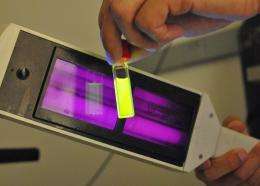
The new test starts with a liquid solution of a perylene dye, which emits a green fluorescent light. Zang attached the mercury-binding group to the perylene, so when mercury is added, the liquid becomes less fluorescent. The less fluorescent the liquid, the more mercury is present. To measure the fluorescence, Zang uses a custom hand-held photodetector, an electronic device that measures light.
Zang is commercializing his test through a startup company called Metallosensors, Inc. The company launched in 2009, and now has the leadership and money needed to refine and market the test. Metallosensors was awarded a $150,000 phase I SBIR (Small Business Innovation Research) grant from the National Science Foundation. Next year, the company will apply for the $500,000 Phase II SBIR. In addition, Metallosensors recently secured a $50,000 VIP (Virtual Incubator Program) grant from the University of Utah.
The CEO of the company is Glenn Prestwich, a veteran entrepreneur – cofounder and chief science officer for five University of Utah startup companies – and Presidential Professor of Medicinal Chemistry at the U.
“Our molecular sensor has enormous potential,” Prestwich said. “In the short term, we are perfecting the underlying chemical test, developing the handheld photodetector with partners in China, establishing a marketing plan in China, and securing intellectual property protection. We are also engaging with Utah’s Mercury Working Group to develop products for monitoring in the United States. In the future, we hope to make the test smarter by adding GPS and real-time graphical displays. This will significantly improve the way we track mercury pollution.”
Metallosensors got an early boost from the Venture Bench program of the University of Utah’s Technology Commercialization Office (TCO). This program helps early stage university startups such as Metallosensors by creating a temporary management team that allows them to apply for an SBIR grant. Venture Bench also provides marketing materials, including a website and logo.
“Metallosensors is a big success for the Venture Bench program,” said Rajiv Kulkarni, Associate Director at the TCO who has helped Metallosensors through the patent and commercialization process. “The technology is very promising, and the company product line addresses a real need to monitor contamination, especially in developing countries. The portability of the instrument will make it very convenient for field use.”
Provided by University of Utah


