Faraway Eris is Pluto's twin: Dwarf planet sized up accurately as it blocks light of faint star
October 26, 2011

Faraway Eris is Pluto's twin: Dwarf planet sized up accurately as it blocks light of faint star

Enlarge

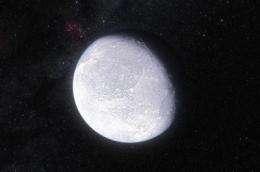
This artist's impression shows the distant dwarf planet Eris. New observations have shown that Eris is smaller than previously thought and almost exactly the same size as Pluto. Eris is extremely reflective and its surface is probably covered in frost formed from the frozen remains of its atmosphere. Credit: ESO/L. Calçada

(PhysOrg.com) -- Astronomers have measured the diameter of the dwarf planet Eris by catching it as it passed in front of a faint star. This was seen by telescopes in Chile, including the TRAPPIST telescope at ESO's La Silla Observatory. The observations show that Eris is an almost perfect twin of Pluto in size and appears to be covered in a layer of ice. Results will be published in the Oct. 27 issue of the journal Nature.

In November 2010, the distant Eris passed in front of a faint background star, an event called an occultation. These occurrences are very rare and difficult to observe as the dwarf planet is very distant and small. The next such event involving Eris will not happen until 2013. Occultations provide the most accurate, and often the only, way to measure the shape and size of a distant body.

The candidate star for the occultation was identified by studying pictures from the MPG/ESO 2.2-metre at ESO's La Silla Observatory. The observations were carefully planned and carried out by a team of astronomers from a number of (mainly French, Belgian, Spanish and Brazilian) universities using — among others — the TRAPPIST (TRAnsiting Planets and PlanetesImals Small Telescope) telescope, also at La Silla.

"Observing occultations by the tiny bodies beyond Neptune in the Solar System requires great precision and very careful planning. This is the best way to measure Eris's size, short of actually going there," explains Bruno Sicardy, the lead author.

This video is not supported by your browser at this time.

Credit: ESO

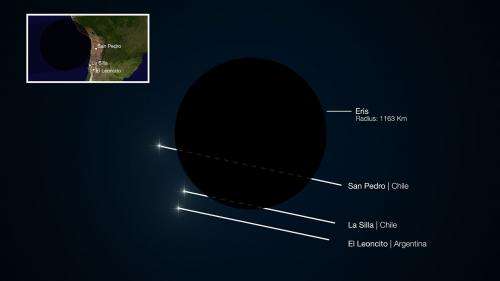
Observations of the occultation were attempted from 26 locations around the globe on the predicted path of the dwarf planet's shadow — including several telescopes at amateur observatories, but only two sites were able to observe the event directly, both of them located in Chile. One was at ESO's using the TRAPPIST telescope, and the other was located in San Pedro de Atacama and used two telescopes. All three telescopes recorded a sudden drop in brightness as Eris blocked the light of the distant star.

The combined observations from the two Chilean sites indicate that Eris is close to spherical. These measurements should accurately measure its shape and size as long as they are not distorted by the presence of large mountains. Such features are, however, unlikely on such a large icy body.

Eris was identified as a large object in the outer Solar System in 2005. Its discovery was one of the factors that led to the creation of a new class of objects called dwarf planets and the reclassification of from planet to dwarf planet in 2006. Eris is currently three times further from the Sun than Pluto.
Faraway Eris is Pluto's twin: Dwarf planet sized up accurately as it blocks light of faint star
Enlarge

This diagram shows the path of a faint star during the occultation of the dwarf planet Eris in November 2010. Two sites in South America saw the faint star briefly disappear as its light was blocked by Eris and another recorded no change in brightness. Studies of where the event was seen, and for how long, have allowed astronomers to measure the size of Eris accurately for the first time. Surprisingly, they find it to be almost exactly the same size as Pluto and that it has a very reflective surface. Credit: ESO/L. Calçada 

While earlier observations using other methods suggested that Eris was probably about 25% larger than Pluto with an estimated of 3000 kilometres, the new study proves that the two objects are essentially the same size. Eris's newly determined diameter stands at 2326 kilometres, with an accuracy of 12 kilometres. This makes its size better known than that of its closer counterpart Pluto, which has a diameter estimated to be between 2300 and 2400 kilometres. Pluto's diameter is harder to measure because the presence of an atmosphere makes its edge impossible to detect directly by occultations. The motion of Eris's satellite Dysnomia was used to estimate the mass of Eris. It was found to be 27% heavier than Pluto. Combined with its diameter, this provided Eris's density, estimated at 2.52 grams per cm^3.

"This density means that Eris is probably a large rocky body covered in a relatively thin mantle of ice," comments Emmanuel Jehin, who contributed to the study .

The surface of Eris was found to be extremely reflective, reflecting 96% of the light that falls on it (a visible albedo of 0.96). This is even brighter than fresh snow on Earth, making Eris one of the most reflective objects in the Solar System, along with Saturn's icy moon Enceladus. The bright surface of Eris is most likely composed of a nitrogen-rich ice mixed with frozen methane — as indicated by the object's spectrum — coating the dwarf planet's surface in a thin and very reflective icy layer less than one millimetre thick.

"This layer of ice could result from the dwarf planet's nitrogen or methane atmosphere condensing as frost onto its surface as it moves away from the Sun in its elongated orbit and into an increasingly cold environment," Jehin adds. The ice could then turn back to gas as Eris approaches its closest point to the Sun, at a distance of about 5.7 billion kilometres.

The new results also allow the team to make a new measurement for the surface temperature of the dwarf planet. The estimates suggest a temperature for the surface facing the Sun of -238 Celsius at most, and an even lower value for the night side of Eris.

"It is extraordinary how much we can find out about a small and distant object such as Eris by watching it pass in front of a , using relatively small telescopes. Five years after the creation of the new class of dwarf planets, we are finally really getting to know one of its founding members," concludes Bruno Sicardy.

Provided by ESO search and more info website

4.9 /5 (15 votes)  

Filter


Move the slider to adjust rank threshold, so that you can hide some of the comments.


Display comments: newest first

Adam
Oct 27, 2011

Rank: 1 / 5 (3)
Go Pluto! Four Moons, maybe rings, now as big (or bigger) as Eris. Make it a planet IAU!
Sinister1811
Oct 27, 2011

Rank: 5 / 5 (1)
I disagree. By the same logic, Eris should also be a planet. Besides, I think the term "Dwarf planet" suits it well. Since it really is just a tiny planetoid (even the Moon is larger in comparison).
Sherrin
Oct 27, 2011

Rank: 1 / 5 (3)
Twice in this article we are told Eris is "... almost exactly ..." the same size as Pluto. Which is it? Almost? Or exactly? Sorry - it simply can't have both!! Check the dictionary dudes. And we're supposed to have faith in these guys measuring the size of an object that's a bazillion kilometres away? Ha!
antialias_physorg
Oct 27, 2011

Rank: 5 / 5 (4)
Let's just say we have more faith in the accuracy of their measurements than in your ability to discern between the actual science/measurement and a journalistic piece based on said data.
Seeker2
Nov 14, 2011

Rank: not rated yet
...at a distance of 128 light-years from the Sun.

Strange. Per http://en.wikiped...se_581_g 20.5

light-years from Earth. That sounds almost doable.
antialias_physorg
Nov 14, 2011

Rank: not rated yet
What do you mean by 'doable'? In what timeframe?
At high speeds (let's say at 0.1c) there's already a substantial problem with the occasional lone hydrogen atom creating serious radiation upon impact. Not to mention what would happen if anything like a grain of sand would hit a craft at that speed.

And we'd need something orders of magnitude larger than the floating washing machines we're currently sending into orbit.

Before we do stuff like this we should try for the planets (and moons/asteroids) in our own solar system. That should keep us occupied for the next thosuand years.

Seeker2
Nov 18, 2011

Rank: not rated yet
Yes no occupied spacecraft rather a flock of miniaturized probes.
Seeker2
Nov 20, 2011

Rank: not rated yet
Might be safer than the space station though considering all the junk up there.
Seeker2
Nov 20, 2011

Rank: not rated yet
I wonder what is the typical speed of an asteroid compared with that of space junk?
Rank 4.9 /5 (15 votes)
Relevant PhysicsForums posts
  • Distance of planets from stars and revolution
    created1 hour ago
  • revamping general concept and cosmological principle
    createdMay 25, 2012
  • Transiting Exoplanet Light Curve
    createdMay 25, 2012
  • Math behind Theoretical Physics
    createdMay 24, 2012
  • Do we know whats at the center of galaxies yet?
    createdMay 23, 2012
  • Structure of the Milky Way?
    createdMay 20, 2012
  • More from Physics Forums - General Astronomy

More news stories

Yale study concludes public apathy over climate change unrelated to science literacy

Are members of the public divided about climate change because they don't understand the science behind it? If Americans knew more basic science and were more proficient in technical reasoning, would public consensus match ...

Space & Earth / Environment

created 1 hour ago | popularity not rated yet | comments 4 | with audio podcast

10 million years needed to recover from mass extinction

It took some 10 million years for Earth to recover from the greatest mass extinction of all time, latest research has revealed.

Space & Earth / Earth Sciences

created 1 hour ago | popularity not rated yet | comments 1 | with audio podcast

Sophisticated simulations predict future warming

The chances of our planet being hit by a global warming of 3 degrees Celsius by 2050 is as likely as it being hit by an increase of 1.4 degrees, new research shows. Presented in the journal Nature Geoscience, the British study ...

Space & Earth / Earth Sciences

created May 22, 2012 | popularity 4.4 / 5 (9) | comments 51

Aliens don't want to eat us, says former SETI director

Alien life probably isn’t interested in having us for dinner, enslaving us or laying eggs in our bellies, according to a recent statement by former SETI director Jill Tarter.

Space & Earth / Space Exploration

created May 25, 2012 | popularity 4.4 / 5 (13) | comments 39

Kyoto Protocol architect 'frustrated' by climate dialogue

UN climate talks are going nowhere, as politicians dither or bicker while the pace of warming dangerously speeds up, one of the architects of the Kyoto Protocol told AFP.

Space & Earth / Environment

created May 23, 2012 | popularity 3.7 / 5 (7) | comments 39


Computer model used to pinpoint prime materials for efficient carbon capture

When power plants begin capturing their carbon emissions to reduce greenhouse gases – and to most in the electric power industry, it's a question of when, not if – it will be an expensive undertaking.

'Unzipped' carbon nanotubes could help energize fuel cells, batteries

Multi-walled carbon nanotubes riddled with defects and impurities on the outside could replace some of the expensive platinum catalysts used in fuel cells and metal-air batteries, according to scientists at ...

T cells 'hunt' parasites like animal predators seek prey, study shows

By pairing an intimate knowledge of immune-system function with a deep understanding of statistical physics, a cross-disciplinary team at the University of Pennsylvania has arrived at a surprising finding: T cells use a movement ...

Same gene that stunts infants' growth also makes them grow too big: research

UCLA geneticists have identified the mutation responsible for IMAGe* syndrome, a rare disorder that stunts infants' growth. The twist? The mutation occurs on the same gene that causes Beckwith-Wiedemann syndrome, which makes ...

Change in developmental timing was crucial in the evolutionary shift from dinosaurs to birds: study

At first glance, it's hard to see how a common house sparrow and a Tyrannosaurus Rex might have anything in common. After all, one is a bird that weighs less than an ounce, and the other is a dinosaur that ...

Scientists develop ultra-sensitive test that detects diseases in their earliest stages

Scientists have developed an ultra-sensitive test that should enable them to detect signs of a disease in its earliest stages, in research published today in the journal Nature Materials.