A living factory

October 5, 2011

A living factory

Enlarge

The time it takes for new products to come to market is getting ever shorter. As a consequence, goods are being produced using manufacturing facilities and IT systems that were designed with completely different models in mind. Fraunhofer developers want to make factories smarter so they can react to changes of their own accord.

As soon as DNA is mentioned, we automatically think of biology and living beings. It is the found inside each and every cell that holds the encoded blueprints for humans, animals or . But too have a master plan of this kind. All modern manufacturing facilities resemble in their complex structure. And, just as in biology, all their parts are linked to one another and have to be painstakingly coordinated. Now, the Fraunhofer Institute for Optronics, System Technologies and Image Exploitation IOSB in Karlsruhe has taken up the challenge – together with Fraunhofer IPA in Stuttgart and Fraunhofer IPT in Aachen – of decoding “factory DNA”.

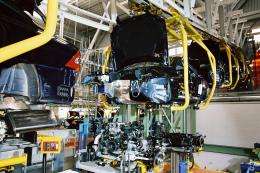
It’s a catchy concept, but one that is bound up with solid goals: The aim is to reduce the costs that arise whenever products or machines have to be changed. Up to now, the interplay between a factory’s various systems has not been optimal. This problem is at its most obvious when production is being switched to a new item, such as a new of car. The simple addition of a manipulator to a – or even just an operating system update – can cause havoc, since the slightest of changes has an impact on the entire operation. What is lacking is an intelligent link between components: the products being manufactured, the facilities doing the manufacturing, and the IT systems controlling things. This is where the experts from the IOSB are stepping in. They want to make the factory smarter by way of new interfaces that will enable it to react more or less autonomously to any changes. In this endeavor the researchers are benefiting from their years of experience of developing software solutions for factories. They are working first and foremost with Daimler AG: Their “ProVis.Agent” production management system manages around 2,000 machines in the plant where the C-Class Mercedes is made.

The key thing is to put in place intelligent links between the manufacturing facilities and the IT systems. Today, if a product is changed, the first step is to rearrange the production line. Only then is the IT system reconfigured. What’s more, the details of each machine that belongs on the line have to be entered manually into a computer. This work is tedious and error-prone, involving as it does a multitude of cryptic alphanumeric combinations. “And the trouble is, you only notice any mistakes when the line is back up and running,” says Dr. Olaf Sauer, division director at the IOSB. Thankfully, the research scientist and his team have managed to come up with a more elegant approach: Now employees can simply plug in a data cable and that’s that. The magic words are “plug and work”.

Home computing underwent a similar . In the past, you had to install the appropriate driver before you could connect a peripheral device. Nowadays, all you need to do is plug in a USB cable. The new device uses this to communicate with the PC and to identify itself. This is effectively the approach that is set to be taken in modern factories, even if things there are a little more complex. For instance, a factory will often have many different kinds of machine built by many different companies. And the sector is nowhere near having standardized software – or even a standard software language. So the researchers have invented and patented a digital translator to take the various digital device descriptions and convert them into a standard machine language called Computer Aided Engineering Exchange (CAEX). This information is then sent to a special data storage system, which is also being patented by the Institute. “Together, these two components are enough to make a simple USB-type solution feasible,” says Sauer. “Once the data have started to flow, the computer can design a process control plan for the new production line unaided.” The IT specialists have proved that the procedure works by putting together a miniature model facility comprising four components: a conveyor belt, a turntable, a testing device, and a further conveyor belt. Work has already started on an initial real-world application.

Provided by Fraunhofer-Gesellschaft search and more info website

Filter


Move the slider to adjust rank threshold, so that you can hide some of the comments.


Display comments: newest first

that_guy
Oct 05, 2011

Rank: 4.5 / 5 (2)
before we put down any uneducated comments, I want to point out the reason that factories seem so 'far behind' consumer computing is that they don't have years and millions of dollars to waste working out the kinks in a system before they start producing - They want everything to run as smoothly as possible, as soon as possible. Their system already works, and they won't change over until it has been proven that another system works better for a complicated system.

It is great that Fraunhofer is putting in the time and research with daimler to produce a system that can automatically adjust to different arrangements - there are a lot of different factors that need to be considered that are not listed in this article. This research will definitely simplify the retooling process - And in the future, you will be able to purchase an overpriced 'statement' car for just a little less.
Rank 4 /5 (3 votes)
Relevant PhysicsForums posts

More news stories

Browser wars flare in mobile space

The browser wars are heating up again, but this time the fight is for dominance of the mobile Internet.

Technology / Software

created 8 hours ago | popularity 5 / 5 (1) | comments 3

Probability of contamination from severe nuclear reactor accidents is higher than expected: study

Catastrophic nuclear accidents such as the core meltdowns in Chernobyl and Fukushima are more likely to happen than previously assumed. Based on the operating hours of all civil nuclear reactors and the number ...

Technology / Energy & Green Tech

created May 22, 2012 | popularity 3.6 / 5 (22) | comments 56 | with audio podcast

SpotterRF debuts Radar Backpack Kit (w/ Video)

(Phys.org) -- SpotterRF has announced a special radar backpack kit designed to enhance situational awareness for soldiers on the ground. The company says its special radar is designed for warfighters as part ...

Technology / Hi Tech & Innovation

created May 26, 2012 | popularity 5 / 5 (5) | comments 13 | with audio podcast report

HyperSolar shows dirty water no barrier to power world

(Phys.org) -- The Santa Barbara, California, company, HyperSolar, is set to transparently share the ups and downs of its research experiences toward the company’s ultimate vision, successfully producing ...

Technology / Energy & Green Tech

created May 24, 2012 | popularity 4.8 / 5 (16) | comments 17 | with audio podcast report

Tesla to launch electric sedan in US on June 22

Tesla Motors said Tuesday it would begin deliveries of "the world's first premium electric sedan" on June 22, slightly ahead of schedule.

Technology / Energy & Green Tech

created May 22, 2012 | popularity 4.5 / 5 (12) | comments 18


Computer model used to pinpoint prime materials for efficient carbon capture

When power plants begin capturing their carbon emissions to reduce greenhouse gases – and to most in the electric power industry, it's a question of when, not if – it will be an expensive undertaking.

'Unzipped' carbon nanotubes could help energize fuel cells, batteries

Multi-walled carbon nanotubes riddled with defects and impurities on the outside could replace some of the expensive platinum catalysts used in fuel cells and metal-air batteries, according to scientists at ...

T cells 'hunt' parasites like animal predators seek prey, study shows

By pairing an intimate knowledge of immune-system function with a deep understanding of statistical physics, a cross-disciplinary team at the University of Pennsylvania has arrived at a surprising finding: T cells use a movement ...

Yale study concludes public apathy over climate change unrelated to science literacy

Are members of the public divided about climate change because they don't understand the science behind it? If Americans knew more basic science and were more proficient in technical reasoning, would public consensus match ...

Same gene that stunts infants' growth also makes them grow too big: research

UCLA geneticists have identified the mutation responsible for IMAGe* syndrome, a rare disorder that stunts infants' growth. The twist? The mutation occurs on the same gene that causes Beckwith-Wiedemann syndrome, which makes ...

Change in developmental timing was crucial in the evolutionary shift from dinosaurs to birds: study

At first glance, it's hard to see how a common house sparrow and a Tyrannosaurus Rex might have anything in common. After all, one is a bird that weighs less than an ounce, and the other is a dinosaur that ...