Experts deny Taj Mahal 'collapse' claims

October 7, 2011 by Sasmita Mishra

Agra police officials inspect the water level of the Yamuna river as it passes the Taj Mahal

Enlarge

Archeologists overseeing the upkeep of the Taj Mahal denied on Friday a press report that said the iconic structure could collapse in as little as two years because of its weakened foundations.

Archeologists overseeing the upkeep of the Taj Mahal denied on Friday a press report that said the iconic structure could collapse in as little as two years because of its weakened foundations.

The white marble mausoleum, known as the "monument of love" after it was built by a former Mughal emperor as a tribute to his dead wife, attracts four million tourists a year to the northern Indian town of Agra.

It stands on the banks of the depleted and polluted river Yamuna, which provides moisture to wooden structures that hold up the onion-shaped dome and its four minarets.

Earlier this week, Britain's Daily Mail newspaper quoted Agra's elected parliamentarian Ramshankar Katheria as saying the Taj would "cave in between two and five years" if were not launched.

The Archeological Survey of India (ASI), which began a major facelift for the Taj Mahal in 2007, dismissed the dire predictions for the 358-year-old monument.

"We have been having regular tests conducted and agencies including Survey of India have never pointed out such threats to the survival of the Taj Mahal," ASI's chief archeologist in Agra, I.D. Dwivedi, told AFP.

Katheria denied forecasting a collapse within five years but he told AFP that he had conveyed his fears for the future of the Taj to Indian Prime Minister Manmohan Singh and President Pratibha Patil more than once.

"I am demanding a high-level enquiry to analyse the severe threat posed to the wooden structures in the foundation of the Taj," the MP said.
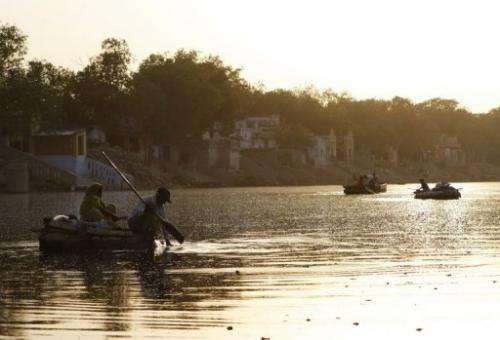
A couple collect refuse floating on the Yamuna River in New Delhi in June
Enlarge

Agra's MP Ramshankar Katheria says timbers supporting the Taj Mahal are turning brittle because the level of Yamuna is declining due to the over-extraction of water by residents and businesses.

He warned that the supporting timber was turning brittle because the level of Yamuna was declining due to the over-extraction of water by residents and businesses.

"The timber in the plinth of the Taj would soon corrode and termites could set in unless it quickly finds a source of moisture," Katheria said in an interview.

"The acrid dust from the dry riverbed is also dulling the domes of the Taj and the government must build a barrage across Yamuna to keep its water levels high," Katheria, who belongs to the main opposition BJP party, added.

The Taj, a popular backdrop to photos of tourists in India, was built by Mughal emperor Shah Jahan as a tomb for his beloved empress, Mumtaz Mahal, who died while giving birth to their 14th child in 1631.

India's Supreme Court in 1996 declared a 10,400-square-kilometre (4,015-square mile) area as a protected zone for the Taj Trapezium Zone after industries were found to be contributing to the monument's yellowing.

It ordered 292 coal-based factories to switch to natural gas or relocate outside the zone by April 30, 1997. Conventional vehicles have also been banned within a 500-metre radius of the building.

(c) 2011 AFP


Rank 5 /5 (1 vote)
Relevant PhysicsForums posts

More news stories

Change in developmental timing was crucial in the evolutionary shift from dinosaurs to birds: study

At first glance, it's hard to see how a common house sparrow and a Tyrannosaurus Rex might have anything in common. After all, one is a bird that weighs less than an ounce, and the other is a dinosaur that ...

Other Sciences / Archaeology & Fossils

created 1 hour ago | popularity 5 / 5 (2) | comments 0 | with audio podcast

Social welfare cuts ultimately come with heavy price, researchers say

(Phys.org) -- Slashing government funding for Medicaid, food stamps and other programs that serve the poor – while politically popular with some lawmakers and many conservatives – may do more harm ...

Other Sciences / Social Sciences

created May 24, 2012 | popularity 4.3 / 5 (16) | comments 149

Ancient Bethlehem seal unearthed in Jerusalem

Israeli archaeologists have discovered a 2,700-year-old seal that bears the inscription "Bethlehem," the Israel Antiquities Authority announced Wednesday, in what experts believe to be the oldest artifact ...

Other Sciences / Archaeology & Fossils

created May 23, 2012 | popularity 3.5 / 5 (14) | comments 23

Oldest Jewish archaeological evidence on the Iberian Peninsula

German archaeologists of the Friedrich Schiller University Jena found one of the oldest archaeological evidence so far of Jewish Culture on the Iberian Peninsula at an excavation site in the south of Portugal, ...

Other Sciences / Archaeology & Fossils

created May 25, 2012 | popularity 4.3 / 5 (4) | comments 12

Dollars and sense: Why are some people morally against tax?

As the U.S. presidential election campaigns heat up, the economic debate is dominated by bailouts, austerity and, inevitably, taxation. Now a new study published in Symbolic Interaction asks why tax is such an important issue ...

Other Sciences / Social Sciences

created May 23, 2012 | popularity 3 / 5 (2) | comments 12


Computer model used to pinpoint prime materials for efficient carbon capture

When power plants begin capturing their carbon emissions to reduce greenhouse gases – and to most in the electric power industry, it's a question of when, not if – it will be an expensive undertaking.

'Unzipped' carbon nanotubes could help energize fuel cells, batteries

Multi-walled carbon nanotubes riddled with defects and impurities on the outside could replace some of the expensive platinum catalysts used in fuel cells and metal-air batteries, according to scientists at ...

T cells 'hunt' parasites like animal predators seek prey, study shows

By pairing an intimate knowledge of immune-system function with a deep understanding of statistical physics, a cross-disciplinary team at the University of Pennsylvania has arrived at a surprising finding: T cells use a movement ...

Yale study concludes public apathy over climate change unrelated to science literacy

Are members of the public divided about climate change because they don't understand the science behind it? If Americans knew more basic science and were more proficient in technical reasoning, would public consensus match ...

Same gene that stunts infants' growth also makes them grow too big: research

UCLA geneticists have identified the mutation responsible for IMAGe* syndrome, a rare disorder that stunts infants' growth. The twist? The mutation occurs on the same gene that causes Beckwith-Wiedemann syndrome, which makes ...

Scientists develop ultra-sensitive test that detects diseases in their earliest stages

Scientists have developed an ultra-sensitive test that should enable them to detect signs of a disease in its earliest stages, in research published today in the journal Nature Materials.