Eurocopter demonstrates new emergency backup electric motor for helicopters
October 14, 2011 by Bob Yirka
(PhysOrg.com) -- Normally, when a helicopter loses power in flight due to engine failure, the pilot reverts to using a technique called autorotation to avoid crashing. What happens is the rotors keep spinning automatically due to the air rushing past as the aircraft descends, which prevents the aircraft from picking up speed as it descends, eventually leading to a reasonably safe landing. The problem though, is that controlling such a descent is quite difficult due to the lack of power adjustments to the angle of the rotors, which can lead to pitching. In a sense its much like the difference between regular and power brakes. The pilot is forced to rely on a lot of muscle power. To make things easier for pilots, and thus safer for all concerned, Eurocopter, the biggest maker of helicopters in the world, has come up with a way to allow a pilot to more easily maintain control of the rotors while descending and landing using an electric motor add-on.
Traditionally, the most difficult parts of using the autorotation technique, is the beginning of the event and the landing. The beginning is difficult because more often than not the helicopter is leaning towards its destination to head forward in that direction, thus the aircraft needs to be leveled off. Landing is always the most difficult part of flying a helicopter because of the many tiny adjustments that need to be made just as the aircraft touches the ground; doing so with no engine power is far more complicated due to the inability to alter the speed of descent and the difficulty in changing the rotor angle. Plus, the pilot only gets one shot.
To help in both cases, the engineers at Eurocopter have developed an electric motor and battery system that can be used in the event of engine failure. It appears that the backup motor doesnt actually make the rotors go around, but instead allows the pilot to effortlessly adjust the rotor angle, which allows for much easier stabilization both during the initial switchover and during landing.
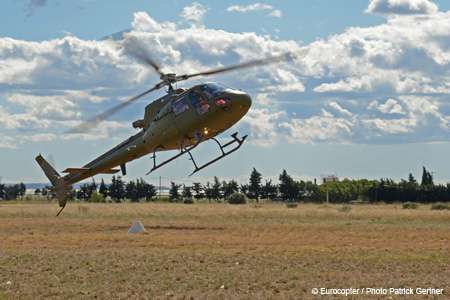
In the demonstration, a AS350 helicopter outfitted with the new motor was able to land very nearly as easily as it would have using its normal gas engine.
Eurocopter is a global company with main offices in France, Germany and Spain. It makes both commercial and military helicopters. As part of its announcement, the company said it plans to implement the new technology in all of its aircraft and will continue to look into using what its learned with the electric motor to help in the development of true hybrid helicopter technology to help cut fuel consumption.
© 2011 PhysOrg.com
-
From lemons to lemonade: Reaction uses carbon dioxide to make carbon-based semiconductor,
32 comments
-
Thioridazine kills cancer stem cells in human while avoiding toxic side-effects of conventional cancer treatments,
3 comments
-
SpaceX private rocket blasts off for space station (Update),
42 comments
-
Climate scientists say they have solved riddle of rising sea,
31 comments
-
SpaceX capsule has 'new car' smell, astronauts say (Update),
3 comments
-
Need a rigid insulation material???
16 hours ago
-
magnets or EMF in car bumpers to protect from fender bender
May 26, 2012
-
length of wire in a coil of known dimensions?
May 25, 2012
-
India Engineering Powerhouse
May 25, 2012
-
electromagnet core dereference between hard and soft iron
May 25, 2012
-
Measuring water pressure in an open tank
May 24, 2012
- More from Physics Forums - General Engineering
More news stories
Browser wars flare in mobile space
The browser wars are heating up again, but this time the fight is for dominance of the mobile Internet.
8 hours ago |
5 / 5 (1) |
3
Probability of contamination from severe nuclear reactor accidents is higher than expected: study
Catastrophic nuclear accidents such as the core meltdowns in Chernobyl and Fukushima are more likely to happen than previously assumed. Based on the operating hours of all civil nuclear reactors and the number ...
Technology / Energy & Green Tech
May 22, 2012 |
3.6 / 5 (22) |
56
|
SpotterRF debuts Radar Backpack Kit (w/ Video)
(Phys.org) -- SpotterRF has announced a special radar backpack kit designed to enhance situational awareness for soldiers on the ground. The company says its special radar is designed for warfighters as part ...
HyperSolar shows dirty water no barrier to power world
(Phys.org) -- The Santa Barbara, California, company, HyperSolar, is set to transparently share the ups and downs of its research experiences toward the companys ultimate vision, successfully producing ...
Tesla to launch electric sedan in US on June 22
Tesla Motors said Tuesday it would begin deliveries of "the world's first premium electric sedan" on June 22, slightly ahead of schedule.
Technology / Energy & Green Tech
May 22, 2012 |
4.5 / 5 (12) |
18
Computer model used to pinpoint prime materials for efficient carbon capture
When power plants begin capturing their carbon emissions to reduce greenhouse gases and to most in the electric power industry, it's a question of when, not if it will be an expensive undertaking.
'Unzipped' carbon nanotubes could help energize fuel cells, batteries
Multi-walled carbon nanotubes riddled with defects and impurities on the outside could replace some of the expensive platinum catalysts used in fuel cells and metal-air batteries, according to scientists at ...
T cells 'hunt' parasites like animal predators seek prey, study shows
By pairing an intimate knowledge of immune-system function with a deep understanding of statistical physics, a cross-disciplinary team at the University of Pennsylvania has arrived at a surprising finding: T cells use a movement ...
Yale study concludes public apathy over climate change unrelated to science literacy
Are members of the public divided about climate change because they don't understand the science behind it? If Americans knew more basic science and were more proficient in technical reasoning, would public consensus match ...
Same gene that stunts infants' growth also makes them grow too big: research
UCLA geneticists have identified the mutation responsible for IMAGe* syndrome, a rare disorder that stunts infants' growth. The twist? The mutation occurs on the same gene that causes Beckwith-Wiedemann syndrome, which makes ...
Change in developmental timing was crucial in the evolutionary shift from dinosaurs to birds: study
At first glance, it's hard to see how a common house sparrow and a Tyrannosaurus Rex might have anything in common. After all, one is a bird that weighs less than an ounce, and the other is a dinosaur that ...
Oct 14, 2011
Rank: 5 / 5 (1)
Great bost for helicopter safety.
Now they just have to add software which automatically manages the stabilizing adjustments in the event of a power failure (or at the very least at the touch of an 'emergency' button) and then they've really got something.
Oct 14, 2011
Rank: not rated yet
Oct 14, 2011
Rank: 5 / 5 (2)
Oct 14, 2011
Rank: 5 / 5 (1)
Oct 14, 2011
Rank: 3 / 5 (1)
a) They are already shut down when not needed (as long as you don't triger them they don't draw power)
b) The event of an engine failure is so unlikely in cars/trucks..and even if: in those cases both can e gotten safely to a halt within seconds anyways.
There is no added benefit for road vehicles here (quite the opposite as the weight of such a system would continually add to fuel consumption)
Oct 14, 2011
Rank: 5 / 5 (1)
There are a number of ways a car can stall from lack of fuel (sadly more common than you think), to unexpected issues, like a radiator leak, etc. To issues caused by poor maintenance.
On most cars, if you stall, the breaks will quickly become stiff, and almost impossible to use (You can always use the mechanical emergency break if you have the presence of mind). Same thing with power steering. You may have 5 to 10 seconds before the car becomes very difficult to drive.
This is generally a good safe window for most occasions, it is not without some perils.
adding this to a car would be pointless and impractical due to the increased cost, lowered fuel efficiency, and limited risk the problem causes...and if you have electric, rather than hydraulic brakes, you wouldn't need this because you have a battery..
Oct 15, 2011
Rank: not rated yet
Ideally we will be moving towards smaller, lighter cars what won't need assist.
Oct 17, 2011
Rank: not rated yet
I've actually experienced this once in a small van (I was being stupid and turned the motor off because I was sitting in a traffic jam on an steeply descending bit of road. When it moved a few meters I released the brakes to simply roll ahead and was almost unable to stop the van again before rearending the next car because the brakes had become unworkeable)
But for emergencies (stalling motor, etc.) I think the car battery should be enough to keep the system working until you can stop at the roadside. In that event you're not going to go much further, anyways (i.e. for a car this emergency lasts seconds until the car is stopped, whereas for a helicopter it can be minutes)
Oct 17, 2011
Rank: not rated yet
I stupidly did nearly the same thing a while ago. i ran into an unexpected traffic jam because of an accident, and i started running really low on fuel. I turned it off and just used the brakes to roll down a hill. The brakes stopped working and I nearly freaked. Fortunately, it did stop once I jammed the e-brake.
Oct 24, 2011
Rank: not rated yet
I haven't had the Fun & Excitement of a loss of power for a rather long time but I do remember it well, especially when the power assist systems first became pretty much universal and now that one must pay extra to retain manual transmission.