EU moves to 'green' its farms in reform effort
October 12, 2011 by Yann Ollivier
The EU has called for a greener, fairer farm policy as it moved to radically overhaul its Common Agricultural Policy (CAP) by capping subsidies and tying them to environmental concerns.
The EU called for a greener, fairer farm policy on Wednesday as it moved to radically overhaul its Common Agricultural Policy (CAP) by capping subsidies and tying them to environmental concerns.
"The CAP must be redefined," EU Agriculture Commissioner Dacian Ciolos told the European Parliament, outlining a sweeping plan to reform the EU's controversial farming subsidies from 2014 -- a plan set to trigger months of heated debate.
Among his proposals to rethink the CAP, which traditionally accounts for about 40 percent of the bloc's annual spending of nearly 140 billion euros, is a call for 30 percent of EU direct farm subisidies to be conditional on respect for the environment.
The measures include crop diversity, maintaining permanent pastures and creating ecological fallows that are havens for plants, animals and insects on at least seven percent of arable land.
Ciolos said the reforms would lead to an agricultural U-turn, putting Europe's 12 million farms on the road to "sustainable practices" after years of free for all.
To even out subsidies in the interests of fairness, Ciolos wants to cap payouts to farmers at 300,000 euros ($424,000) per year. In addition, levies would be applied progressively on all payments exceeding 150,000 euros.
While highly-mechanised large farms would be hit, those using a large number of workers could win exemptions as salaries could be deducted from the handouts.
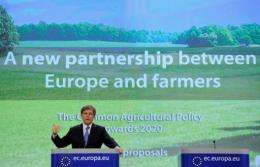
EU Agriculture and Rural Development commissioner Dacian Ciolos speaks at a news conference on the adoption by the EC of the legislative proposals for the Common Agriculture Policy (CAP) after 2013 at the European headquarters in Brussels. The EU has called for a greener, fairer farm policy as it moved to radically overhaul CAP by capping subsidies and tying them to environmental concerns.
Germany, the Netherlands and Britain -- where the royal family are major beneficiaries of the subsidies -- strongly oppose capping subsidies on the grounds it could lead to a carve-up of large farms.Large farms remain the rule across Europe, with EU data this week showing that over the last seven years, the number of farms has decreased 20 percent but the average size has come down only two percent.
Likewise in the interests of the environment, Ciolos is proposing to gradually favour extensive rather than intensive farming by progressively calculating subsidies per hectare (acre) from 2014 to 2019, rather than basing payments on production, as has often been the case.
The proposals are intended also to address squabbling between member states on their respective quotas, with newer members from eastern Europe complaining more money goes to founder states.
However, while France, currently the top beneficiary, would see a 1.5 percent fall in the 2014-2019, it would remain the largest recipient.
Romania, Bulgaria and the three Baltic nations would see an increase -- in Romania's case of 33.7 percent. But eastern EU members would continue to be behind the older EU members, with Latvia notably 54 percent below the average.
"Politics, especially at the European level, is the art of what is possible," Ciolos said. "The most important thing is to launch movement in the right direction."
Responding to criticism from the EU's Court of Auditors, the commission proposals also seek to ensure subsidies go only to "active farmers" -- rather than to airports or golf-clubs, as has sometimes been the case.

Activists of the Friends of the Earth Europe environmental group stage a protest on October 12 in front of EU headquarters in Brussels. The EU has called for a greener, fairer farm policy as it moved to radically overhaul its Common Agricultural Policy (CAP) by capping subsidies and tying them to environmental concerns.
The reform proposals will have to be approved by both the parliament and all member states before taking effect.But critics are already making their voices heard, with an angry response from Europe's leading farmers' organisation, Copa-Cogeca.
"At a time when the Chinese are massively purchasing land in Africa, we are being asked to leave seven percent of our land fallow," said German Copa-Cogeca official Gerd Sonnleitner.
The group said the reform would leave six to seven million hectares idle.
Bio-innovation leader Novozymes meanwhile said the proposals failed to go far enough.
"A bio-based economy can foster the transition of Europe's agriculture towards an economically and environmentally competitive sector," it said in a statement.
"However, we are disappointed that the current proposal falls short in delivering concrete measures."
(c) 2011 AFP
-
From lemons to lemonade: Reaction uses carbon dioxide to make carbon-based semiconductor,
32 comments
-
Thioridazine kills cancer stem cells in human while avoiding toxic side-effects of conventional cancer treatments,
3 comments
-
SpaceX private rocket blasts off for space station (Update),
42 comments
-
Climate scientists say they have solved riddle of rising sea,
31 comments
-
SpaceX capsule has 'new car' smell, astronauts say (Update),
3 comments
-
Hypothetical desert earth
16 hours ago
-
More human population = greater mass?
May 25, 2012
-
Conversion from aircraft bearing to normal degrees
May 23, 2012
-
Interpretation/Analysis of the Lab results(HEPA filter)
May 22, 2012
-
Has anyone here attended the The Urbino Summer School in Paleoclimatology?
May 22, 2012
-
Earthquakes: Mag 6 N. Italy and Mag 5.6 W. Bulgaria
May 21, 2012
- More from Physics Forums - Earth
More news stories
Yale study concludes public apathy over climate change unrelated to science literacy
Are members of the public divided about climate change because they don't understand the science behind it? If Americans knew more basic science and were more proficient in technical reasoning, would public consensus match ...
1 hour ago |
not rated yet |
4
|
10 million years needed to recover from mass extinction
It took some 10 million years for Earth to recover from the greatest mass extinction of all time, latest research has revealed.
Space & Earth / Earth Sciences
1 hour ago |
not rated yet |
1
|
Sophisticated simulations predict future warming
The chances of our planet being hit by a global warming of 3 degrees Celsius by 2050 is as likely as it being hit by an increase of 1.4 degrees, new research shows. Presented in the journal Nature Geoscience, the British study ...
Space & Earth / Earth Sciences
May 22, 2012 |
4.4 / 5 (9) |
51
Aliens don't want to eat us, says former SETI director
Alien life probably isnt interested in having us for dinner, enslaving us or laying eggs in our bellies, according to a recent statement by former SETI director Jill Tarter.
Space & Earth / Space Exploration
May 25, 2012 |
4.4 / 5 (13) |
39
Kyoto Protocol architect 'frustrated' by climate dialogue
UN climate talks are going nowhere, as politicians dither or bicker while the pace of warming dangerously speeds up, one of the architects of the Kyoto Protocol told AFP.
May 23, 2012 |
3.7 / 5 (7) |
39
Computer model used to pinpoint prime materials for efficient carbon capture
When power plants begin capturing their carbon emissions to reduce greenhouse gases and to most in the electric power industry, it's a question of when, not if it will be an expensive undertaking.
'Unzipped' carbon nanotubes could help energize fuel cells, batteries
Multi-walled carbon nanotubes riddled with defects and impurities on the outside could replace some of the expensive platinum catalysts used in fuel cells and metal-air batteries, according to scientists at ...
T cells 'hunt' parasites like animal predators seek prey, study shows
By pairing an intimate knowledge of immune-system function with a deep understanding of statistical physics, a cross-disciplinary team at the University of Pennsylvania has arrived at a surprising finding: T cells use a movement ...
Same gene that stunts infants' growth also makes them grow too big: research
UCLA geneticists have identified the mutation responsible for IMAGe* syndrome, a rare disorder that stunts infants' growth. The twist? The mutation occurs on the same gene that causes Beckwith-Wiedemann syndrome, which makes ...
Change in developmental timing was crucial in the evolutionary shift from dinosaurs to birds: study
At first glance, it's hard to see how a common house sparrow and a Tyrannosaurus Rex might have anything in common. After all, one is a bird that weighs less than an ounce, and the other is a dinosaur that ...
Scientists develop ultra-sensitive test that detects diseases in their earliest stages
Scientists have developed an ultra-sensitive test that should enable them to detect signs of a disease in its earliest stages, in research published today in the journal Nature Materials.

