Close encounters of the galactic kind
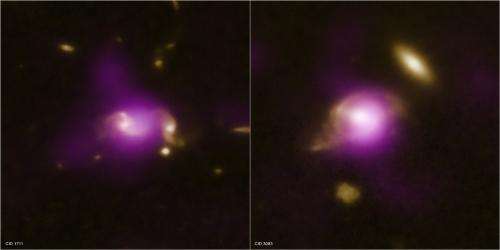
Credits: X-ray: NASA/CXC/IPMU/J.Silverman et al; Optical: NASA/STScI/Caltech/N.Scoville et al.
(PhysOrg.com) -- Astronomers have used a large survey to test a prediction that close encounters between galaxies can trigger the rapid growth of supermassive black holes. Key to this work was Chandra's unique ability to pinpoint actively growing black holes through the X-rays they generate.
The researchers looked at 562 pairs of galaxies ranging in distances from about 3 billion to 8 billion light years from Earth. They found that the galaxies in the early stages of an encounter with another were more likely than isolated, or "lonelier" galaxies to have actively growing black holes in their cores.
These two composite images show a sample of the pairs of galaxies that are undergoing close encounters in the survey. In these images, the data from NASA's Chandra X-ray Observatory are shown in purple and Hubble Space Telescope data are in gold. In both images, the point-like X-ray source near the center is generated by gas that has been heated to millions of degrees as it falls toward a supermassive black hole located in the middle of its host galaxy. The other faint X-ray emission may be caused by hot gas associated with the pair of galaxies.
The authors of the study estimate that nearly one-fifth of all moderately active black holes are found in galaxies undergoing the early stages of an interaction. This leaves open the question of what events are responsible for fueling the remaining 80% of growing black holes. Some of these may involve the late stages of mergers between two galaxies. Less violent events such as gas falling in from the halo of the galaxy, or the disruption of small satellite galaxies are also likely to play an important role.
The survey used in this research is called the Cosmic Evolution Survey (COSMOS), which covers two square degrees on the sky with observations from several major space-based observatories including Chandra and Hubble. Accurate distance information about the galaxies was also derived from optical observations with the European Southern Observatory's Very Large Telescope. The researchers compared a sample of 562 galaxies in pairs with 2726 solo galaxies to come to their conclusions.
A paper describing this work has been accepted for publication in The Astrophysical Journal. The study was led by John Silverman from the Institute for the Physics and Mathematics of the Universe (IPMU) at the University of Tokyo in Japan. There are 54 co-authors from various institutions around the world.
Provided by Chandra X-ray Observatory
-
From lemons to lemonade: Reaction uses carbon dioxide to make carbon-based semiconductor,
32 comments
-
Thioridazine kills cancer stem cells in human while avoiding toxic side-effects of conventional cancer treatments,
3 comments
-
SpaceX private rocket blasts off for space station (Update),
42 comments
-
Climate scientists say they have solved riddle of rising sea,
31 comments
-
SpaceX capsule has 'new car' smell, astronauts say (Update),
3 comments
-
Distance of planets from stars and revolution
1 hour ago
-
revamping general concept and cosmological principle
May 25, 2012
-
Transiting Exoplanet Light Curve
May 25, 2012
-
Math behind Theoretical Physics
May 24, 2012
-
Do we know whats at the center of galaxies yet?
May 23, 2012
-
Structure of the Milky Way?
May 20, 2012
- More from Physics Forums - General Astronomy
More news stories
Yale study concludes public apathy over climate change unrelated to science literacy
Are members of the public divided about climate change because they don't understand the science behind it? If Americans knew more basic science and were more proficient in technical reasoning, would public consensus match ...
1 hour ago |
not rated yet |
4
|
10 million years needed to recover from mass extinction
It took some 10 million years for Earth to recover from the greatest mass extinction of all time, latest research has revealed.
Space & Earth / Earth Sciences
1 hour ago |
not rated yet |
1
|
Sophisticated simulations predict future warming
The chances of our planet being hit by a global warming of 3 degrees Celsius by 2050 is as likely as it being hit by an increase of 1.4 degrees, new research shows. Presented in the journal Nature Geoscience, the British study ...
Space & Earth / Earth Sciences
May 22, 2012 |
4.4 / 5 (9) |
51
Aliens don't want to eat us, says former SETI director
Alien life probably isnt interested in having us for dinner, enslaving us or laying eggs in our bellies, according to a recent statement by former SETI director Jill Tarter.
Space & Earth / Space Exploration
May 25, 2012 |
4.4 / 5 (13) |
39
Kyoto Protocol architect 'frustrated' by climate dialogue
UN climate talks are going nowhere, as politicians dither or bicker while the pace of warming dangerously speeds up, one of the architects of the Kyoto Protocol told AFP.
May 23, 2012 |
3.7 / 5 (7) |
39
Computer model used to pinpoint prime materials for efficient carbon capture
When power plants begin capturing their carbon emissions to reduce greenhouse gases and to most in the electric power industry, it's a question of when, not if it will be an expensive undertaking.
'Unzipped' carbon nanotubes could help energize fuel cells, batteries
Multi-walled carbon nanotubes riddled with defects and impurities on the outside could replace some of the expensive platinum catalysts used in fuel cells and metal-air batteries, according to scientists at ...
T cells 'hunt' parasites like animal predators seek prey, study shows
By pairing an intimate knowledge of immune-system function with a deep understanding of statistical physics, a cross-disciplinary team at the University of Pennsylvania has arrived at a surprising finding: T cells use a movement ...
Same gene that stunts infants' growth also makes them grow too big: research
UCLA geneticists have identified the mutation responsible for IMAGe* syndrome, a rare disorder that stunts infants' growth. The twist? The mutation occurs on the same gene that causes Beckwith-Wiedemann syndrome, which makes ...
Change in developmental timing was crucial in the evolutionary shift from dinosaurs to birds: study
At first glance, it's hard to see how a common house sparrow and a Tyrannosaurus Rex might have anything in common. After all, one is a bird that weighs less than an ounce, and the other is a dinosaur that ...
Scientists develop ultra-sensitive test that detects diseases in their earliest stages
Scientists have developed an ultra-sensitive test that should enable them to detect signs of a disease in its earliest stages, in research published today in the journal Nature Materials.
Oct 26, 2011
Rank: 1.6 / 5 (7)
Oct 26, 2011
Rank: 3.9 / 5 (7)
Welcome back Tux. We missed you. The repulsive one has gone quiet and ether boy has been dominating the conversation with himself. Never the less, your application was denied.
AGN's near galactic interactions are most likely caused by the disturbance of gravity resulting from the proximity of another galaxy. Why make up new physics to explain something that seems pretty simple? I am curious as to how often we see double AGN's in these events? i.e. AGN's in both of the merging/colliding/passing galaxies?
The article raises the question of what factors contribute to creation/maintenance of the other 80% of AGN's, those not associated with galactic interactions. My guess, worth less than the pixels displaying it, is AGN's just happen. A stellar collision here, supernova there, thicker primordial soup here, binary star ejected over there, etc. Something "random" that causes a chain reaction/feeding frenzy. Not very creative, am I?
Oct 26, 2011
Rank: 1.7 / 5 (6)
Rather simple model, but which steps in the holy water. Thus, it represents an assault for the rationally-minded. Note the (your-own?) forthcoming reactions. It will offer a clue about the mental fixations of the irrationally rational-minded. Nature does not care about your fixations!
Oct 26, 2011
Rank: 4.3 / 5 (6)
We don't care about your fixations, at least until you show us some real work supporting anything you say.
Again. Application denied.
Oct 26, 2011
Rank: 1 / 5 (9)
Experimental observations and data over the last 50 years [1-4, and references therein] have shown that the Sun, Earth's climate, the universe, and life itself are all sustained by dynamic competition between:
a.) Attractive forces of gravity, and
b.) Repulsive forces between neutrons:
1. "Super-fluidity in the solar interior:
Implications for solar eruptions and climate",
Journal of Fusion Energy 21, 193-198 (2002)
http://arxiv.org/.../0501441
2. "Neutron Repulsion", The APEIRON Journal, in press (2011)
http://arxiv.org/....1499v1. "Is the Universe Expanding?"
3. "Is the Universe expanding?"
Journal of Cosmology 13, 4187-4190 (2011)
http://journalofc...102.html
4. "Origin and Evolution of Life"
Journal of Modern Physics 2, 587-594 (2011)
http://dl.dropbox...5079.pdf
With kind regards,
Oliver K. Manuel
Oct 27, 2011
Rank: 5 / 5 (3)
By magically creating new matter of ... of ungh I know TuxMagic as Seen On TV.
Steps in crap anyway by creating matter and energy out handwaving.
Mr. PitchMan today announced:
"Here at As Seen On TV labs we have recently hired Tuxford to design our new Mr. Fusion, which will only use that name bacause its so cool, as Mr. Fusion will actualy produce energy by waving simulacra of Tuxfords hands. The massive power to ignore all reality in the TuxSimHandsTM* will produce the power needed to fill our new line of WoopieCushions with hot air."
*Peanuts are sometimes processed on the same equipment.
Ethelred
Oct 27, 2011
Rank: 4.8 / 5 (6)
Goodbye Oliver you have proved you don't exist.
Unless of course you can actually show some evidence for Neutron Repulsion and give us an idea of what its properties are beyond the magic of whatever you want that day as opposed to what you wanted yesterday.
Remember Oliver its your own faulty when you contradict yourself. And pretending you aren't doing that doesn't change fact that you do.
Ethelred
Oct 27, 2011
Rank: 4.2 / 5 (5)
http://mominer.ms...hildren/
http://www.homefa...uel.html