Second Dutch nuclear rail shipment heads to France
October 12, 2011

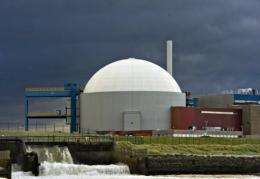
Dutch nuclear power station Borssele prepares a transport of nuclear waste by train

Enlarge

Dutch nuclear power station Borssele prepares a transport of nuclear waste by train from Borssele to the French nuclear processing plant in La Hague in France. Demonstrations against the transport are expected.

A train carrying nuclear waste on Tuesday left the Netherlands bound for a recycling plant in France, the second such shipment that has sparked ire and protests of anti-nuclear activists.

"The convoy just left," said Fenny Barends, a spokeswoman for the EPZ operator of the Borssele where the waste was produced.

The train is due to pass through Belgium before arriving on Thursday at a nuclear recycling plant in La Hague in France's northwest.

Environmental organisations called for activists to protest the shipment and some 20 protestors lined its route in Goes northeast of Borssele, chanting "down with nuclear power" and holding up signs " no thanks".

It marked the second of 10 planned shipments from Borssele to La Hague over the next two years.

During the first shipment in June, police arrested 33 Dutch activists belonging to Greenpeace after they chained themselves to the traintracks, forcing the convoy to be delayed by several hours.

"There is as much nuclear waste in this train as what escaped during the Chernobyl explosion," Greenpeace nuclear energy campaign spokesman Ike Teuling told AFP, referring to the 1986 accident in then Soviet Union.

"We tried to take radioactivity measures this morning but the police didn't allow us to come near. We'll try again tonight in Essen (on the Belgian-Dutch border) since the train will stop there for 10 minutes."

says that only a small part of the will be recycled and what is returned to the Netherlands will remain for 240,000 years.

(c) 2011 AFP


Rank not rated yet
Relevant PhysicsForums posts

More news stories

Yale study concludes public apathy over climate change unrelated to science literacy

Are members of the public divided about climate change because they don't understand the science behind it? If Americans knew more basic science and were more proficient in technical reasoning, would public consensus match ...

Space & Earth / Environment

created 1 hour ago | popularity not rated yet | comments 4 | with audio podcast

10 million years needed to recover from mass extinction

It took some 10 million years for Earth to recover from the greatest mass extinction of all time, latest research has revealed.

Space & Earth / Earth Sciences

created 1 hour ago | popularity not rated yet | comments 1 | with audio podcast

Sophisticated simulations predict future warming

The chances of our planet being hit by a global warming of 3 degrees Celsius by 2050 is as likely as it being hit by an increase of 1.4 degrees, new research shows. Presented in the journal Nature Geoscience, the British study ...

Space & Earth / Earth Sciences

created May 22, 2012 | popularity 4.4 / 5 (9) | comments 51

Aliens don't want to eat us, says former SETI director

Alien life probably isn’t interested in having us for dinner, enslaving us or laying eggs in our bellies, according to a recent statement by former SETI director Jill Tarter.

Space & Earth / Space Exploration

created May 25, 2012 | popularity 4.4 / 5 (13) | comments 39

Kyoto Protocol architect 'frustrated' by climate dialogue

UN climate talks are going nowhere, as politicians dither or bicker while the pace of warming dangerously speeds up, one of the architects of the Kyoto Protocol told AFP.

Space & Earth / Environment

created May 23, 2012 | popularity 3.7 / 5 (7) | comments 39


Computer model used to pinpoint prime materials for efficient carbon capture

When power plants begin capturing their carbon emissions to reduce greenhouse gases – and to most in the electric power industry, it's a question of when, not if – it will be an expensive undertaking.

'Unzipped' carbon nanotubes could help energize fuel cells, batteries

Multi-walled carbon nanotubes riddled with defects and impurities on the outside could replace some of the expensive platinum catalysts used in fuel cells and metal-air batteries, according to scientists at ...

T cells 'hunt' parasites like animal predators seek prey, study shows

By pairing an intimate knowledge of immune-system function with a deep understanding of statistical physics, a cross-disciplinary team at the University of Pennsylvania has arrived at a surprising finding: T cells use a movement ...

Same gene that stunts infants' growth also makes them grow too big: research

UCLA geneticists have identified the mutation responsible for IMAGe* syndrome, a rare disorder that stunts infants' growth. The twist? The mutation occurs on the same gene that causes Beckwith-Wiedemann syndrome, which makes ...

Change in developmental timing was crucial in the evolutionary shift from dinosaurs to birds: study

At first glance, it's hard to see how a common house sparrow and a Tyrannosaurus Rex might have anything in common. After all, one is a bird that weighs less than an ounce, and the other is a dinosaur that ...

Scientists develop ultra-sensitive test that detects diseases in their earliest stages

Scientists have developed an ultra-sensitive test that should enable them to detect signs of a disease in its earliest stages, in research published today in the journal Nature Materials.