On guard against drought
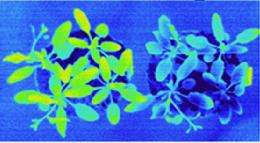
Figure 1: Thermal images of control plants (left) with normal leaf temperature, and atabcg22 mutant plants (right), with lower leaf temperature and greater water loss, captured by an infrared thermography device. Credit: Ref. 1 © 2011 Blackwell Publishing Ltd
Identification of a gene that helps plants to conserve water under drought conditions will bring biologists closer to understanding how plants tolerate drought. Researchers, led by Takashi Kuromori at Japan's RIKEN Plant Science Center, Yokohama, report this discovery in The Plant Journal.
In order to grow, green plants must take up carbon dioxide via gas exchange from the atmosphere for photosynthesis, which occurs through tiny pores called stomata on the surface of leaves and other aerial organs. However, plants also lose water during this opening through a separate process called transpiration.
During drought, plants protect themselves from excessive water loss by closely regulating stomatal opening and closing. Each stomatal pore is flanked by a pair of kidney-shaped guard cells. When the plant becomes desiccated, the plant hormone abscisic acid (ABA) mediates the drought response by facilitating stomatal closure through its action on the specialized guard cells. Only when sufficient water is available do the guard cells change back to their original shape, opening the pore and allowing transpiration to resume.
We wish to understand the molecular mechanisms that trigger guard cell responses to environmental and hormonal stimuli, explains Kuromori.
Working with the plant Arabidopsis thaliana, Kuromori and colleagues previously identified a gene called AtABCG25, which is expressed in vascular tissues and is involved in ABA transport and responses*. In their latest work, they identified a related gene called AtABCG22, which is expressed predominantly in guard cells and regulates stomata in Arabidopsis. Both genes encode ATP-binding cassette (ABC) transporter proteins, which use chemical energy stored in the biological molecule ATP to ferry other molecules across cell membranes.
Evaporative cooling during transpiration reduces leaf temperature. Thermal imaging methods can therefore be used to monitor transpirational water loss (Fig. 1). Using such methods, the researchers showed that mutant plants lacking functional AtABCG22 protein had lower leaf temperature and increased water loss compared to normal, wild-type plants. They also found that the mutant plants were more susceptible to drought stress than were wild-type plants. These findings imply that AtABCG22 plays a role in stomatal regulation and in protecting plants against drought stress, says Kuromori.
Further experiments, in which the researchers crossed various mutant plants, revealed that AtABCG22 interacts genetically with other genes already known to be involved in ABA biosynthesis, transport or signaling.
Our next task will be to identify the exact target molecule, or molecules of AtABCG22, says Kuromori. We hope that our work will eventually lead to the breeding of drought-tolerant crop varieties.
More information: Kuromori, T., et al. Arabidopsis mutants of AtABCG22, an ABC transporter gene, increase water transpiration and drought susceptibility. The Plant Journal 67, 885894 (2011).
*Kuromori, T., et al. ABC transporter AtABCG25 is involved in abscisic acid transport and responses. Proceedings of the National Academy of Sciences USA 107, 23612366 (2010).
Provided by
RIKEN
-
From lemons to lemonade: Reaction uses carbon dioxide to make carbon-based semiconductor,
32 comments
-
Thioridazine kills cancer stem cells in human while avoiding toxic side-effects of conventional cancer treatments,
3 comments
-
SpaceX private rocket blasts off for space station (Update),
42 comments
-
Climate scientists say they have solved riddle of rising sea,
31 comments
-
SpaceX capsule has 'new car' smell, astronauts say (Update),
3 comments
-
What would stain as translucent on light-coloured fabric?
20 hours ago
-
How do I identify different bacteria on culture plates?
May 26, 2012
-
Why Do Dogs do Strange things...
May 25, 2012
-
What does exophillic and endophillic mean in terms of mosquito and their control?
May 24, 2012
-
Semen stains glows under black lights (uv light)?
May 23, 2012
-
Question on Human Chromosome 2
May 23, 2012
- More from Physics Forums - Biology
More news stories
Manufacturing genes to attack flu virus
An international research team has manufactured a new protein that can combat deadly flu epidemics.
1 hour ago |
not rated yet |
0
|
Scientist: Evolution debate will soon be history
(AP) -- Richard Leakey predicts skepticism over evolution will soon be history. Not that the avowed atheist has any doubts himself.
19 hours ago |
3.3 / 5 (18) |
73
More plant species responding to global warming than previously thought
(Phys.org) -- Far more wild plant species may be responding to global warming than previous large-scale estimates have suggested.
May 22, 2012 |
4.6 / 5 (14) |
18
|
Thousands of shellfish found dead in Peru
Thousands of crustaceans were found dead off the coast of Lima following the mystery mass death of dolphins and pelicans, the Peruvian Navy said Friday.
May 26, 2012 |
4.8 / 5 (4) |
7
For monogamous sparrows, it doesn't pay to stray (but they do it anyway)
It's quite common for a female song sparrow to stray from her breeding partner and mate with the male next door, but a new study shows that sleeping around can be costly.
May 22, 2012 |
5 / 5 (2) |
8
|
Computer model used to pinpoint prime materials for efficient carbon capture
When power plants begin capturing their carbon emissions to reduce greenhouse gases and to most in the electric power industry, it's a question of when, not if it will be an expensive undertaking.
'Unzipped' carbon nanotubes could help energize fuel cells, batteries
Multi-walled carbon nanotubes riddled with defects and impurities on the outside could replace some of the expensive platinum catalysts used in fuel cells and metal-air batteries, according to scientists at ...
T cells 'hunt' parasites like animal predators seek prey, study shows
By pairing an intimate knowledge of immune-system function with a deep understanding of statistical physics, a cross-disciplinary team at the University of Pennsylvania has arrived at a surprising finding: T cells use a movement ...
Yale study concludes public apathy over climate change unrelated to science literacy
Are members of the public divided about climate change because they don't understand the science behind it? If Americans knew more basic science and were more proficient in technical reasoning, would public consensus match ...
Same gene that stunts infants' growth also makes them grow too big: research
UCLA geneticists have identified the mutation responsible for IMAGe* syndrome, a rare disorder that stunts infants' growth. The twist? The mutation occurs on the same gene that causes Beckwith-Wiedemann syndrome, which makes ...
Change in developmental timing was crucial in the evolutionary shift from dinosaurs to birds: study
At first glance, it's hard to see how a common house sparrow and a Tyrannosaurus Rex might have anything in common. After all, one is a bird that weighs less than an ounce, and the other is a dinosaur that ...