Distant galaxies reveal the clearing of the cosmic fog
October 12, 2011

Distant galaxies reveal the clearing of the cosmic fog

Enlarge

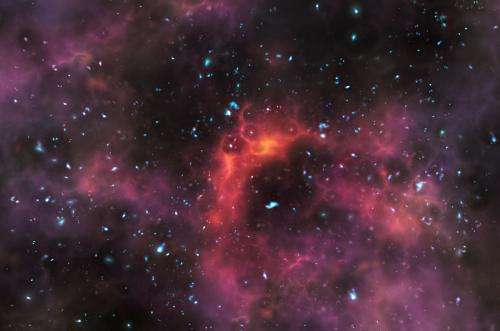
This artist's impression shows galaxies at a time less than a billion years after the Big Bang, when the Universe was still partially filled with hydrogen fog that absorbed ultraviolet light. New observations with the ESO Very Large Telescope are probing this important phase of the early Universe by studying the light from some of the most distant galaxies ever detected. Credit: Image courtesy of ESO/M. Kornmesser

(PhysOrg.com) -- Scientists have used ESO's Very Large Telescope to probe the early Universe at several different times as it was becoming transparent to ultraviolet light. This brief but dramatic phase in cosmic history occurred around 13 billion years ago. By studying some of the most distant galaxies, the team has been able to establish a timeline for reionisation for the first time. They have also demonstrated that this phase must have happened quicker than previously thought.

An international team of astronomers used the as a time machine, to look back into the and observe several of the most distant galaxies ever detected. They have been able to measure their distances accurately and find that we are seeing them as they were between 780 million and a billion years after the Big Bang.

The new observations have allowed astronomers to establish a timeline for what is known as the age of reionisation for the first time. During this phase the fog of hydrogen gas in the early Universe was clearing, allowing ultraviolet light to pass unhindered for the first time.

This video is not supported by your browser at this time.

This animated artist’s impression shows galaxies at a time less than a billion years after the Big Bang, when the Universe was still partially filled with hydrogen fog that absorbed ultraviolet light. New observations with the ESO Very Large Telescope are probing this important phase of the early Universe by studying the light from some of the most distant galaxies ever detected. Credit: ESO/M. Kornmesser

The new results, which will appear in the , build on a long and systematic search for distant galaxies that the team has carried out with the VLT over the last three years.

"Archaeologists can reconstruct a timeline of the past from the artifacts they find in different layers of soil. Astronomers can go one better: we can look directly into the remote past and observe the faint light from different galaxies at different stages in cosmic evolution," explains Adriano Fontana, of INAF Rome Astronomical Observatory who led this project. "The differences between the galaxies tell us about the changing conditions in the Universe over this important period, and how quickly these changes were occurring."

Different glow brightly at characteristic colours. These spikes in brightness are known as emission lines. One of the strongest ultraviolet emission lines is the Lyman-alpha line, which comes from . It is bright and recognisable enough to be seen even in observations of very faint and faraway galaxies.

Spotting the Lyman-alpha line for five very distant galaxies allowed the team to do two key things: first, by observing how far the line had been shifted toward the red end of the spectrum, they were able to determine the galaxies' distances, and hence how soon after the Big Bang they could see them. This let them place them in order, creating a timeline which shows how the galaxies' light evolved over time. Secondly, they were able to see the extent to which the Lyman-alpha emission -- which comes from glowing hydrogen within the galaxies -- was reabsorbed by the neutral hydrogen fog in intergalactic space at different points in time.

"We see a dramatic difference in the amount of ultraviolet light that was blocked between the earliest and latest galaxies in our sample," says lead author Laura Pentericci of INAF Rome . "When the Universe was only 780 million years old this neutral hydrogen was quite abundant, filling from 10 to 50% of the Universe' volume. But only 200 million years later the amount of neutral hydrogen had dropped to a very low level, similar to what we see today. It seems that reionisation must have happened quicker than astronomers previously thought."
Distant galaxies reveal the clearing of the cosmic fog
Enlarge

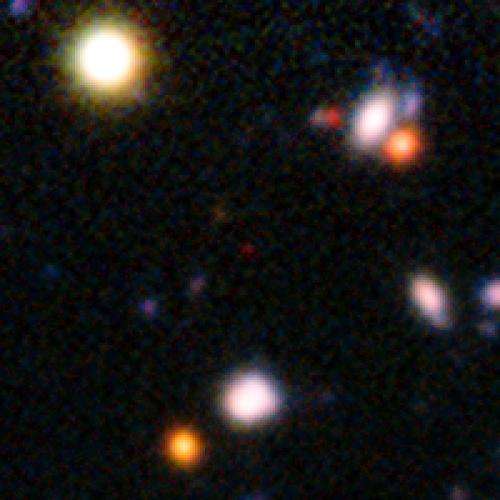
The red speck at the centre of this very deep image from the ESO Very Large Telescope shows the galaxy NTTDF-474, one of the most distant ever to have had its distance measured accurately. This extremely faint object is one of five that have been used to chart the timeline of the reionisation of the Universe about 13 billion years ago. Credit: ESO/ L. Pentericci

As well as probing the rate at which the primordial fog cleared, the team's observations also hint at the likely source of the which provided the energy necessary for reionisation to occur. There are several competing theories for where this light came from — two leading candidates are the Universe's first generation of stars, and the intense radiation emitted by matter as it falls towards black holes.

"The detailed analysis of the faint light from two of the most distant galaxies we found suggests that the very first generation of stars may have contributed to the energy output observed," says Eros Vanzella of the INAF Trieste Observatory, a member of the research team. "These would have been very young and massive stars, about five thousand times younger and one hundred times more massive than the Sun, and they may have been able to dissolve the primordial fog and make it transparent."

The highly accurate measurements required to confirm or disprove this hypothesis, and show that the stars can produce the required energy, require observations from space, or from ESO's planned European Extremely Large Telescope, which will be the world's largest eye on the sky once completed early next decade.

Studying this early period in is technically challenging because accurate observations of extremely distant and faint galaxies are needed, a task which can only be attempted with the most powerful telescopes. For this study, the team used the great light-gathering power of the 8.2-metre VLT to carry out spectroscopic observations, targetting galaxies first identified by the NASA/ESA Hubble Space Telescope and in deep images from the VLT.

Provided by ESO search and more info website

Filter


Move the slider to adjust rank threshold, so that you can hide some of the comments.


Display comments: newest first

kevinrtrs
Oct 12, 2011

Rank: 1 / 5 (12)
So just how did those first massive stars form without any outside help? The researchers are silent on this important but very vexing issue.
Eoprime
Oct 12, 2011

Rank: 5 / 5 (7)
So just how did those first massive stars form without any outside help? The researchers are silent on this important but very vexing issue.


If you would read half the articles you are commenting on, you would have clue.
Nanobanano
Oct 12, 2011

Rank: 2.3 / 5 (9)
Look how much of this stuff is speculative at best, or has an "off by half an order of magnitude" margin of error, yet it's taught as an "irrefutable fact" in your physics text.

PinkElephant
Oct 12, 2011

Rank: 5 / 5 (7)
Look how much of this stuff is speculative at best, or has an "off by half an order of magnitude" margin of error, yet it's taught as an "irrefutable fact" in your physics text.
What "stuff" are you talking about? The study above is so new, it wouldn't be in any physics text, never mind 'taught as an "irrefutable fact"'.
RealScience
Oct 12, 2011

Rank: 5 / 5 (6)
kevinrtrs - did you ever hear of gravity?

Nano- it isn't taught as 'irrefutable fact' by good physics texts, but as 'the theory that currently best fits what the observations we have made to date'.

Even things where we have found massive amounts of supporting evidence for an overall concept (such as evolution) are theories rather than facts. However many reporters and even a some people in science carelessly call these things 'facts'.

Still, while science is far from perfect (and scientists even farther), science is the best means humans have yet found for slowly but steadily uncovering a self-consistent and extremely productive way of understanding our world. Religion didn't bring about the transistors, lasers, cell phones, the internet, airplanes, etc., while science and engineering did. But some scientists go too far and think that science is the only road to knowledge, rather than just the best-paved road to knowledge that we know.
Deesky
Oct 12, 2011

Rank: 5 / 5 (2)
So just how did those first massive stars form without any outside help? The researchers are silent on this important but very vexing issue.

So just how did that first god of yours form without any outside help? The priests are silent on this important but very vexing issue.
Deesky
Oct 12, 2011

Rank: 5 / 5 (2)
But some scientists go too far and think that science is the only road to knowledge

What do you mean by that?
rwinners
Oct 13, 2011

Rank: not rated yet
I like this simply because of the word 're-ionized' as relating to the universe.

From what?
PinkElephant
Oct 13, 2011

Rank: 5 / 5 (1)
I like this simply because of the word 're-ionized' as relating to the universe.
Eh?

One note, just in case: "the universe" as a whole wasn't re-ionized (that isn't even wrong); the clouds of neutral gas (overwhelmingly hydrogen) surrounding the nascent galaxies, were re-ionized.
From what?
From neutral gas. Or, from ultraviolet light emitted by the first generations of stars. Depending on what you were intending with that cryptic question.

In conclusion, RTFA (A for Article) ...
Daleg
Oct 13, 2011

Rank: 1 / 5 (3)
Let us be clear re-ionization occurrs from the spreading or stretching and cooling of space, the first stars could not of ignited to burn off excess hydrogen until after this time. 2nd God formed the Universe which operates by the laws of Science which this article does a wonderful job of showing how humans can deduce these things. 3rd once the first stars began to burn, they would of course create UV radiation, this would then speed up the process of Star formation, which along with Gravity then would hasten the re-ionization process. Re-ionization from what? From Plasma the only form of matter which could exist before the expansion rate caused the temperature to drop below the level at which atoms could in truth re-combine to create molecules such as hydrogen in the first place. This took around 700 million years or so.
PinkElephant
Oct 13, 2011

Rank: 5 / 5 (1)
^^ ......

...

LOL WUT
Rank 5 /5 (6 votes)
Relevant PhysicsForums posts
  • Distance of planets from stars and revolution
    created1 hour ago
  • revamping general concept and cosmological principle
    createdMay 25, 2012
  • Transiting Exoplanet Light Curve
    createdMay 25, 2012
  • Math behind Theoretical Physics
    createdMay 24, 2012
  • Do we know whats at the center of galaxies yet?
    createdMay 23, 2012
  • Structure of the Milky Way?
    createdMay 20, 2012
  • More from Physics Forums - General Astronomy

More news stories

Yale study concludes public apathy over climate change unrelated to science literacy

Are members of the public divided about climate change because they don't understand the science behind it? If Americans knew more basic science and were more proficient in technical reasoning, would public consensus match ...

Space & Earth / Environment

created 1 hour ago | popularity not rated yet | comments 4 | with audio podcast

10 million years needed to recover from mass extinction

It took some 10 million years for Earth to recover from the greatest mass extinction of all time, latest research has revealed.

Space & Earth / Earth Sciences

created 1 hour ago | popularity not rated yet | comments 1 | with audio podcast

Sophisticated simulations predict future warming

The chances of our planet being hit by a global warming of 3 degrees Celsius by 2050 is as likely as it being hit by an increase of 1.4 degrees, new research shows. Presented in the journal Nature Geoscience, the British study ...

Space & Earth / Earth Sciences

created May 22, 2012 | popularity 4.4 / 5 (9) | comments 51

Aliens don't want to eat us, says former SETI director

Alien life probably isn’t interested in having us for dinner, enslaving us or laying eggs in our bellies, according to a recent statement by former SETI director Jill Tarter.

Space & Earth / Space Exploration

created May 25, 2012 | popularity 4.4 / 5 (13) | comments 39

Kyoto Protocol architect 'frustrated' by climate dialogue

UN climate talks are going nowhere, as politicians dither or bicker while the pace of warming dangerously speeds up, one of the architects of the Kyoto Protocol told AFP.

Space & Earth / Environment

created May 23, 2012 | popularity 3.7 / 5 (7) | comments 39


Computer model used to pinpoint prime materials for efficient carbon capture

When power plants begin capturing their carbon emissions to reduce greenhouse gases – and to most in the electric power industry, it's a question of when, not if – it will be an expensive undertaking.

'Unzipped' carbon nanotubes could help energize fuel cells, batteries

Multi-walled carbon nanotubes riddled with defects and impurities on the outside could replace some of the expensive platinum catalysts used in fuel cells and metal-air batteries, according to scientists at ...

T cells 'hunt' parasites like animal predators seek prey, study shows

By pairing an intimate knowledge of immune-system function with a deep understanding of statistical physics, a cross-disciplinary team at the University of Pennsylvania has arrived at a surprising finding: T cells use a movement ...

Same gene that stunts infants' growth also makes them grow too big: research

UCLA geneticists have identified the mutation responsible for IMAGe* syndrome, a rare disorder that stunts infants' growth. The twist? The mutation occurs on the same gene that causes Beckwith-Wiedemann syndrome, which makes ...

Change in developmental timing was crucial in the evolutionary shift from dinosaurs to birds: study

At first glance, it's hard to see how a common house sparrow and a Tyrannosaurus Rex might have anything in common. After all, one is a bird that weighs less than an ounce, and the other is a dinosaur that ...

Scientists develop ultra-sensitive test that detects diseases in their earliest stages

Scientists have developed an ultra-sensitive test that should enable them to detect signs of a disease in its earliest stages, in research published today in the journal Nature Materials.