Climate change is altering the lives of Alaska's natives
October 25, 2011 By Joel N. Shurkin

Climate change is altering the lives of Alaska's natives

Enlarge

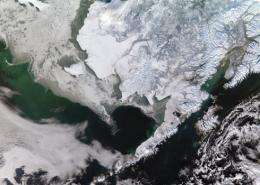
Winter snow blankets southwest Alaska on January 12, 2011, bringing the varied topography of the region into sharp relief. The Moderate Resolution Imaging Spectroradiometer (MODIS) aboard the Aqua satellite captured this true-color image at 23:20 UTC that same day. Near the upper edge of the image, just left of center, the white arc of the Yukon River Delta protrudes into the ice-covered Bering Sea. The spreading branches of the Yukon River appear blue-white within that arc, creating a design which looks much like a stylized leafless tree on a snowy background. Credit: NASA Goddard

Climate change has altered the lives of Native Alaskans in the state's interior in dramatic, sometimes dangerous ways.

Although the effects of change are well documented along the coast, where higher tides and ferocious storms have threatened native communities, a study by the U.S. Geological Survey has found indigenous people in Alaska's interior also have felt the transformation to a warmer climate during the past several decades of their lifetimes.

The study, appearing in the October 2011 issue of the journal Human Organization, is a rare, but increasingly common kind of research that tried to match the "traditional knowledge" of people at the site -- hunters and village elders -- with scientific data.

"They pretty much agreed," said Nicole Herman-Mercer of the USGS in Boulder, Co.

Herman-Mercer and Paul F. Schuster, also of USGS, along with Karonhiakt'tie Bryan Maracle of the Council of Athabascan Tribal Governments in Fort Yukon, traveled to two outlying villages in the Yukon Delta, St. Mary's and Pitka's Point, to interview the people on how their lives have been affected. Like most of the villages in the delta, the population is entirely Yup'ik Eskimos who have a subsistence-based lifestyle.

The researchers interviewed 13 people, eight of them men. The number of subjects was small because of logistical and cultural difficulties, the researchers said, and they plan to go back.

All of the subjects remarked that the weather has been warmer in recent years, most notably in the winter. Temperatures once commonly fell to minus 40 degrees F for days. Now if they sink that low, it is for shorter periods of time. The weather also has become less predictable, the men said, as well as more dangerous.

The Yup'iks believe they could accurately predict the weather sometimes a week in advance by looking at the moon, but can no longer with any reliability, they said.

This makes it more likely hunters would be caught out in the tundra when the weather changes for the worse, particularly in dark winter days. They also noted a decrease in precipitation, especially snow.

“Maybe in the 80s, late 70s, there was this gradual change started, and it seemed like the winters were getting a little warmer, less snow, rain in December and January. It seemed like there's hardly any snow, frozen tundra, ice,” said one of the men. (The researchers did not publish the names of the interviewees.)

The Yup’ik also saw a change in the populations of animals in the area, important to subsistence hunters. Ptarmigan and ducks have disappeared, while beaver and moose, not seen before in that part of the delta, are now common.

According to lore, everything in Alaska moves east to west, so the Yup’iks are convinced the new species are coming in from the east, not just reproducing at greater rates.

Flora also has changed, with salmonberries (berries that look like orange raspberries) smaller and harder to find, they said.

Herman-Mercer said correlating what the hunters said with scientific studies wasn't solid because there are very little data on local areas that remote.

Changes to the area's rivers are even more extreme. Frozen rivers are the highways that link communities in the winter and the ice is now almost half as thick as they remember it, making travel more difficult and considerably more dangerous.

Breakup, the thunderous release of river water when the ice melts, now comes earlier in the spring and instead of a sudden, clamorous event, the ice just quietly melts.The rivers also contain much less driftwood, used by the villagers for heating, greatly upsetting the economics of living on the tundra.

The USGS researchers said almost everything the Yup'iks were telling them matched what data exists.

Since the average temperature in Alaska over the course of the year is at about the freezing point of water, warming by even a few degrees can completely alter life there.

The average temperature in the area has increased by one degree C since 1966, and Arctic temperatures are now at a 400-year high. There is less snow and more rain.

Researchers in other interior areas have found similar results. Yup'iks in Newtok, northeast of St. Mary's, are being forced to move upriver because changes to the river are now washing away their village. Evacuation of 400 people has begun at a cost that could reach $100 million.

"Indigenous knowledge and scientific research must work in concert to further understand specific impacts in specific locations in order to develop appropriate adaptation strategies," the researchers wrote.

Craig Gerlach of the Alaska Center for Climate Assessment and Policy at the University of Alaska Fairbanks said local lore was valuable to scientists because the lives of the native population in the upper latitudes is intricately linked with the climate, weather and ecosystem.

"Unexpected changes and unprecedented environmental conditions are easily noticed," Gerlach said. What the USGS survey found matches what scientists know is happening elsewhere.

Provided by Inside Science News Service search and more info website

Filter


Move the slider to adjust rank threshold, so that you can hide some of the comments.


Display comments: newest first

omatumr
Oct 25, 2011

Rank: 1.3 / 5 (14)
Thanks for the story.

Today there is encouraging news from Princeton of studies that may unlock the secret of solar eruptions and changes in Earths climate.

www.princeton.edu...featured

One question is the possible role of the Meissner effect in expelling magnetic fields from the surface of a deep-seated, iron-rich superconductor [Barry Ninham, "Charged Bose gas in astrophysics", Physics Letters 4, 278-279 (1963].

See also: Super-fluidity in the solar interior: Implications for solar eruptions and climate, Journal of Fusion Energy 21, 193-198 (2002)

http://arxiv.org/.../0501441

With kind regards,
Oliver K. Manuel
http://myprofile....anuelo09

hush1
Oct 26, 2011

Rank: 5 / 5 (1)
"Indigenous knowledge and scientific research must work in concert to further understand specific climate change impacts in specific locations in order to develop appropriate adaptation strategies," the researchers wrote.


Ask first. Before imposing "must". Ask in their native tongue. Regardless of your intentions.
omatumr
Oct 26, 2011

Rank: 1 / 5 (6)
"Indigenous knowledge and scientific research must work in concert to further understand specific climate change impacts in specific locations in order to develop appropriate adaptation strategies," the researchers wrote.


Ask first. Before imposing "must". Ask in their native tongue. Regardless of your intentions.


I agree. Big Brother (BB) has little regard for reality.

BB is only now starting to inquire seriously about Earth's heat source - the Sun:

www.physorg.com/n...sun.html

If diligent, BB will learn that Earth's climate, the universe, and life itself are all sustained by dynamic competition between

a.) Attractive forces of gravity, and
b.) Repulsive forces between neutrons:

http://journalofc...102.html

Big Brother has absolutely no control over reality.

That simple fact has been true over recorded history:

www.tparents.org/...0-06.htm
jsdarkdestruction
Oct 27, 2011

Rank: 3.7 / 5 (3)
Oliver Manuel's recent efforts to plaster Physorg.com and other public news sites with his theories and personal URLs are a bit puzzling, as scientists have a variety of publications available to communicate directly to each other in. My best guess is that he is desperately trying to prop up his legacy in light of his arrest in his university office on 7 charges of rape and sodomy based on allegations by 4 of his own children. The charges have been reduced to one count of felony attempted sodomy, not necessarily because of his innocence, but because of the statute of limitations. One can only guess how the recent charges and decades of family strife have affected his ability to reason rationally and to remain objective while defending his unpopular theories.

http://mominer.ms...hildren/

http://www.homefa...uel.html

Nerdyguy
Oct 27, 2011

Rank: 1 / 5 (1)
"Indigenous knowledge and scientific research must work in concert to further understand specific climate change impacts in specific locations in order to develop appropriate adaptation strategies," the researchers wrote.


Ask first. Before imposing "must". Ask in their native tongue. Regardless of your intentions.


From the article, it is clear that they did ask. In the native language.
Rank 5 /5 (6 votes)
Relevant PhysicsForums posts

More news stories

Land and sea species differ in climate change response: study

(Phys.org) -- Marine and terrestrial species will likely differ in their responses to climate warming, new research by Simon Fraser University and Australia’s University of Tasmania has found.

Space & Earth / Environment

created 2 hours ago | popularity 5 / 5 (2) | comments 2 | with audio podcast

Yale study concludes public apathy over climate change unrelated to science literacy

Are members of the public divided about climate change because they don't understand the science behind it? If Americans knew more basic science and were more proficient in technical reasoning, would public consensus match ...

Space & Earth / Environment

created 4 hours ago | popularity 4 / 5 (1) | comments 11 | with audio podcast

10 million years needed to recover from mass extinction

It took some 10 million years for Earth to recover from the greatest mass extinction of all time, latest research has revealed.

Space & Earth / Earth Sciences

created 4 hours ago | popularity not rated yet | comments 1 | with audio podcast

Sophisticated simulations predict future warming

The chances of our planet being hit by a global warming of 3 degrees Celsius by 2050 is as likely as it being hit by an increase of 1.4 degrees, new research shows. Presented in the journal Nature Geoscience, the British study ...

Space & Earth / Earth Sciences

created May 22, 2012 | popularity 4.4 / 5 (9) | comments 51

Aliens don't want to eat us, says former SETI director

Alien life probably isn’t interested in having us for dinner, enslaving us or laying eggs in our bellies, according to a recent statement by former SETI director Jill Tarter.

Space & Earth / Space Exploration

created May 25, 2012 | popularity 4.4 / 5 (14) | comments 40


Nvidia trumpets Tegra 3 phone design wins for 2012

(Phys.org) -- Nvidia’s competitive war paint has a name, Tegra 3. On the heels of Nvidia announcements about lowering costs of its Tegra 3 processors and Nvidia-enabled tablets running Android Ice Cream ...

'Unzipped' carbon nanotubes could help energize fuel cells, batteries

Multi-walled carbon nanotubes riddled with defects and impurities on the outside could replace some of the expensive platinum catalysts used in fuel cells and metal-air batteries, according to scientists at ...

T cells 'hunt' parasites like animal predators seek prey, study shows

By pairing an intimate knowledge of immune-system function with a deep understanding of statistical physics, a cross-disciplinary team at the University of Pennsylvania has arrived at a surprising finding: T cells use a movement ...

Computer model used to pinpoint prime materials for efficient carbon capture

When power plants begin capturing their carbon emissions to reduce greenhouse gases – and to most in the electric power industry, it's a question of when, not if – it will be an expensive undertaking.

Change in developmental timing was crucial in the evolutionary shift from dinosaurs to birds: study

At first glance, it's hard to see how a common house sparrow and a Tyrannosaurus Rex might have anything in common. After all, one is a bird that weighs less than an ounce, and the other is a dinosaur that ...

Scientist: Evolution debate will soon be history

(AP) -- Richard Leakey predicts skepticism over evolution will soon be history. Not that the avowed atheist has any doubts himself.