Breakthrough holds promise for hydrogen's use as fuel source
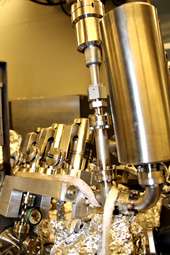
The research team had to design and build ultra-high vacuum equipment to conduct the experiments.
(PhysOrg.com) -- Imagine your car running on an abundant, environmentally friendly fuel generated from the surrounding atmosphere. Sounds like science fiction, but UT Dallas researchers recently published a paper in the journal Nature Materials detailing a breakthrough in understanding how such a fuel in this case, hydrogen can be stored in metals.
Hydrogen, which is in abundance all around us, has shown a lot of promise as an alternative fuel source in recent years, said UT Dallas graduate student Irinder Singh Chopra. Moreover, its environmentally friendly as it gives off only water after combustion.
Chopra is part of a collaborative effort among UT Dallas, Washington State University and Brookhaven National Laboratory to find ways to store hydrogen for use as an alternative fuel.
Hydrogen has potential for use as an everyday fuel, but the problem of safely storing this highly flammable, colorless gas is a technological hurdle that has kept it from being a viable option.
We investigated a certain class of materials called complex metal hydrides (aluminum-based hydrides) in the hope of finding cheaper and more effective means of activating hydrogen, Chopra said.
Our research into an aluminum-based catalyst turned out to be much more useful than just designing good storage materials, he said. It has also provided very encouraging results into the possible use of this system as a very cheap and effective alternative to the materials currently used for fuel cells.
This is the first step in producing many important industrial chemicals that have so far required expensive noble-metal catalysts and thermal activation. Essentially, the process can easily break apart molecular hydrogen and capture the individual atoms, potentially leading to a robust and affordable fuel storage system or a cheap catalyst for important industrial reactions.
Chopra discovered that the key to unlocking aluminum's potential is to impregnate its surface with trace amounts of titanium that can catalyze the separation of molecular hydrogen.
It has long been theoretically predicted that titanium-doped aluminum can be used as an effective catalyst, Chopra said. We discovered, however, that a specific arrangement of titanium atoms was critical and made it possible to produce atomic hydrogen on aluminum surfaces at remarkably low temperatures.
For use as a fuel-storage device, aluminum could be made to release its store of hydrogen by raising its temperature slightly. This system presents a method for storing and releasing hydrogen at lower temperatures than what is currently available, which is critical for safe day-to-day applications.
To perform these experiments, Dr. Jean-Francois Veyan, a research scientist in Chabals lab, greatly assisted Chopra in the design and construction of a sophisticated ultra-high vacuum equipment.
A critical aspect of the work was the ability to clean single crystal aluminum samples without damaging the arrangement of the surface atoms, Veyan said. Experience gathered from my earlier PhD work on aluminum was very important to help prepare these novel Ti-doped surfaces.
Dr. Yves Chabal, Texas Instruments Distinguished University Chair in Nanoelectronics and head of the Universitys Department of Materials Science and Engineering, who oversaw the research program, praised the teams achievements.
This is a good example of the kind of collaborative research that can lead to new advances in the field, Chabal said, and how painstaking work started five years ago can bring unexpected and exciting results.
More information: http://www.nature. … mat3123.html
Provided by
University of Texas at Dallas
-
From lemons to lemonade: Reaction uses carbon dioxide to make carbon-based semiconductor,
32 comments
-
Thioridazine kills cancer stem cells in human while avoiding toxic side-effects of conventional cancer treatments,
3 comments
-
SpaceX private rocket blasts off for space station (Update),
42 comments
-
Climate scientists say they have solved riddle of rising sea,
31 comments
-
SpaceX capsule has 'new car' smell, astronauts say (Update),
4 comments
-
Calculating partial pressures Pa and Pw
1 hour ago
-
Gibbs Free Energy Change/Entropy
11 hours ago
-
What's the rule to covalent character
12 hours ago
-
Schwartz reagent-- NMR/MS/IR
May 26, 2012
-
High school chemistry EEI
May 25, 2012
-
oxidation of I- by KMnO4
May 25, 2012
- More from Physics Forums - Chemistry
More news stories
Computer model used to pinpoint prime materials for efficient carbon capture
When power plants begin capturing their carbon emissions to reduce greenhouse gases and to most in the electric power industry, it's a question of when, not if it will be an expensive undertaking.
4 hours ago |
not rated yet |
0
|
Scientists develop ultra-sensitive test that detects diseases in their earliest stages
Scientists have developed an ultra-sensitive test that should enable them to detect signs of a disease in its earliest stages, in research published today in the journal Nature Materials.
Chemistry / Analytical Chemistry
4 hours ago |
not rated yet |
0
|
New CO2-removing catalyst can take the heat
(Phys.org) -- The current method of removing the greenhouse gas carbon dioxide (CO2) from the flues of coal-fired power plants uses so much energy that no one bothers to use it. So says Roger Aines, principal ...
May 24, 2012 |
5 / 5 (9) |
10
|
High-speed method to aid search for solar energy storage catalysts
Eons ago, nature solved the problem of converting solar energy to fuels by inventing the process of photosynthesis.
May 25, 2012 |
5 / 5 (3) |
4
|
Researchers demonstrate possible primitive mechanism of chemical info self-replication
(Phys.org) -- When scientists think about the replication of information in chemistry, they usually have in mind something akin to what happens in living organisms when DNA gets copied: a double-stranded molecule ...
May 25, 2012 |
5 / 5 (4) |
2
|
Land and sea species differ in climate change response: study
(Phys.org) -- Marine and terrestrial species will likely differ in their responses to climate warming, new research by Simon Fraser University and Australia’s University of Tasmania has found.
'Unzipped' carbon nanotubes could help energize fuel cells, batteries
Multi-walled carbon nanotubes riddled with defects and impurities on the outside could replace some of the expensive platinum catalysts used in fuel cells and metal-air batteries, according to scientists at ...
T cells 'hunt' parasites like animal predators seek prey, study shows
By pairing an intimate knowledge of immune-system function with a deep understanding of statistical physics, a cross-disciplinary team at the University of Pennsylvania has arrived at a surprising finding: T cells use a movement ...
Change in developmental timing was crucial in the evolutionary shift from dinosaurs to birds: study
At first glance, it's hard to see how a common house sparrow and a Tyrannosaurus Rex might have anything in common. After all, one is a bird that weighs less than an ounce, and the other is a dinosaur that ...
Nvidia trumpets Tegra 3 phone design wins for 2012
(Phys.org) -- Nvidias competitive war paint has a name, Tegra 3. On the heels of Nvidia announcements about lowering costs of its Tegra 3 processors and Nvidia-enabled tablets running Android Ice Cream ...
Yale study concludes public apathy over climate change unrelated to science literacy
Are members of the public divided about climate change because they don't understand the science behind it? If Americans knew more basic science and were more proficient in technical reasoning, would public consensus match ...
Oct 27, 2011
Rank: 4.3 / 5 (7)
Two major flaws: there is no hydrogen around and it is not a fuel. Hydrogen is an energy-storage material. It has to be created at a very high energy cost from water, natural gas, or another hydrogen-containing compound.
Oct 27, 2011
Rank: 1 / 5 (1)
What I wonder about this technology is how will it be able to scale up considering how dead-careful they had to be to make it in the first place.
Oct 27, 2011
Rank: 5 / 5 (7)
Only if you want to be obtuse.
Hydrogen is there all around us (bound with oxygen and in many other forms). And the definition of fuel is: "Any material that stores energy that can later be extracted to perform mechanical work in a controlled manner"
or "A material such as wood, coal, gas, or oil burned to produce heat or power." Depending on which dictionary entry you wish to use. Hydrogen gas fits those perfectly.
What you are thinking is a primary energy source. But a fuel is not necessarily one.
Oct 27, 2011
Rank: not rated yet
Do you have a source for that information dsch? I understand hydrogen can be created by electrolysis of water - efficiency can be around 80 - 90% http://schools-wi...ysis.htm
This seems very much in line with current rechargeable battery expectations http://www.techno.../25503/- of course you would have to factor in the efficiency of what ever system you were using to generate the electricity from the hydrogen with - but fuel cells have good efficiency too - http://www.worlde.../377.asp I am curious how you arrived at your determination of "very high energy cost".
Oct 27, 2011
Rank: 3.7 / 5 (3)
Here's my biggest worry about Hydrogen as a "green" fuel. It leaks far too easily. Then, being the lightest gas in existence, rises to the top of the atmosphere. Where it then proceeds to react with Ozone. End-result: no ozone layer. Oopsie...
Oct 28, 2011
Rank: not rated yet
And in 'number of times you can recharge'.
I'm not sure this is much of a problem unless you store it as pressurized gas. If you store it in metal hydrides then the volume of the entire reservoir-fuelcell-system where the hydrogen is actually in gaseous form (and hence where it could escape from in that form) is very low.
Oct 28, 2011
Rank: not rated yet
But then you have hardly any weight advantage over batteries, and you're at a great disadvantage in efficiency.
Oct 28, 2011
Rank: not rated yet
Lithium-ion batteries have a specific energy density of up to 250Wh/kg.
Hydrogen storage using MOF-177 seems to have a capacity in excess of 1.5kWh/L. (and somewhere between 1.5 and 2.0kWh/kg if I read the wikipedia link correctly)
Although the value for hydrogen storage systems must usually be reduced by 50% because you need to add the weight of the tank and the control systems. Even so it seems that the two can play in the same ballpark.
And with hydrogen's advantage in transport, refuel times and number of cycles as opposed to those for batteries it seems that hydrogen is still a real contender.
Oct 31, 2011
Rank: 1 / 5 (1)
It's the safest hydrogen storage system going and we already have enormous infrastructure to deliver it almost every where.
Oct 31, 2011
Rank: not rated yet
It will be once it is cost effective to use. Right now un-subsidized hydrogen is well over $16 per energy equivalent of a gallon of petroleum type fuels. Still somewhat cheaper than bottled water or a good single malt whisky by not by much ;-]