From blue whales to earthworms, a common mechanism gives shape to living beings
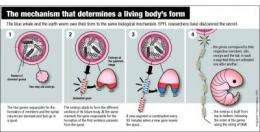
This is a diagram of the mechanism for form. The blue whale and the earth worm owe their form to the same biological mechanism. EPFL researchers have discovered the secret. Infographic courtesy of Pascal Coderay, EPFL
Why don't our arms grow from the middle of our bodies? The question isn't as trivial as it appears. Vertebrae, limbs, ribs, tailbone ... in only two days, all these elements take their place in the embryo, in the right spot and with the precision of a Swiss watch. Intrigued by the extraordinary reliability of this mechanism, biologists have long wondered how it works. Now, researchers at EPFL (Ecole Polytechnique Fédérale de Lausanne) and the University of Geneva (Unige) have solved the mystery. Their discovery will be published October 13, 2011 in the journal Science.
The embryo is built one layer at a time
During the development of an embryo, everything happens at a specific moment. In about 48 hours, it will grow from the top to the bottom, one slice at a time scientists call this the embryo's segmentation. "We're made up of thirty-odd horizontal slices," explains Denis Duboule, a professor at EPFL and Unige. "These slices correspond more or less to the number of vertebrae we have."
Every hour and a half, a new segment is built. The genes corresponding to the cervical vertebrae, the thoracic vertebrae, the lumbar vertebrae and the tailbone become activated at exactly the right moment one after another. "If the timing is not followed to the letter, you'll end up with ribs coming off your lumbar vertebrae," jokes Duboule. How do the genes know how to launch themselves into action in such a perfectly synchronized manner? "We assumed that the DNA played the role of a kind of clock. But we didn't understand how."
When DNA acts like a mechanical clock
Very specific genes, known as "Hox," are involved in this process. Responsible for the formation of limbs and the spinal column, they have a remarkable characteristic. "Hox genes are situated one exactly after the other on the DNA strand, in four groups. First the neck, then the thorax, then the lumbar, and so on," explains Duboule. "This unique arrangement inevitably had to play a role."
The process is astonishingly simple. In the embryo's first moments, the Hox genes are dormant, packaged like a spool of wound yarn on the DNA. When the time is right, the strand begins to unwind. When the embryo begins to form the upper levels, the genes encoding the formation of cervical vertebrae come off the spool and become activated. Then it is the thoracic vertebrae's turn, and so on down to the tailbone. The DNA strand acts a bit like an old-fashioned computer punchcard, delivering specific instructions as it progressively goes through the machine.
"A new gene comes out of the spool every ninety minutes, which corresponds to the time needed for a new layer of the embryo to be built," explains Duboule. "It takes two days for the strand to completely unwind; this is the same time that's needed for all the layers of the embryo to be completed."
This system is the first "mechanical" clock ever discovered in genetics. And it explains why the system is so remarkably precise.
This discovery is the result of many years of work. Under the direction of Duboule and Daniël Noordermeer, the team analyzed thousands of Hox gene spools. With assistance from the Swiss Institute for Bioinformatics, the scientists were able to compile huge quantities of data and model the structure of the spool and how it unwinds over time.
The snake: a veritable vertebral assembly line
The process discovered at EPFL is shared by numerous living beings, from humans to some kinds of worms, from blue whales to insects. The structure of all these animals the distribution of their vertebrae, limbs and other appendices along their bodies is programmed like a sheet of player-piano music by the sequence of Hox genes along the DNA strand.
The sinuous body of the snake is a perfect illustration. A few years ago, Duboule discovered in these animals a defect in the Hox gene that normally stops the vertebrae-making process.
"Now we know what's happening. The process doesn't stop, and the snake embryo just keeps on making vertebrae, all identical, until the process just runs out of steam."
The Hox clock is a demonstration of the extraordinary complexity of evolution. One notable property of the mechanism is its extreme stability, explains Duboule. "Circadian or menstrual clocks involve complex chemistry. They can thus adapt to changing contexts, but in a general sense are fairly imprecise. The mechanism that we have discovered must be infinitely more stable and precise. Even the smallest change would end up leading to the emergence of a new species."
Provided by Ecole Polytechnique Federale de Lausanne
-
From lemons to lemonade: Reaction uses carbon dioxide to make carbon-based semiconductor,
32 comments
-
Thioridazine kills cancer stem cells in human while avoiding toxic side-effects of conventional cancer treatments,
3 comments
-
SpaceX private rocket blasts off for space station (Update),
42 comments
-
Climate scientists say they have solved riddle of rising sea,
31 comments
-
SpaceX capsule has 'new car' smell, astronauts say (Update),
4 comments
-
What would stain as translucent on light-coloured fabric?
23 hours ago
-
How do I identify different bacteria on culture plates?
May 26, 2012
-
Why Do Dogs do Strange things...
May 25, 2012
-
What does exophillic and endophillic mean in terms of mosquito and their control?
May 24, 2012
-
Semen stains glows under black lights (uv light)?
May 23, 2012
-
Question on Human Chromosome 2
May 23, 2012
- More from Physics Forums - Biology
More news stories
Scientist: Evolution debate will soon be history
(AP) -- Richard Leakey predicts skepticism over evolution will soon be history. Not that the avowed atheist has any doubts himself.
22 hours ago |
3.5 / 5 (20) |
86
Manufacturing genes to attack flu virus
An international research team has manufactured a new protein that can combat deadly flu epidemics.
4 hours ago |
not rated yet |
0
|
More plant species responding to global warming than previously thought
(Phys.org) -- Far more wild plant species may be responding to global warming than previous large-scale estimates have suggested.
May 22, 2012 |
4.6 / 5 (14) |
18
|
Thousands of shellfish found dead in Peru
Thousands of crustaceans were found dead off the coast of Lima following the mystery mass death of dolphins and pelicans, the Peruvian Navy said Friday.
May 26, 2012 |
4.7 / 5 (6) |
7
For monogamous sparrows, it doesn't pay to stray (but they do it anyway)
It's quite common for a female song sparrow to stray from her breeding partner and mate with the male next door, but a new study shows that sleeping around can be costly.
May 22, 2012 |
5 / 5 (2) |
8
|
Land and sea species differ in climate change response: study
(Phys.org) -- Marine and terrestrial species will likely differ in their responses to climate warming, new research by Simon Fraser University and Australia’s University of Tasmania has found.
'Unzipped' carbon nanotubes could help energize fuel cells, batteries
Multi-walled carbon nanotubes riddled with defects and impurities on the outside could replace some of the expensive platinum catalysts used in fuel cells and metal-air batteries, according to scientists at ...
T cells 'hunt' parasites like animal predators seek prey, study shows
By pairing an intimate knowledge of immune-system function with a deep understanding of statistical physics, a cross-disciplinary team at the University of Pennsylvania has arrived at a surprising finding: T cells use a movement ...
Computer model used to pinpoint prime materials for efficient carbon capture
When power plants begin capturing their carbon emissions to reduce greenhouse gases and to most in the electric power industry, it's a question of when, not if it will be an expensive undertaking.
Change in developmental timing was crucial in the evolutionary shift from dinosaurs to birds: study
At first glance, it's hard to see how a common house sparrow and a Tyrannosaurus Rex might have anything in common. After all, one is a bird that weighs less than an ounce, and the other is a dinosaur that ...
Nvidia trumpets Tegra 3 phone design wins for 2012
(Phys.org) -- Nvidias competitive war paint has a name, Tegra 3. On the heels of Nvidia announcements about lowering costs of its Tegra 3 processors and Nvidia-enabled tablets running Android Ice Cream ...
Oct 13, 2011
Rank: 5 / 5 (8)
Oct 13, 2011
Rank: 5 / 5 (1)
Oct 13, 2011
Rank: not rated yet
Oct 14, 2011
Rank: not rated yet
Please avoid mentioning watches when discussing biology..
I'm sick to death of the 'watchmaker' argument.
Oct 14, 2011
Rank: not rated yet
Might also be useful in the (very) early detection of birth defects due to failure in this process.
At the other end of the spectrum this is a fundamental insight for the artificial creation of complex organisms. It may not seem obvious why we should do this but think about artificially creating higher order animals which are already adapted to other planet's climates without having to go through the 'evolution from scratch' approach. (Now THAT would be intelligent design)
Now THAT is an even simpler solution. Evolution is just full of neat surprises.
Oct 17, 2011
Rank: 1 / 5 (1)
Oct 17, 2011
Rank: not rated yet
This would be fairer, but would not impart any information to the reader. This is a site for the interested layman - not a journal of science (in which the relevant researchers would surely be mentioned - even if only as coauthors in the references section).
The names of the researchers mean nothing to 99.99% of readers here. If you want to have the original article then googling for Duboule will be enough.
Oct 18, 2011
Rank: 1 / 5 (1)
Oct 18, 2011
Rank: not rated yet
That said: The article clearly states where you can get the original paper (as do most other articles on physorg) - so you don't need to google at all.
Oct 18, 2011
Rank: not rated yet
Dec 11, 2011
Rank: 1 / 5 (1)
"If the timing is not followed to the letter, you'll end up with ribs coming off your lumbar vertebrae," jokes Duboule. How do the genes know how to launch themselves into action in such a perfectly synchronized manner? "
"The DNA strand acts a bit like an old-fashioned computer punchcard, delivering specific instructions as it progressively goes through the machine."
"A new gene comes out of the spool every ninety minutes, which corresponds to the time needed for a new layer of the embryo to be built," explains Duboule. "It takes two days for the strand to completely unwind; this is the same time that's needed for all the layers of the embryo to be completed."
Of COURSE, amazing precision, amazing timing, amazing that it is already encoded to such PHENOMENALLY COMPLEX ENGINEERED SEQUENCES, yet so many of you can't see the intelligence behind it.