Astronomers pin down galaxy collision rate
October 27, 2011

Astronomers pin down galaxy collision rate

Enlarge

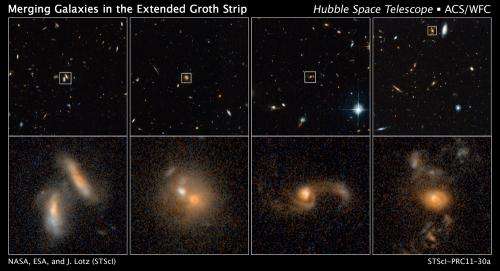
These images from NASA's Hubble Space Telescope show four examples of interacting galaxies far away from Earth. The galaxies, beginning at far left, are shown at various stages of the merger process. The top row displays merging galaxies found in different regions of a large survey known as the All-Wavelength Extended Groth Strip International Survey (AEGIS). The images were taken in 2004 and 2005 by Hubble's Advanced Camera for Surveys. Credit: NASA, ESA, J. Lotz (STScI), M. Davis (University of California, Berkeley), and A. Koekemoer (STScI)

(PhysOrg.com) -- A new analysis of images from the Hubble Space Telescope combined with supercomputer simulations of galaxy collisions has cleared up years of confusion about the rate at which smaller galaxies merge to form bigger ones. This paper, led by Jennifer Lotz of Space Telescope Science Institute, is about to be published in the Astrophysical Journal.

Galaxies grow mostly by acquiring small amounts of matter from their surroundings. But occasionally galaxies merge with other galaxies large or small. Collisions between big galaxies can change rotating disk galaxies like the Milky Way into featureless , in which the stars are moving every which way.

In order to understand how galaxies have grown, it is essential to measure the rate at which galaxies merge. In the past, astronomers have used two principal techniques: counting the number of close pairs of galaxies about to collide and by counting the number of galaxies that appear to be disturbed in various ways. The two techniques are analogous to trying to estimate the number of automobile accidents by counting the number of cars on a versus counting the number of wrecked cars seen by the side of the road.

However, these studies have often led to discrepant results. "These different techniques probe mergers at different 'snapshots' in time along the merger process," Lotz says. "Studies that looked for close pairs of galaxies that appeared ready to collide gave much lower numbers of mergers (5%) than those that searched for galaxies with disturbed shapes, evidence that they're in smashups (25%)."

This video is not supported by your browser at this time.

Credit: NASA, ESA, and G. Bacon (STScI)

In the new work, all the previous observations were reanalyzed using a key new ingredient: highly accurate of galaxy collisions. These simulations, which include the effects of and dust, show the lengths of time over which close galaxy pairs and various types of galaxy disturbances are likely to be visible. Lotz's team accounted for a broad range of merger possibilities, from a pair of galaxies with equal masses joining together to an interaction between a giant galaxy and a puny one. The team also analyzed the effects of different orbits for the galaxies, possible collision impacts, and how the galaxies were oriented to each other.

The simulations were done by T. J. Cox (now at Carnegie Observatories in Pasadena), Patrik Jonsson (now at the Harvard-Smithsonian Center for Astrophysics in Cambridge, Massachusetts), and Joel Primack (at the University of California, Santa Cruz -- UCSC), using small supercomputers at UCSC and the large Columbia supercomputer at NASA Ames Research Center. These simulations were "observed" as if through by Jennifer Lotz in a series of papers with Cox, Jonsson, and Primack that were published over the past three years. A key part of the analysis was a new way of measuring galaxy disturbances that was developed by Lotz, Primack, and Piero Madau in 2004. All this work was begun when Lotz was a postdoc with Primack, and Cox and Jonsson were his graduate students.

"Viewing the simulations was akin to watching a slow-motion car crash," Lotz says. "Having an accurate value for the merger rate is critical because galactic collisions may be a key process that drives galaxy assembly, rapid star formation at early times, and the accretion of gas onto central supermassive black holes at the centers of ."

"The new paper led by Jennifer Lotz for the first time makes sense of all the previous observations, and shows that they are consistent with theoretical expectations," says Primack. "This is a great example of how new astronomical knowledge is now emerging from a combination of observations, theory, and supercomputer simulations." Primack now heads the University of California High-Performance AstroComputing Center (UC-HiPACC), headquartered at the University of California, Santa Cruz.

The simulated galaxy merger images have been gathered into an archive called Dusty Interacting Galaxy Gadget-Sunrise Simulations (DIGGSS, at http://archive.stsci.edu/prepds/diggss/) and placed in the Multimission Archive at STSci (MAST), the online archive otherwise used only for images from space telescopes.

More information: The paper by Lotz et al., entitled "The Major and Minor Galaxy Merger Rates at z < 1.5," is online at http://adsabs.harv … iv1108.2508L

Provided by University of California - Santa Cruz search and more info website

Filter


Move the slider to adjust rank threshold, so that you can hide some of the comments.


Display comments: newest first

omatumr
Oct 27, 2011

Rank: 1 / 5 (2)
This is a great example of how new astronomical knowledge is now emerging from a combination of observations, theory, and supercomputer simulations."


Thanks for the story.

Is it possible that fragmentation events have been mistakenly simulated in reverse as collisions?

Nuclear rest mass data and astronomical observations [1-4] suggest that repulsive forces between neutrons cause the the universe to fragment and expand.

1. "Attraction and repulsion of nucleons: Sources of stellar energy," J. Fusion Energy 19, 93-98 (2001)

www.omatumr.com/a...tnuc.pdf

2. Neutron repulsion confirmed as energy source," J Fusion Energy 20, 197-201 (2002)

www.springerlink....6685079/

3. "Is the Universe Expanding?" J. Cosmology 13, 4187-4190 (2011)

http://journalofc...102.html

4. "Neutron Repulsion", The APEIRON Journal, in press, (2011)

http://arxiv.org/...2.1499v1

With kind regards,
Oliver K. Manuel

Rank 5 /5 (2 votes)
Relevant PhysicsForums posts
  • Distance of planets from stars and revolution
    created4 hours ago
  • revamping general concept and cosmological principle
    createdMay 25, 2012
  • Transiting Exoplanet Light Curve
    createdMay 25, 2012
  • Math behind Theoretical Physics
    createdMay 24, 2012
  • Do we know whats at the center of galaxies yet?
    createdMay 23, 2012
  • Structure of the Milky Way?
    createdMay 20, 2012
  • More from Physics Forums - General Astronomy

More news stories

Land and sea species differ in climate change response: study

(Phys.org) -- Marine and terrestrial species will likely differ in their responses to climate warming, new research by Simon Fraser University and Australia’s University of Tasmania has found.

Space & Earth / Environment

created 2 hours ago | popularity not rated yet | comments 1 | with audio podcast

Yale study concludes public apathy over climate change unrelated to science literacy

Are members of the public divided about climate change because they don't understand the science behind it? If Americans knew more basic science and were more proficient in technical reasoning, would public consensus match ...

Space & Earth / Environment

created 4 hours ago | popularity 4 / 5 (1) | comments 10 | with audio podcast

10 million years needed to recover from mass extinction

It took some 10 million years for Earth to recover from the greatest mass extinction of all time, latest research has revealed.

Space & Earth / Earth Sciences

created 4 hours ago | popularity not rated yet | comments 1 | with audio podcast

Sophisticated simulations predict future warming

The chances of our planet being hit by a global warming of 3 degrees Celsius by 2050 is as likely as it being hit by an increase of 1.4 degrees, new research shows. Presented in the journal Nature Geoscience, the British study ...

Space & Earth / Earth Sciences

created May 22, 2012 | popularity 4.4 / 5 (9) | comments 51

Aliens don't want to eat us, says former SETI director

Alien life probably isn’t interested in having us for dinner, enslaving us or laying eggs in our bellies, according to a recent statement by former SETI director Jill Tarter.

Space & Earth / Space Exploration

created May 25, 2012 | popularity 4.4 / 5 (14) | comments 40


'Unzipped' carbon nanotubes could help energize fuel cells, batteries

Multi-walled carbon nanotubes riddled with defects and impurities on the outside could replace some of the expensive platinum catalysts used in fuel cells and metal-air batteries, according to scientists at ...

T cells 'hunt' parasites like animal predators seek prey, study shows

By pairing an intimate knowledge of immune-system function with a deep understanding of statistical physics, a cross-disciplinary team at the University of Pennsylvania has arrived at a surprising finding: T cells use a movement ...

Computer model used to pinpoint prime materials for efficient carbon capture

When power plants begin capturing their carbon emissions to reduce greenhouse gases – and to most in the electric power industry, it's a question of when, not if – it will be an expensive undertaking.

Change in developmental timing was crucial in the evolutionary shift from dinosaurs to birds: study

At first glance, it's hard to see how a common house sparrow and a Tyrannosaurus Rex might have anything in common. After all, one is a bird that weighs less than an ounce, and the other is a dinosaur that ...

Nvidia trumpets Tegra 3 phone design wins for 2012

(Phys.org) -- Nvidia’s competitive war paint has a name, Tegra 3. On the heels of Nvidia announcements about lowering costs of its Tegra 3 processors and Nvidia-enabled tablets running Android Ice Cream ...

Scientist: Evolution debate will soon be history

(AP) -- Richard Leakey predicts skepticism over evolution will soon be history. Not that the avowed atheist has any doubts himself.